RADAR PRO ELITE™ FINBEAR — October 28, 2026
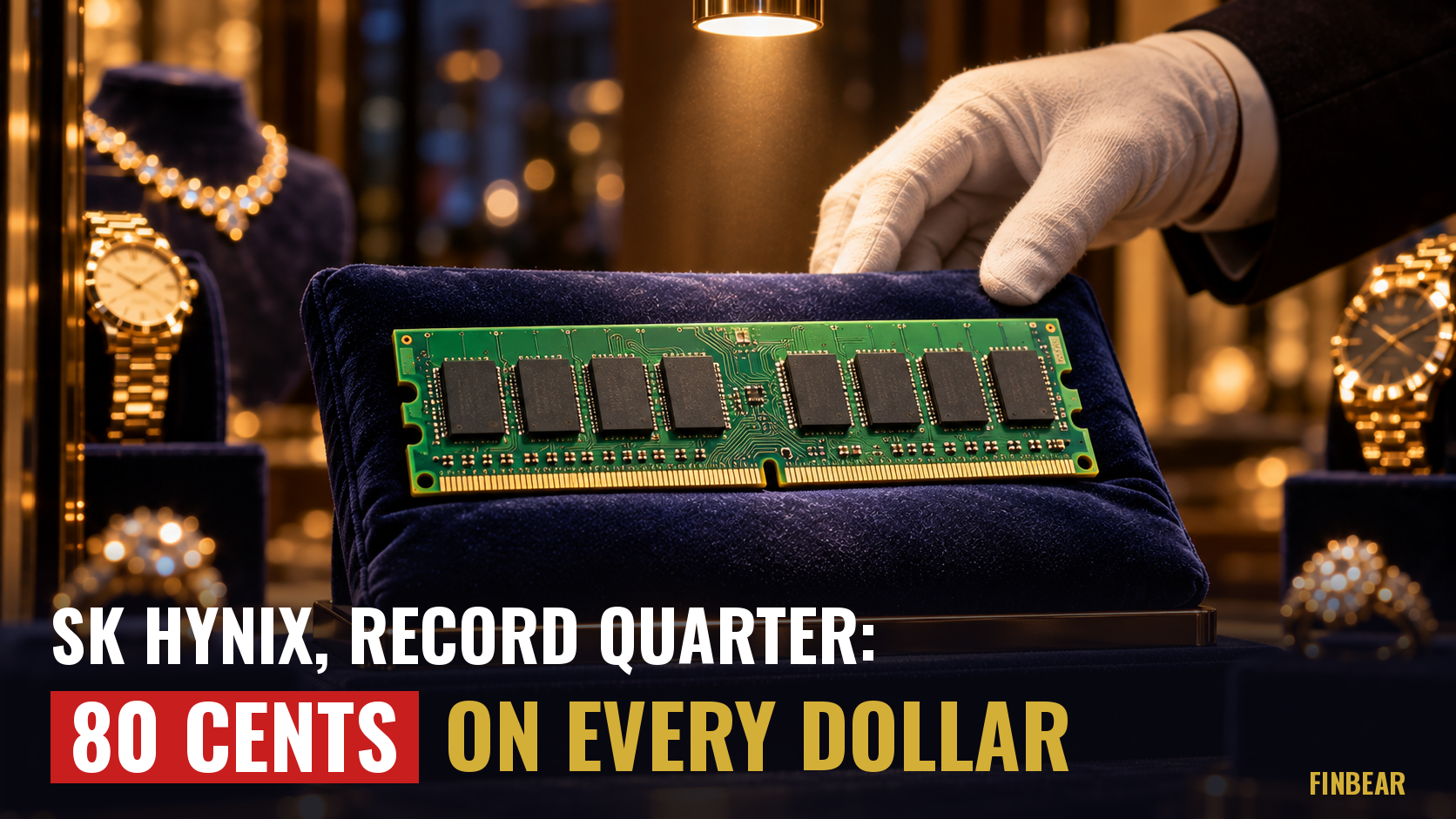
Table of Contents
- 🧭 Before You Open the Terminal
- Key Indicators Dashboard
- 🗿 The Pretore Today
- 🧭 Compass of the Day
- 📐 Yield Curve
- 🏦 Banks: Large vs Regional
- Executive Summary
-
News in Detail
- 1. The Fed decides today: a pause expected, but strong data keep a December hike alive
- 2. Memory pulls the Nasdaq higher: SK hynix posts a record quarter, semiconductors +3.60%, Seoul +6.63%
- 3. The AI bill: Broadcom arranges $63 billion of financing for chips headed to Anthropic, Microsoft and Alphabet report tonight
- 4. Boeing loses 10.69%: a wider-than-expected loss and a delayed 737, the Dow closes flat
- 5. Crude falls on the talks and climbs back on a Houthi-claimed attack on Saudi Arabia’s largest refinery; Trump calls high gasoline prices “short-term pain”
- 6. SoFi rises 13.42%, Robinhood loses 7% after the close: two fintechs, two opposite verdicts
- 7. Bitcoin back above $80,000, but still below the threshold that would make the Pretore’s short signature lapse
- 📰 In Brief
- Aggregated Sentiment Table
- Fear and Loathing on Wall Street™
- Cross-Cutting Synthesis
- Strategic Alerts
- Disclaimer & Maxim
🧭 Before You Open the Terminal
🏛️ The Fed: the verdict comes tonight
The decision lands at 7:00 p.m. CET, Kevin Warsh’s press conference half an hour later. The market gives a hike today about a 7% chance; Tuesday’s data, with consumer confidence at 91.7 and durable goods orders up 1.8%, keep a December hike on the table.
🌏 Chips and memory
🔥 SK hynix tops 100 trillion won in quarterly revenue for the first time: 104.6155 trillion ($78.21 billion), with an operating margin of 80%. Semiconductors rise 3.60%, the Nasdaq 1.18%; this morning the KOSPI closes up 6.63%, above 6,000.
🏢 Big Tech and debt
Broadcom arranges $63 billion in financing for chips headed to Anthropic; up to 21 billion of it could become bonds. Tonight, after the close, Microsoft and Alphabet report; Amazon follows on Thursday.
🛢️ Oil and the Houthis
On Tuesday Brent falls 1.67% to $113.88 on the regional talks; overnight the Houthis claim an attack on Saudi Arabia’s largest refinery, and this morning Brent is at 115.93. On WTI the Pretore’s signature turns short.
📈 U.S. equities
The S&P 500 gains 0.60% to 7,722.60; Boeing loses 10.69% and the Dow closes flat (+0.03%).
Verdict
🔴 High priority — Fantiborsa’s take: on Tuesday the people selling memory pocketed an eighty percent margin, the people buying it got financed on the supplier’s guarantee, and the people building airplanes found out that an order book doesn’t take off on its own. Tonight Warsh sets the price of money, and Microsoft and Alphabet hand over the receipt.
Trust me: today it’s worth finding five minutes to read the whole thing ☕
Key Indicators Dashboard
| Indicator | Value | Change | Reading | Signal |
|---|---|---|---|---|
| S&P 500 | 7,722.60 | +0.60% | RSI 51.2; above SMA50 (7,697.01) and SMA200 (7,298.87); Pretore active long, above the Consensus | |
| Nasdaq (COMPQ) | 26,477.81 | +1.18% | RSI 47.7; below SMA50 (26,584.47), above SMA200 (25,019.47); Pretore active long | |
| Nasdaq-100 (NDX) | 29,651.44 | +1.29% | RSI 47.2; below SMA50 (29,806.90), above SMA200 (27,874.28); Pretore active long | |
| Philadelphia Semi (SOX) | 11,482.50 | +3.60% | RSI 45.4; below SMA50 (11,900.38), above SMA200 (10,727.56); Pretore attenuated long, below the Consensus | |
| Dow Jones | 52,377.57 | +0.03% | RSI 54.5; above SMA50 (52,270.97); Boeing −10.69% holds the index back; Pretore active long | |
| Russell 2000 ETF (IWM) | 280.18 | +1.15% | RSI 51.8; below SMA50 (285.37), above SMA200 (278.43) | |
| VIX | 17.52 | −4.73% | Above SMA50 (16.04), below SMA200 (18.22); Pretore active short on its reference ETF | |
| US 2Y | 4.70% | +2 bp | The short end rises on the eve of the Fed | |
| US 10Y | 4.99% | −1 bp | Just below the 5% threshold | |
| 2s10s spread | 29 bp | −3 bp | Positive, flattening | |
| DXY | 102.32 | +0.35% | RSI 62.8; above SMA50 (100.70) and SMA200 (99.60) | |
| Gold | 4,074.60 | +0.90% | December contract; below SMA50 (4,318.37) and SMA200 (4,525.80); Pretore active long; 4,042.60 this morning | |
| Silver | 54.29 | +0.34% | Below SMA50 (62.39) and SMA200 (71.26); Pretore turns to active short | |
| WTI | 99.90 | −1.83% | Above SMA50 (93.58) and SMA200 (85.75); Pretore turns to active short; 101.57 this morning | |
| Brent | 113.88 | −1.67% | Above SMA50 (102.05) and SMA200 (91.70); Pretore active long; 115.93 this morning | |
| EUR/USD | 1.12 | −0.39% | RSI 30.3; below SMA50 (1.14) and SMA200 (1.16) | |
| BTC | 80,887.94 | +1.10% | Below SMA50 (81,833.30), above SMA200 (73,026.08); Pretore active short | |
| ETH | 2,353.07 | +1.41% | Below SMA50 (2,536.70), above SMA200 (2,158.49); Pretore active short | |
| Crypto Fear & Greed | n/a | — | Current value not available in session |
Equity indices, VIX, dollar, gold, silver, crude and euro at the close on Tuesday, October 27, 2026 (StockCharts/Yahoo Finance; gold is the December contract). Treasury yields: official U.S. Treasury data for October 27 compared with October 26. Crypto and this morning’s values: Yahoo Finance and StockCharts at 7:25 a.m. CET.
The Pretore Today
U.S. index signatures. The S&P 500, the Nasdaq-100, the Composite and the Dow stay in active long, semiconductors in attenuated long; the VIX, read through its reference ETF, stays in active short. The signatures point to risk appetite, with no changes from Monday.
Signature vs. consensus: divergent for semiconductors. The SOX closes below its AVWAP Consensus by more than the tolerance band, so its long signature is read one notch lower: attenuated long. The SOX Consensus is computed on uniform weights, because the index's volume isn't reliable.
Polarity flip: yes. WTI and silver move from the `long_attiva` recorded on the close of Monday, October 26, to `short_attiva`.
The awkward signatures. The first is a split crude market: WTI turns short closing exactly on its Consensus, while Brent stays long with a 2.17% cushion. The two crude benchmarks tell different market stories on the same day, and overnight the attack on the Saudi refinery put the outcome back in play. The second is metals: silver turns short in a session in which it rises 0.34%, while gold stays long but this morning trades below its own invalidation level. The third is the chip rally itself: a 3.60% gain isn't enough to put semiconductors back above their volume-weighted average.
Macro convergence. The dollar, read through its ETF, stays in active long; the euro, also through its ETF, in active short. On rates the Pretore works off an ETF holding 7–10-year Treasuries, in active long: a long signature on the ETF means falling yields. The 10-year closes at 4.99%. Brent stays in active long, WTI turns to active short.
$SPX operating levels: close 7,722.60 · AVWAP Consensus 7,698.84 (+0.31%) · closing invalidation 7,616.58 (−1.37%). The AVWAP Consensus is the volume-weighted average the Pretore uses as a structural anchor for prices. The invalidation is the level below which, on a closing basis, the long signature lapses: it is not a stop-loss order.
The overall read. The Pretore confirms the return to long on the indices recorded on Monday, and this time the S&P 500 closes above its volume-weighted average: the cushion is thin, but it's there. The signature agrees with today's thesis, a rally led by suppliers to the AI industry while the verdict is pending. The strains sit at the edges: semiconductors lead the rally without reclaiming their Consensus, and the Composite closes six-tenths of a percentage point from its invalidation.
Snapshot as of October 28, 2026 (reference close October 27; crypto October 26).
Compass of the Day
FINBEAR Compass™ · $SPX · Oct 27, 2026
  VERDICT           CONTESTED        — recent momentum doesn't take a side
  OPERATING REGIME  Sideways
  LINEARITY         Non-linear trends
  COHERENCE         NONE
  RELIABILITY       SUSPENDED
  POSITION          in band          — below the underlying trend
  UNDERLYING TREND  Persistent bull  — solid
The Compass still captures an S&P 500 with no operating direction: the regime is sideways, the horizons disagree and the signal is scattered, so the trend can't be read with confidence and the compass says to wait. The underlying trend is still a solid bull, with price inside the band, just below the trend line.
On the Nasdaq-100 and the Composite the Compass measures a strong-bear operating regime with reliability suspended; on semiconductors the same regime, with price below the underlying trend. Among the indices we follow, the Dow and the financial sector are the only ones with a strong-bull operating regime and high reliability. The compass measures the last few months: two sessions of chip gains don't change its picture yet.
Yield Curve
U.S. Treasury Curve · Oct 27, 2026
  SHAPE       flat
  MOVEMENT    bear flattening
  MACRO       normal
For the economy: on the eve of the Fed the short end rises and the long end stands still. The market isn't pricing in a slowdown, it's pricing in a central bank that may have to tighten again: on Tuesday consumer confidence came in above expectations and durable goods orders grew 1.8%.
For banks: when the curve flattens from the short end, funding costs rise faster than the yield on long-dated loans, and net interest margin gets squeezed. Lenders that live mainly on interest margin feel it first, as the next panel shows.
Banks: Large vs Regional
XLF · KBWB · KRE — financial sector
- XLF (sector) — at 55.88 (−0.25%), just below the 55.89–56.18 resistance; the Pretore's signature on the sector stays in active long, with a closing invalidation at 55.55 (−0.59%).
- KBWB (large banks) — at 88.60 (+0.45%), above the 87.74–88.43 support; on Tuesday it touched the 88.70–89.24 resistance again without clearing it.
- KRE (regionals) — at 72.58 (−0.21%), inside the 72.42–73.24 zone.
On Tuesday the large banks rise and the regionals slip: it's the divergence a curve flattening from the short end tends to produce, because regionals depend more on interest margin. The large banks, though, stall below resistance once again, and the sector as a whole closes slightly lower. The gap has opened only a little: we're watching it, not betting on it.
KBWB and KRE under watch — a reading, not a signal.
Executive Summary
🎬 The day in one line
Semiconductors rise 3.60% on the back of memory, the Nasdaq 1.18%, the S&P 500 0.60% to 7,722.60; Boeing loses 10.69% and the Dow stands still. The rally is real, but narrow: suppliers to the AI industry are leading it.
🏢 Memory comes at a price
- The seller cashes in. 🔥 SK hynix tops 100 trillion won in quarterly revenue for the first time: 104.6155 trillion ($78.21 billion), with an 80% operating margin and more than half of its 2027-2028 capacity already sold under multiyear contracts. This morning Seoul rises 6.63%.
- The buyer takes on debt. 🆕 Broadcom arranges $63 billion in financing for the chips it sells to Anthropic: the banks lend about 42 billion and plan to turn up to 21 billion of it into bonds.
- The user has to prove it. Tonight Microsoft, which expects capital spending above $50 billion in the quarter, and Alphabet report; Amazon follows on Thursday.
🏛️ The Fed, tonight at 7:00 p.m. CET
A hold is all but certain: the market gives a hike today about 7%. But consumer confidence rebounds to 91.7 and durable goods orders grow 1.8%: data that hand Warsh arguments for December, not for standing pat.
🛢️ Barrels and gasoline
Brent loses 1.67% on the regional talks and overnight wins it all back on the Houthi-claimed attack on the Saudi refinery at Ras Tanura. Trump, in Texas, calls gasoline at $4.27 a gallon “short-term pain”; the midterm elections are next Tuesday.
⏳ The bottom line
The Pretore confirms the long signature on the indices and the S&P 500 climbs back above its volume-weighted average, but the Compass doesn’t register a change of regime yet. The correction thesis of October 23 expires tonight and hasn’t been invalidated: semiconductors are above 10,979.42, the S&P 500 is still below 7,799.45. Once again, the verdict will be written by the Fed and tonight’s earnings.
News in Detail
1. The Fed decides today: a pause expected, but strong data keep a December hike alive
What happened
✅ The monetary policy committee’s decision comes today, Wednesday, October 28, at 2:00 p.m. in New York, 7:00 p.m. CET; Kevin Warsh’s press conference is at 2:30 p.m., 7:30 p.m. CET (Yahoo Finance). ✅ The fed funds rate sits in a 3.75%-4.00% range, after the September hike (Yahoo Finance).
📊 On Tuesday evening CME’s FedWatch put the odds of a hike today at about 7% (CME via Yahoo Finance); on Monday afternoon it gave more than an 80% chance of at least one hike by December, including a 73.1% chance of a single hike (FedWatch via InvestmentNews). 📊 In a Reuters poll of October 16-20, 94 of 100 economists expected rates on hold today and all 100 a hike in December (Reuters via Mitrade).
✅ On Tuesday the Conference Board’s consumer confidence index rises 7.5 points to 91.7, from a revised 84.2 in September (Conference Board); ✅ September durable goods orders grow 1.8%, against the 0.6% expected according to FXStreet (FXStreet), the strongest increase in five months (Bloomberg). ✅ The 2-year yield closes at 4.70% (+2 basis points), the 10-year at 4.99% (−1) (U.S. Treasury). Tomorrow at 1:30 p.m. CET come third-quarter GDP and September PCE inflation. The October 27 RADAR put the odds of a hike today at 12.7%: in one day the bet has almost halved, while for December the latest available reading, from Monday afternoon, still gives more than an 80% chance of at least one hike.
What sources say
“This is a perfect time for clear forward guidance that doesn’t quite say, but strongly hints, we’re pausing now” — Alan Blinder, former Fed vice chair (Yahoo Finance)
“There is a political implication for going in October.” — Stephanie Roth, Wolfe Research (Yahoo Finance)
FINBEAR Take: the pause is in the price; December’s bill isn’t
The market has already bought today’s pause: the odds of a hike down to 7% say so, and so does the curve, which on Tuesday saw the 2-year rise and the 10-year slip one basis point. That’s how the bond market prices a tightening that’s been postponed, not cancelled. Tuesday’s data point the same way: more confident consumers and companies ordering more durable goods don’t paint a picture of an economy asking for help, and with September inflation at 3.7% Warsh has few reasons to promise a truce.
What holds the Fed back today is the calendar: the midterm vote falls next Tuesday, and moving a week before the polls would carry a political meaning the central bank would rather avoid. So the press conference becomes the real decision. If Warsh signals that a December hike is firmly on the calendar, the curve will flatten further from the short end; if he leaves the door ajar, Tuesday’s chip rally will find an ally. Equities, meanwhile, are behaving as if they already knew the answer.
Cui prodest? The dollar, and those holding cash at the short end, paid more than 4%. The losers are those who built the rebound of the past few days on a Fed that stops in December.
For investors
Instruments involved:
- Stocks: $SHY, $IEF, $TLT, $UUP, $XLF, $SPY
Opportunities:
With the pause already priced in, a Warsh less firm on December could bring yields down at the short end of the curve
Risks:
A message making a December hike near-certain, followed tomorrow by a hot PCE, would push the 10-year back above 5% and weigh on tech valuations
What to avoid:
Positioning ahead of the press conference: Warsh speaks at 7:30 p.m. CET tonight, Microsoft and Alphabet after 9:00 p.m. CET
Bottom line:
Tonight the Fed isn’t deciding today’s rates, it’s deciding what December costs.
Impact: (2/5) — Pause priced in, strong data keep a December hike alive · against the grain: dollar favored
2. Memory pulls the Nasdaq higher: SK hynix posts a record quarter, semiconductors +3.60%, Seoul +6.63%
What happened
✅ SK hynix closes the third quarter with revenue of 104.6155 trillion won ($78.21 billion), up 32% on the quarter and 328% on the year: the first time above 100 trillion won in the company’s history. Operating profit is 83.3338 trillion won ($62.30 billion), for a margin of 80%; net profit is 39.7756 trillion won ($29.73 billion) (SK hynix, preliminary figures). The dollar amounts are converted at 1,337.7 won to the dollar, the Seoul close this morning, 7:30 a.m. CET (Seoul Economic Daily).
✅ Multiyear contracts with 14 large customers cover more than 50% of production capacity for 2027 and 2028; for 2026 the company plans to return about 100 trillion won (about $75 billion) to shareholders (SK hynix).
✅ On Tuesday the semiconductor index rises 3.60% to 11,482.50 (StockCharts; BigGo Finance). ✅ Western Digital gains more than 6%, Seagate and SanDisk more than 3%, Lumentum more than 5%, Coherent more than 6%, Intel 3.6% after expanding its Xeon processor deal with Oracle (BigGo Finance); AMD rises 5.45%, Broadcom 4.00%, Micron 2.77% (HDFC Sky). ✅ Among the drivers cited are the extension of the Oracle-Nvidia deal and the opening of Oracle’s cloud to chips from Google, Cerebras and SambaNova; 📊 TrendForce expects fourth-quarter contract prices to rise 10-15% for DRAM and 15-20% for NAND (BigGo Finance).
✅ This morning at 7:30 a.m. CET the KOSPI closes at 6,012.44 (+6.63%), with SK hynix up 10.89% and Samsung Electronics 9.01%; during the morning the exchange’s mechanism that temporarily halts automated buy orders kicked in (Yonhap via K-Vibe). The October 27 RADAR was waiting on SK hynix’s earnings today: they arrived, and semiconductors close 4.58% above the 10,979.42 level set by the October 23 RADAR.
What sources say
“the structure in which demand exceeds supply to persist through 2030” — SK hynix, third-quarter earnings release
“strong demand for AI chips can translate into solid operating profits and shareholder returns” — Lee Jae-won, Yuanta Securities (Yonhap)
FINBEAR Take: the market is buying the price list, not the intelligence
An 80% operating margin isn’t what a manufacturer earns: it’s what the price-setter earns, and on Tuesday that’s exactly what the market bought. Memory has become the bottleneck of the artificial-intelligence supply chain, and the companies that make it have already sold more than half of their capacity for the next two years under multiyear contracts. TrendForce’s estimate of fourth-quarter contract prices completes the picture: for buyers, memory will cost even more.
The reaction, though, also shows where the rally stops. Semiconductors rise 3.60% but stay below their volume-weighted average, and the Compass still measures them in a bearish operating regime. The Dow doesn’t join in, and two of the largest stocks in the market, Microsoft and Meta, close lower. It’s a suppliers’ rally that rests on customers’ spending — and the customers report tonight.
Cui prodest? Memory makers and their shareholders, to whom SK hynix promises to return about 100 trillion won (about $75 billion) in 2026. The bill goes to the big buyers of memory, who will see contract prices rise further.
For investors
Instruments involved:
- Stocks: $MU, $WDC, $STX, $SNDK, $AMD, $INTC, $AVGO, $SMH, $SOXX, $EWY
Opportunities:
Multiyear contracts and rising prices give memory makers visibility into revenue that the sector lacked in previous cycles
Risks:
Semiconductors still below the Pretore’s volume-weighted average; a cautious message on capital spending from Microsoft or Alphabet would hit the suppliers first
What to avoid:
Reading SK hynix’s margin as the margin of the whole supply chain: whoever buys memory foots the bill
Bottom line:
Memory has become AI’s bottleneck, and whoever controls the bottleneck sets the price.
Impact: (3/5) — Record memory margins lift the Nasdaq and semiconductors · against the grain: memory buyers hurt
3. The AI bill: Broadcom arranges $63 billion of financing for chips headed to Anthropic, Microsoft and Alphabet report tonight
What happened
✅ Broadcom has arranged a $63 billion financing package for chips headed to Anthropic: a special-purpose vehicle buys the equipment and leases it to Anthropic, whose lease payments service the debt (Bloomberg via Yahoo Finance). ✅ The banks, led by Bank of America, Citigroup and Morgan Stanley, lend about 42 billion on a first-lien basis, and Broadcom partly guarantees the equipment’s residual value; Blackstone puts in 9 billion (Bloomberg). 📊 The banks plan to place up to about 21 billion of investment-grade bonds as early as the start of 2027, with a maturity of around five years (Bloomberg).
✅ It’s the second large chip-financing deal Broadcom has arranged this year, after the 35 billion one with Apollo and Blackstone; since the start of 2026 companies worldwide have raised more than $455 billion of debt for AI-related spending (Bloomberg). ✅ On Tuesday Broadcom rises 4.00% (HDFC Sky).
✅ Tonight, after the close, Microsoft and Alphabet report (TradingView, Zacks). 📊 For Microsoft the market expects revenue of about $90.6 billion and earnings per share of $4.71; the company guides to Azure growth of 44-45% in constant currency and capital spending above $50 billion in the quarter (FinanceFeeds). 📊 For Alphabet, estimates point to earnings per share of $2.94 and Google Cloud revenue of around $29.15 billion, up 92%; the company expects capital spending of $195 billion to $205 billion for the year (Zacks via TradingView).
✅ On Tuesday Microsoft closes −0.24%, Alphabet +0.84%, Meta −1.64% (Yahoo Finance). The October 27 RADAR counted three ways Big Tech pays for AI: Meta’s shares, Microsoft’s employees and Anthropic’s future shareholders. Now a fourth joins them: the supplier that backs the residual value of the chips its customer works with. The deal was announced on Monday and came back into the news on Tuesday with the bond plan.
What sources say
“Big Tech earnings could prove just as important as monetary policy for the direction of risk appetite.” — Daniela Hathorn, market analyst (TheStreet)
According to a person familiar with the matter cited by Bloomberg, the final size and timing of the bond sale will depend on market conditions.
FINBEAR Take: the supplier guarantees, the market applauds
Broadcom’s financing is a formula as old as trade: the store that arranges credit for its customer so the customer can buy its goods. Here the store sells chips and the customer is the AI lab that on Monday filed a prospectus showing an $80.7 billion net loss, almost all of it on paper, and a very real need for capital. The debt, if the market takes it, will end up in bonds sold to institutional investors. Broadcom books the sale without waiting for Anthropic’s cash and partly guarantees the value of what it sold. On Tuesday the market rewarded it with a 4% gain.
Tonight the bill goes back to the buyers. Microsoft has to show that spending more than $50 billion in a quarter delivers Azure growth at the promised pace; Alphabet has to show that its $195 billion to $205 billion in spending for the year translates into cloud growth. This is where the suppliers’ rally meets its test: if customers slow their spending, the memory bottleneck loosens fast.
Cui prodest? Broadcom, which sells without waiting for its customer’s cash, and the banks arranging the deal. At risk are the future bond buyers, who will be lending to a customer still losing money at the operating level.
For investors
Instruments involved:
- Stocks: $AVGO, $MSFT, $GOOGL, $AMZN, $BAC, $C, $MS, $BX, $QQQ, $XLK
Opportunities:
Results in line with guidance on Azure and Google Cloud would confirm the demand holding up the whole supplier chain
Risks:
Capital spending still rising without cloud revenue growth to match; a credit market less willing to absorb AI-related debt
What to avoid:
Mistaking supplier financing for demand paid in cash
Bottom line:
When the supplier backs the residual value of its customer’s chips, the sale still leaves a risk on its books.
Impact: — Credit to AI still plentiful, verdict deferred to tonight’s earnings
4. Boeing loses 10.69%: a wider-than-expected loss and a delayed 737, the Dow closes flat
What happened
✅ In the third quarter Boeing reports revenue of $24.2 billion (+4%) and a loss of 26 cents per share; the core loss is 34 cents (Boeing), against the 21 cents expected by analysts polled by LSEG (MarketScale). ✅ Free cash flow is positive at $464 million, deliveries total 161 and the order backlog reaches a record $745 billion; the commercial airplanes unit closes with an operating margin of −6.5% (Boeing).
✅ A stable rate of 47 737s a month is now expected in early 2027 rather than in summer 2026, and the step-up to 52 is planned for the second half of 2027. The company won’t reach its target of about 500 737 deliveries in 2026, after 367 in the first nine months (MarketScale).
✅ The stock closes at $168.18 (−10.69%) (Yahoo Finance), its lowest since November 2025 (TheStreet). ✅ The Dow closes at 52,377.57 (+0.03%), while the S&P 500 gains 0.60% and the Nasdaq 1.18% (TheStreet).
What sources say
“We remain focused on safety and quality as we redouble our efforts on Lean and disciplined execution” — Kelly Ortberg, Boeing CEO (earnings release)
“But we are not done.” — Kelly Ortberg, Boeing CEO (TheStreet)
FINBEAR Take: the demand is there, the calendar isn’t
Boeing has a $745 billion order book, growing revenue and positive cash flow: on paper, a recovery quarter. The market looked at a different line, the one with the dates. The 47-a-month rate slips by about six months, the year’s delivery target is gone, and for a company that gets paid on delivery every month of delay is cash deferred. The 10.69% drop doesn’t measure demand for airplanes, it measures time.
The case weighs on the indices too. The Dow, weighted by share price rather than market value, gives up part of its gain with Boeing and closes almost unchanged, while the Nasdaq rises more than 1%. It’s the same day seen from two windows: in tech the market buys scarcity, in industry it charges for delay.
Cui prodest? Those who own aircraft already in service, such as leasing companies: when deliveries of new planes slow, their fleets are worth more. The losers are those who were counting on a return to normal production in 2026.
For investors
Instruments involved:
- Stocks: $BA, $GE, $HWM, $ITA, $XAR, $DIA, $BA
Opportunities:
Record backlog and positive cash flow: the stated problem is timing, not demand
Risks:
Further slippage in the production rate; margin still negative in the commercial airplanes unit
What to avoid:
Buying the dip while betting on a quick return to normal: the company itself has pushed its targets to 2027
Bottom line:
Boeing doesn’t have a customer problem, it has a clock problem.
Impact: (1/5) — A company-specific case, it holds back the Dow, not the market · against the grain: leasing companies favored
5. Crude falls on the talks and climbs back on a Houthi-claimed attack on Saudi Arabia’s largest refinery; Trump calls high gasoline prices “short-term pain”
What happened
✅ On Tuesday Brent closes at $113.88 (−1.67%) and WTI at 99.90 (−1.83%) (StockCharts; HDFC Sky): the drop of almost two dollars comes as talks in the Middle East ease supply fears (Reuters via Business Recorder). ✅ Yemen’s Houthis claim to have hit Saudi Arabia’s largest refinery, with 550,000 barrels a day of capacity, with a missile; 🔸 the Saudi authorities have not confirmed the attack (Reuters via Business Recorder).
✅ Overnight, at 2:40 a.m. CET, Brent was at $115.36 (+1.3%); at 7:25 a.m. it’s at 115.93 (+1.80%) and WTI at 101.57 (+1.67%) (Reuters via Business Recorder; StockCharts). ✅ On Tuesday Exxon loses 2.52%, Chevron 1.59%, Valero more than 7% (HDFC Sky); Delek and Par Pacific more than 10% (Yahoo Finance).
✅ At a rally in Corpus Christi, Texas, Trump called the price of gasoline short-term pain for long-term gain; according to AAA, a gallon of regular gasoline costs $4.27 on average, against 2.98 before the war (Bloomberg via Yahoo Finance). ✅ The midterm elections are on Tuesday, November 3 (Yahoo Finance). The October 27 RADAR wrote that crude could “fall on words and climb back on facts within a single session”: that’s exactly what happened.
What sources say
“Short-term pain, right, for long-term gain. You’re going to see very soon,” — Donald Trump, Corpus Christi rally (Bloomberg)
According to Reuters, the Houthis claimed a missile attack on Saudi Arabia’s largest refinery; the Saudi authorities had not confirmed the claim.
FINBEAR Take: talks bring the price down, missiles push it back up
This week’s crude is a pendulum. In two sessions the regional talks took almost three dollars off Brent; overnight a single missile gave two of them back. The market hasn’t changed its mind about supply: October is the worst month for attacks on ships in the Strait of Hormuz, and when a headline reminds everyone how exposed Saudi infrastructure is, the risk premium comes back within minutes. A refinery attack, moreover, has a greater impact on fuels than on crude — that is, on the very gasoline that feeds into inflation.
This is where the oil story meets the election story. With gasoline at $4.27 a gallon and the vote six days away, the pump price has become the campaign issue, and Trump presents it as a sacrifice with an end date. For the Fed, which decides tonight, it’s the data point that complicates everything: the longer gasoline stays expensive, the more the inflation data due in December will vindicate those who want another hike.
Cui prodest? Crude producers outside the Gulf, who sell at wartime prices without exposing their own facilities. The loser is the American consumer, paying more to fill up a week before the vote.
For investors
Instruments involved:
- Stocks: $XOM, $CVX, $COP, $VLO, $PSX, $XLE, $XOP, $USO, $BNO, $USO
Opportunities:
A regional deal with Iran would remove part of the risk premium, to the benefit of energy-consuming sectors
Risks:
New attacks on Saudi infrastructure would send Brent back toward last week’s highs; the Pretore’s signature on Brent stays long
What to avoid:
Reading WTI’s turn to short as the end of the risk: with the attack, Brent is already back above 115
Bottom line:
Every round of talks takes two dollars off the barrel, every missile puts them back.
Impact: (2/5) — Attack on Saudi refinery sends Brent back above 115 · against the grain: crude producers favored
6. SoFi rises 13.42%, Robinhood loses 7% after the close: two fintechs, two opposite verdicts
What happened
✅ SoFi closes the third quarter with adjusted net revenue of $1.37 billion (+44%), net income of $241 million and 17.1 million members (+35%), with a record 1.2 million new sign-ups in the quarter (SoFi). ✅ The company raises its 2026 revenue guidance to about $5.04 billion and points to 2027 revenue of around $6.4 billion and adjusted earnings per share of about $0.90 (SoFi). ✅ The stock closes at $16.40 (+13.42%) (Yahoo Finance).
✅ Robinhood posts record revenue of $1.42 billion (+12%) (Robinhood), just short of the 1.43 billion expected, and diluted earnings per share of 51 cents (Robinhood); on an adjusted basis, 60 cents against 55 expected (Investing.com). ✅ Crypto revenue falls 55% to $120 million, while revenue from prediction contracts rises to $173 million, more than six times a year earlier; net income drops 14% to $476 million (Robinhood). ✅ The stock closes the session +1.85% and loses 7.36% in after-hours trading, to $87.60 (Yahoo Finance; Investing.com).
What sources say
“Our conviction in the opportunity ahead has never been greater.” — Anthony Noto, SoFi CEO
“Our vision is to make everyone an owner, because broad ownership is essential to a free, stable, and prosperous society” — Vlad Tenev, Robinhood CEO
FINBEAR Take: the market pays for loans, not for bets
Two companies built for the same customer, the young saver who lives on a smartphone, get two opposite verdicts on the same day. SoFi grows like a bank: more members, more products, more loans, and 2027 guidance the market has chosen to believe. Robinhood grows like a casino switching tables: crypto brings in less than half what it did a year ago, and the hole is filled by prediction contracts, which now outweigh crypto in its revenue.
The reaction shows what the market is willing to pay for. A recurring interest margin is worth more than fee revenue tied to customers’ moods, and the mood of Robinhood’s customers, judging by crypto, has cooled. It’s the same chill that left bitcoin struggling to hold above $80,000 on Tuesday.
Cui prodest? Platforms that live on loans and deposits, rewarded for the predictability of their revenue. The losers are those who depend on retail investors’ crypto trading.
For investors
Instruments involved:
- Stocks: $SOFI, $HOOD, $COIN, $SCHW, $IBKR, $ARKF, $FINX, $BTCUSD, $HOOD
Opportunities:
SoFi’s 2027 guidance is explicit and rising; for Robinhood, a new revenue stream less tied to crypto
Risks:
A slowdown in consumer credit would hit SoFi; for Robinhood, its reliance on customers’ speculative trading
What to avoid:
Treating the two companies as the same investment: one lends, the other brokers bets
Bottom line:
The market rewarded the bank and punished the house.
Impact: — Two results with opposite signs, effect limited to fintech
7. Bitcoin back above $80,000, but still below the threshold that would make the Pretore’s short signature lapse
What happened
✅ This morning at 7:25 a.m. CET bitcoin is at $80,887.94 (+1.10%) and ether at 2,353.07 (+1.41%) (Yahoo Finance). ✅ At 6:27 a.m. CET bitcoin was at $80,948 (+1.2%), after a weekly low of 79,496.80; October is on track to close down 3.2%, the second negative October in a row (Investing.com via CoinCentral). ✅ U.S.-listed bitcoin ETFs have so far seen net outflows of about $203 million in October, after inflows of $6.2 billion in August and September (CoinCentral).
✅ The Pretore’s signature on bitcoin stays in active short, with a closing invalidation at 80,970.35, 1.20% above the close the engine uses; the Pretore’s data is frozen at October 26 (Pretore dei Mercati™). The October 27 RADAR had already set this threshold: bitcoin is getting closer, but invalidation needs a close above that level.
What sources say
“We think the bear market ended in June and that bitcoin is in the accumulation phase that has preceded every prior advance.” — Alex Thorn, Galaxy (CoinCentral)
No direct statements attributable to primary sources are available for the other claims in this story.
FINBEAR Take: the rebound is there, the buyer isn’t
Bitcoin follows chips, but from a distance: this morning it gains about 1%, against semiconductors’ 3.60% in Tuesday’s session. On Monday it fell while stocks rose; on Tuesday it follows them at a distance, a modest step forward. The weightiest data point comes from Robinhood: crypto revenue more than halved in a year suggests the retail investor, the buyer who powered past rallies, has switched tables. The ETFs, which were buying at the end of the summer, are selling in October.
The Pretore’s threshold stays within reach, but tonight the Fed can put everything back in play. With money market funds paying more than 4%, a hawkish message on December takes away bitcoin’s simplest argument: money getting cheaper again.
Cui prodest? Those earning interest on dollar cash, which pays more than simply holding bitcoin. The losers are those waiting for the retail crypto investor to come back.
For investors
Instruments involved:
- Stocks: $MSTR, $COIN, $HOOD, $IBIT, $FBTC, $BTCUSD, $ETHUSD, $IBIT
Opportunities:
A close above 80,970.35 would make the Pretore’s short signature lapse
Risks:
Short signature, price below the 50-day average, ETF outflows for the month and a Fed leaning toward a hike
What to avoid:
Reading Tuesday’s rebound as the return of retail investors’ appetite: Robinhood’s results counsel caution
Bottom line:
Bitcoin follows the chip rally, but from a distance and without the people who used to buy it.
Impact: — Rebound below the Pretore’s threshold, no effect on the market
In Brief
- Gold above the threshold, for now. On Tuesday gold rises 0.90% to $4,074.60 on the December contract; this morning it's at 4,042.60 (−0.79%), below the invalidation of the Pretore's long signature at 4,051.74, which however only counts on a closing basis (StockCharts, Yahoo Finance, Pretore dei Mercati™). The October 27 RADAR saw it back above $4,000 "on a rates passport": tonight the Fed decides whether the passport is still valid.
- Whirlpool cuts its guidance for the third time. Third-quarter revenue is $3.68 billion against 3.97 expected. For 2026 the company now expects a loss of about $1.30 per share on an ongoing basis, that is, excluding one-off items, while analysts had estimated earnings of 1.21. Also weighing is the court-supervised restructuring of Grupo Casas Bahia, its largest retail customer in Brazil (Investing.com, Tradingpedia).
- Xylem −14.21%. The company reports revenue of $2.201 billion against 2.276 expected and cuts its 2026 adjusted earnings-per-share guidance to $5.40-5.45, from 5.55-5.70 (Benzinga via TradingView; Yahoo Finance).
- GM moves to the Nasdaq. From November 17 General Motors shares will trade on the Nasdaq and become eligible for the Nasdaq-100; the stock rises 5.54% (GM, Yahoo Finance).
- Nuclear, a federal loan for Constellation. The Department of Energy conditionally approves a loan of up to $5 billion to Constellation to upgrade eight plants and add about 1.1 gigawatts of capacity; part of the work is tied to its power-supply contract with Google. The stock rises 2.57% (Bloomberg via Yahoo Finance; POWER Magazine).
Aggregated Sentiment Table
| Cluster | Story | Sentiment | Score |
|---|---|---|---|
| 💰 Central Banks | The Fed decides today; a December hike remains in play | Negative / higher rates for longer | -5 |
| 🧱 AI Infrastructure | Record memory, chips +3.60% | Positive / suppliers’ pricing power | +18 |
| 🧠 AI & Tech | Broadcom arranges financing for Anthropic, Microsoft and Alphabet tonight | Neutral / verdict at earnings | 0 |
| 📊 Earnings | Boeing −10.69%, Dow flat | Negative / production delays | -5 |
| 🔋 Energy | Crude between diplomacy and the Houthis | Negative / risk premium returning | -8 |
| 🧾 Corporate | SoFi +13%, Robinhood down after the close | Neutral / opposite verdicts | +2 |
| 🥇 Precious Metals / Commodities | Bitcoin back above 80,000 | Neutral / rebound without a buyer | +2 |
| Net Score | +4 |
Fear and Loathing on Wall Street™
Neutral — Index: 17

Registry comparison: the latest recorded reading is +2 (⚪ NEUTRAL, FEAR UNDER COMPRESSION) on October 27. Since then volatility has fallen further (VIX 17.52, −4.73%), semiconductors have gained 3.60% and the S&P 500 has climbed back above its volume-weighted average; Brent, after Tuesday’s drop, rose back above $115 this morning.
Reading. On Tuesday the market bought with conviction, but in a single aisle: memory, optical components, suppliers to the AI industry. The rest of the market stood and watched: the Dow flat, Boeing in free fall, the big platforms lower on the eve of earnings. Fear hasn’t gone away; it has shifted to the day and a half that brings the Fed, Microsoft, Alphabet, the PCE and Amazon in quick succession: it’s the nerves of someone who has already bought the ticket and is waiting to find out what it costs.
Cross-Cutting Synthesis
The thread of the day is the price of memory, and on Tuesday everyone played their part. SK hynix collects it: an 80% operating margin, half of the next two years’ capacity already sold, about 100 trillion won (about $75 billion) promised to shareholders. Broadcom gets it financed: it arranges, with the banks, the financing through which a special-purpose vehicle buys the chips and leases them to Anthropic. Broadcom partly backs their residual value. Microsoft and Alphabet will have to show tonight that their spending produces revenue to match. The market rewarded the sellers and suspended judgment on the buyers.
The reactions tell the rest. Semiconductors rise 3.60% and pull the Nasdaq higher, but stay below their volume-weighted average; the Dow stands still because Boeing pays for the 737 delays with a 10.69% drop. Crude falls on the talks and climbs back on the claimed attack on the Saudi refinery within a single night, while gasoline becomes an election issue. Bitcoin follows chips from a distance, and Robinhood‘s results suggest why: less crypto activity, more prediction contracts, as if the retail investor had switched tables.
The Pretore confirms the long signature on the indices and the S&P 500 closes above its Consensus, but the Compass doesn’t register a change of regime yet. To invalidate its tech-correction thesis, the October 23 RADAR required the S&P 500 above 7,799.45 and semiconductors above 10,979.42 by tonight: semiconductors have been there for two sessions, the S&P 500 is still 1.00% below. Triggering the invalidation takes a close above that level after the Fed; otherwise the October 23 thesis expires without being invalidated.
The October 27 RADAR’s thesis still stands: the S&P 500 has closed neither below 7,616.58 nor above 7,799.45, and the thesis window expires on Thursday the 29th. The conditions of the Week Ahead’s October 26 defensive thesis, by contrast, no longer hold: the S&P 500 is above 7,680.63, the Nasdaq-100 above 29,190.35, the VIX below 18.19.
Cui prodest? Whoever controls the supply chain’s bottleneck, the memory makers, who set the price while everyone else borrows to pay it. The bill falls on memory’s customers and on those who, like Boeing, have to deliver a physical product on a fixed schedule.
📌 Thesis invalidation — This RADAR’s dominant thesis is: the market is buying those who sell computing capacity, with memory setting the price, and deferring judgment on those who buy it. The Fed tonight and Microsoft’s and Alphabet’s earnings will decide.
- Holds because: semiconductors rise 3.60%, SK hynix posts an 80% operating margin and the S&P 500 closes at 7,722.60, above the Consensus (7,698.84). The rest of the picture, though, holds it back: the Dow stands still, the Compass measures a sideways regime and semiconductors stay below their own Consensus.
- Invalidated if: the S&P 500 closes below 7,616.58, the level that voids the long signature, or above 7,799.45, in which case the suppliers’ rally becomes a renewed advance of the whole market.
- By: the close on Friday, October 30, after the Fed, Microsoft’s, Alphabet’s and Amazon’s earnings and the PCE.
- In that case: below 7,616.58 the FINBEAR reading returns to the October 23 tech correction; above 7,799.45 it shifts to a renewed advance confirmed by price.
Strategic Alerts
active long on the 7,722.60 close; closing invalidation at 7,616.58 (−1.37%); the Consensus at 7,698.84 sits below price.
active long; closing invalidation at 26,312.40 (−0.62%), the closest among the indices.
active long; closing invalidation at 29,190.35 (−1.56%).
active long, read as attenuated because they’re below the Consensus, on the 11,482.50 close; closing invalidation at 11,207.91 (−2.39%).
active long on the 52,377.57 close; closing invalidation at 51,584.55 (−1.51%).
active long on the 4,074.60 close; closing invalidation at 4,051.74 (−0.56%), already breached to the downside this morning.
active long on the 113.88 close; closing invalidation at 112.18 (−1.50%).
active short on the 99.90 close; the signature lapses above 102.635 on a closing basis (+2.74%).
active short; closing invalidation at 80,970.35, with the Pretore’s data frozen at October 26.
the Fed decision at 7:00 p.m. CET, Warsh’s press conference at 7:30 p.m. CET; after the Wall Street close, Microsoft’s and Alphabet’s earnings.
on Thursday at 1:30 p.m. CET third-quarter GDP and September PCE inflation, Amazon’s earnings in the evening; the midterm elections on Tuesday, November 3.
Disclaimer & Maxim
This RADAR is independent analysis for a general audience, not advice and not a recommendation. If you read a buy order into it, take it up with a licensed adviser — or your therapist. And remember Boeing: a $745 billion order book and a 10.69% drop in one session. Being right about demand isn’t enough; you also have to deliver — and the only delivery we guarantee is this one.