RADAR PRO ELITE™ FINBEAR — November 10, 2026
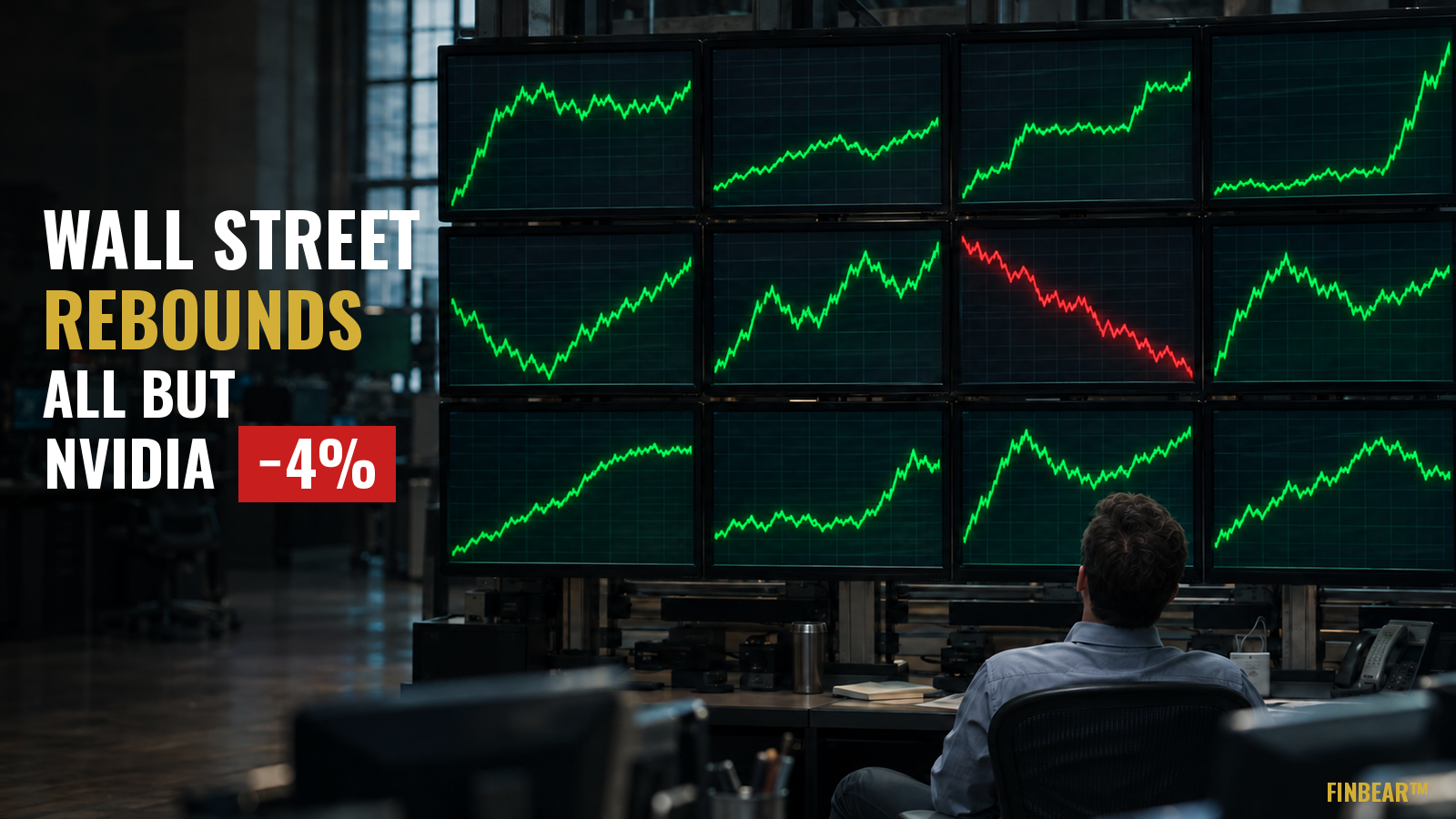
Wall Street had its best day since April on Monday. The S&P 500 gained 2.35%, the Nasdaq-100 3.40% and the chip index 6.85%, while the VIX slipped under 20. Cheaper oil helped, after Trump backed away from new strikes on Iran. One name missed the party: Nvidia fell 4.27% as its board looked into reports that Jensen Huang had been targeted by a foreign intelligence operation. Trump says the FBI is now handling the matter. That rally overturns the November 6 thesis. Next up, at 2:30 p.m. CET: October’s consumer prices, the Fed’s last CPI read before it meets in December.
Table of Contents
- 🧭 Before You Open the Terminal
- Key Indicators Dashboard
- 🗿 The Pretore Today
- 🧭 Compass of the Day
- 📐 Yield Curve
- 🏦 Banks: Large vs Regional
- Executive Summary
-
News in Detail
- 1. The rebound: best day since April, led by chips
- 2. Inflation day: the last CPI before the Fed, after a jobs beat
- 3. Oil: Trump steps back on Iran, Brent at its lowest since late August
- 4. Nvidia: the Huang affair sinks the stock as chips rally
- 5. Anthropic: new 5.2 models ahead of the IPO
- 6. Space: NASA puts up to $10 billion behind its moon base
- 7. Power for data centers: Constellation lifts its outlook
- 8. Crypto: bitcoin stuck under $75,000, Coinbase wins its trust charter
- 📰 In Brief
- Aggregated Sentiment Table
- Fear and Loathing on Wall Street™
- Cross-Cutting Synthesis
- Strategic Alerts
- Disclaimer & Maxim
🧭 Before You Open the Terminal
🔄 The rebound
🔥 The S&P 500 closed Monday at 7,549.94, up 2.35% for its strongest session since April, after a 0.31% gain on Friday. The Nasdaq-100 rose 3.40%, the Nasdaq Composite 2.74% and the Dow 2.15%, or 1,104 points, with all eleven sectors higher. Chipmakers led: the semiconductor index climbed 6.85% and AMD 13.3%. The VIX dropped 22.31% to 19.92.
🕵️ Nvidia, the exception
Nvidia ended at $178.67, down 4.27%, on a day the chip index rallied. On Sunday its board opened an independent inquiry into reports that Jensen Huang had been the target of a foreign intelligence operation. Huang has admitted to infidelity in a letter to staff. On Monday Trump said the FBI is looking into the matter.
🛢️ Oil and crypto
Brent settled at $92.57 a barrel, down 5.85%, and WTI at $86.85, down 4.38%; after settlement, Brent futures slid to their lowest since late August. Trump had said new strikes on Iran are very unlikely while talks go on, and Brent kept falling this morning toward $90. Bitcoin is holding just under $75,000. Coinbase’s national trust bank, meanwhile, has won final approval.
📅 Today
October CPI is due at 8:30 a.m. New York time (2:30 p.m. CET), the last inflation print before the Fed meets on December 8-9. Economists polled by Dow Jones expect a 0.3% monthly rise in the headline index and 0.2% excluding food and energy. In London this morning, Fed Governor Christopher Waller said he’s inclined to back a quarter-point hike even if October inflation eases from September’s pace, and that a half-point hike should be considered if the core monthly reading holds around 0.3% or higher. The backdrop: Friday’s jobs report showed 165,000 new jobs, against 65,000 expected. At 10:12 a.m. CET, S&P 500 futures were flat and Nasdaq futures down 0.31%.
Verdict
🔴 High priority — Fantiborsa’s take: On Friday the market was still spooked by the November 3 election. On Monday it bought back everything it had dumped, except the man who sells chips to everyone else. Oil is down, chips are up and the VIX has gone soft, so the liquidation is over. The rebound, though, was bought on credit, and the Fed shows up today at 8:30 a.m. ET (2:30 p.m. CET) to collect.
Trust me: today it’s worth finding five minutes to read the whole thing ☕
Key Indicators Dashboard
| Indicator | Value | Change | Reading | Signal |
|---|---|---|---|---|
| S&P 500 | 7,549.94 | +2.35% | RSI 45.8; below the SMA50 (7,676.21), above the SMA200 (7,328.22); Pretore flips to active long; futures flat at 10:12 a.m. CET | |
| Nasdaq (COMPQ) | 25,253.14 | +2.74% | RSI 42.4; below the SMA50 (26,434.83), above the SMA200 (25,107.04); Pretore flips to active long | |
| Nasdaq-100 (NDX) | 27,907.63 | +3.40% | RSI 41.1; below the SMA50 (29,602.18) and SMA200 (27,995.40); Pretore flips to active long; futures −0.31% at 10:12 a.m. CET | |
| Philadelphia Semi (SOX) | 10,033.93 | +6.85% | RSI 39.8; below the SMA50 (11,665.95) and SMA200 (10,841.49), 7.45% under the latter; Pretore flips to active long | |
| Dow Jones | 52,389.75 | +2.15% | RSI 52.5; above the SMA50 (52,040.63) and SMA200 (50,692.81); Pretore flips to active long; futures +0.26% at 10:12 a.m. CET | |
| Russell 2000 ETF (IWM) | 282.51 | +3.23% | RSI 53.9; above the SMA50 (281.84) and SMA200 (279.09) | |
| VIX | 19.92 | −22.31% | Above the SMA50 (17.01) and SMA200 (18.40); RSI 51.74; Pretore flips to active short on its reference ETF (VIXY) | |
| US 2Y | 4.56% | +5 bp | Two-year yield rises more than the ten-year | |
| US 10Y | 4.88% | +2 bp | Yields edge higher as stocks rebound | |
| 2s10s spread | 32 bp | −3 bp | Curve flattens as yields climb | |
| DXY | 101.65 | −0.64% | RSI 47.5; above the SMA50 (101.17) and SMA200 (99.75); Pretore active long on its ETF | |
| Gold | 4,114.50 | +0.97% | RSI 51.2; below the SMA50 (4,215.01) and SMA200 (4,492.39); Pretore active long | |
| Silver | 52.56 | +1.47% | RSI 41.9; below the SMA50 (59.42) and SMA200 (69.30); Pretore active long | |
| WTI | 86.85 | −4.38% | Below the SMA50 (95.51) and SMA200 (87.41); Pretore active short; 84.54 this morning (−2.66%) | |
| Brent | 92.57 | −5.85% | Below the SMA50 (104.27) and SMA200 (93.60); Pretore flips to active short; 90.26 this morning (−2.49%) | |
| EUR/USD | 1.1238 (Nov. 10) | n/a | Below the SMA50 (1.13) and SMA200 (1.15); Pretore active long on its ETF | |
| BTC | 74,452.87 | n/a | RSI 36.1; below the SMA50 (81,377.43), above the SMA200 (73,139.45); Pretore active short; 74,151.76 at 10:12 a.m. CET | |
| ETH | 2,110.92 | n/a | RSI 32.9; below the SMA50 (2,457.41) and SMA200 (2,152.49); Pretore flips to active long | |
| Crypto Fear & Greed | n/a | — | Latest reading unavailable at the time of writing |
Closing levels for Monday, November 9, 2026. Prices, RSI and moving averages come from the November 9 datapack (StockCharts/Yahoo Finance), with gold and silver taken from its futures series. VIX price, averages and RSI are from the StockCharts chart; for WTI and Brent, the price is from StockCharts and the averages from the datapack’s futures series. Treasury yields are official U.S. Treasury data for November 9, compared with November 6. For bitcoin and ether, the datapack’s changes don’t match the previous closes, so they’re omitted. EUR/USD is the Pretore’s November 10 reference (1.1238); the datapack’s averages are as of November 9, and no change is shown. Futures: Yahoo Finance screen at 10:12 a.m. CET.
The Pretore Today
U.S. index signatures. All four index signatures, on the S&P 500, the Nasdaq-100, the Nasdaq Composite and the Dow, are back at active long, with prices sitting close to the Consensus. The S&P 500 is 0.39% above it and the Dow 0.55% above, while the Nasdaq-100 trails it by 0.45% and the Composite by 0.30%. Semiconductors flip to active long too, 3.15% under a Consensus that is built on uniform weights because the index's volume can't be relied on. Read through its reference ETF, VIXY, the VIX signature returns to active short.
Signature-consensus status: not available today.
Polarity flip: yes. Since the November 6 RADAR, the S&P 500, the Nasdaq-100, the Composite, the Dow and semiconductors have all moved from active short to active long, and so has ether. The VIX and Brent went the other way, from active long to active short.
The awkward signatures. The Composite tops the list. Its long signature lapses on a close below 24,997.67, only 1.01% under Monday's, and the index is still below the Consensus, so a hot inflation number would be enough to test it. WTI comes next: it's in active short but a hair from invalidation, with the signature lapsing on a close above 86.9333, just 0.10% over Monday's, although crude is sliding again this morning. Then there's gold, whose long signature lapses on a close below 4,099.425, 0.37% under Monday's; at 10:12 a.m. CET, gold futures were at $4,105 an ounce.
Macro convergence. Both the dollar and the euro, each read through its ETF, stay in active long. For rates the Pretore tracks an ETF that holds 7- to 10-year Treasuries, also active long. A long signature there means falling yields, even though Monday's yields rose slightly. Gold and silver remain active long, while bitcoin stays active short and Brent now joins it.
$SPX operating levels: close 7,549.94 · AVWAP Consensus 7,520.25 (+0.39%) · closing invalidation 7,319.48 (−3.05%) · resistance 7,589.43 (+0.52%). The AVWAP Consensus is the volume-weighted average the Pretore uses as a structural anchor for prices. The invalidation level is the close below which the long signature lapses; it is not a stop-loss order.
The overall read. Two sessions have turned Thursday's general retreat on its head. The S&P 500, Nasdaq-100, Composite, Dow and semiconductor signatures are bullish again, the VIX is bearish again, and Brent has turned bearish along with WTI. The havens are still long, from gold and silver to the dollar, the euro and Treasuries: the rebound hasn't yet made anyone sell them. The soft spot is how close everything sits to the Consensus. The Nasdaq-100 and the Composite remain below it, and a 1% drop would be enough to cancel the Composite's signature.
Snapshot as of November 10, 2026 (reference close November 9).
Compass of the Day
FINBEAR Compass™ · $SPX · Nov 9, 2026
  VERDICT           CONTESTED          — recent momentum challenges the regime
  OPERATING REGIME  Strong bear
  LINEARITY         Non-linear trends
  COHERENCE         full
  RELIABILITY       SUSPENDED
  POSITION          -- below trend     — below the underlying trend
  UNDERLYING TREND  Persistent bull    — solid
For the S&P 500, the Compass still reads a strong-bear operating regime, now challenged by recent momentum. On Thursday the verdict read "confirmed"; the rebound on Friday and Monday has moved it to "contested." Coherence is full, yet reliability remains suspended because the medium-term measure can't be read with confidence. All of this sits inside a solid underlying uptrend, so the bear regime reads as a short-term correction. The rebound has narrowed the gap, but price is still below that trend.
The Nasdaq-100 and the Composite show the same picture: a strong bear regime contested by momentum, full coherence, suspended reliability, and a persistent, solid bull underneath. The Nasdaq-100 remains far below its underlying trend, the Composite somewhat less so. The financial sector is different. It is still in a strong bull regime confirmed by momentum, but with no coherence and suspended reliability, price within its normal range around the underlying trend, and a persistent yet fragile underlying bull. That scattered signal says wait.
Today the Pretore and the Compass disagree. The Pretore, with the index signatures back to long, is the first to register a change in direction; the Compass, which measures the regime over longer horizons, still sees a short-term bear and only notes that momentum is pushing back. That's the usual gap between whoever opens the case file and whoever measures the regime. Price will settle it either way.
Yield Curve
U.S. Treasury Curve · Nov 9, 2026
  SHAPE       flat
  MOVEMENT    bear flattening
  MACRO       normal
For the economy: Yields rose on the day of the rebound, the short end more than the long end, so an already flat curve got flatter. It's what a market does when it shakes off its fear and goes back to pricing in a Fed rate hike. Friday's strong jobs report took away an argument for a pause, and today's inflation data will test the case for a hike.
For banks: A curve that flattens from the short end should, in theory, squeeze net interest margins. Banks rallied with the rest of the market on Monday anyway, as the next panel shows.
Banks: Large vs Regional
XLF · KBWB · KRE — financial sector
- XLF (sector) — at 57.99 (+1.45%), RSI 59.6, above its 50- and 200-day averages. The Pretore's signature on the sector stays in active long, with the closing invalidation at 56.6033 (−2.39%); price is 1.18% above the Consensus, and resistance sits around 58.43.
- KBWB (large banks) — at 89.77 (+2.45%), above its 200-day average and just under its 50-day; resistance around 90.44, support around 88.74.
- KRE (regionals) — at 73.45 (+1.73%), above its 50- and 200-day averages and inside the 73.43–74.27 zone; next support around 72.52.
Big and regional banks fell together on Thursday, with the big names leading the decline, and both slipped a little further on Friday. On Monday they bounced together, and this time the large banks recovered more than the regionals. The sector holds above its averages and the signature stands, with a cushion now over 2%. Politics hasn't gone away, though: Democratic Senator Ron Wyden, in line to chair the Finance Committee, has named three big banks with ties to Jeffrey Epstein as possible targets of an investigation.
KBWB and KRE under watch — a reading, not a signal.
Executive Summary
🎬 The day in one line
Stocks rallied on Monday, with the S&P 500 up 2.35%, the Nasdaq-100 up 3.40%, the Dow up 2.15% and semiconductors up 6.85%, while the VIX fell to 19.92 and Brent lost 5.85%. Nvidia dropped 4.27% even as the chip index climbed.
🔄 The rebound and the overturned thesis
- 🔥 Best session since April. The S&P 500 won back much of what it had lost in its worst week since April 2025, and the Nasdaq-100 recovered roughly 70% of Thursday’s drop over Friday and Monday. All eleven sectors rose, led by industrials and consumer discretionary.
- Chips without Nvidia. AMD gained 13.3%, Broadcom 8.8% and Intel 5.5%. Nvidia lost 4.27% to its lowest close since April 7, according to Reuters.
- The November 6 thesis is overturned. On Monday, in the same session, the S&P 500 and the Composite both closed above the thresholds set on November 6 (7,517.48 and 24,343.74).
📊 Fed, jobs, inflation
The October jobs report, released on Friday, showed 165,000 new jobs against 65,000 expected; unemployment fell to 4.1% and wages rose 0.4% for the month. Today’s inflation data is expected to show a 0.3% monthly rise in the headline index and 0.2% excluding food and energy. This morning Waller said he’s inclined to support a quarter-point hike in December even if inflation eases, and that a half-point hike should be considered if the core reading holds around 0.3% or higher.
🛢️ Oil, space, power, crypto
Brent fell 5.85% after Trump’s comments on Iran, and post-settlement futures hit their lowest since late August. SpaceX climbed back above its IPO price, up 5.81% to $142.07 on NASA’s lunar contracts. Constellation raised its 2026 outlook. Coinbase’s national trust bank won final approval, while bitcoin stays just under $75,000.
⏳ The bottom line
The November 6 RADAR argued that the vote had reopened the case against artificial intelligence, and named the condition that would overturn that view: an S&P 500 close above 7,517.48 together with a Composite close above 24,343.74 in the same session. Monday met both, with the S&P 500 at 7,549.94 and the Composite at 25,253.14. The scenario that RADAR had sketched for that outcome, “the liquidation has run its course and the market goes back to looking at earnings,” is the one that played out, with one exception that matters: Nvidia.
Pretore vs thesis. Signature of the day on $SPX: active long — in agreement with today’s thesis, the liquidation over and the rebound still on trial ahead of the Fed; closing invalidation at 7,319.48 (−3.05%). The Nasdaq-100, Composite, Dow and semiconductor signatures, all back to active long, agree as well, though the Composite’s lapses on a drop of just over 1%. The thesis is invalidated if, by Friday, November 13, the Composite closes below 24,997.67 and, in the same session, the Dow closes below 51,579.35.
News in Detail
1. The rebound: best day since April, led by chips
What happened
✅ The S&P 500 finished Monday at 7,549.94, up 2.35% or 173.08 points. The Nasdaq Composite closed at 25,253.14 (+2.74%), the Nasdaq-100 at 27,907.63 (+3.40%) and the Dow at 52,389.75 (+2.15%, or 1,104.02 points); the Russell 2000 ETF ended at 282.51 (+3.23%) and the VIX at 19.92 (−22.31%) (StockCharts; Yahoo Finance). ✅ It was the S&P 500’s biggest gain since April 8, with all eleven sectors higher, nine of them by more than 1% and industrials and consumer discretionary by more than 3% (Reuters). ✅ It followed the S&P 500’s worst week since April 2025 (Investing.com).
✅ Chips did the heavy lifting. The Philadelphia Semiconductor Index rose 6.85% to 10,033.93 on top of Friday’s 4.21%, an 11.35% gain in two sessions that put it back above 10,000, though still 7.45% under its 200-day average (StockCharts; datapack). ✅ AMD jumped 13.3%, Broadcom 8.8% (Reuters) and Intel 5.5% (Investing.com). ✅ Reuters credited the rally to falling oil, which eased inflation worries, and to the bounce in chipmakers (Reuters).
✅ The rebound had started on Friday, jobs-report day, when the S&P 500 added 0.31% and the Nasdaq-100 1.35% while the Dow slipped 0.46% (datapack, November 9). ✅ Seoul’s KOSPI followed this morning, closing up 4.39% at 5,239.13 (Yonhap).
The November 6 RADAR read the sell-off as the vote reopening the case against artificial intelligence. On Monday the court let every defendant walk free, except one.
What sources say
“The mood goes from fear of downside to fear of missing out on the upside” — Keith Lerner, Truist Advisory Services (MarketWatch, via World Today News) 🔸
FINBEAR Take: the liquidation is over, the trial isn’t
The November 6 RADAR spelled out what a move back above the S&P 500 and Composite thresholds would mean: that the liquidation had run its course and the market would go back to looking at earnings. That is how Monday played out. Funds that were dumping the year’s winners on Thursday to lock in gains stopped selling, and investors with cash went back into the hardest-hit chips. A VIX under 20 says the rush for the exit is over.
Still, both of the rebound’s engines are external. One is oil, falling because Trump is backing off Iran, and a cheaper barrel means lower expected inflation. The other is simply the end of forced selling. Neither means the political fight over data-center permits has gone away. If anything, that fight was already priced in. Today’s inflation report will test the first engine.
Cui prodest? Investors who bought semiconductors and industrials late Thursday, and anyone who had sold VIX protection. The losers are those who bought protection after the crash and those who were short chips.
For investors
Instruments involved:
- Stocks: $SPY, $QQQ, $DIA, $IWM, $AMD, $AVGO, $INTC
- ETFs: $SMH, $SOXX, $VIXY
- Futures/Commodities: S&P 500 (ES) and Nasdaq-100 (NQ) futures
Opportunities:
In our view a rally that lifts every sector, with smaller companies in front, stands on firmer ground than one carried by a handful of giants
Risks:
The Nasdaq-100 and the Composite are still below the Consensus and below their respective 50-day averages, and the Compass still sees a short-term bear
What to avoid:
Chasing chips before 2:30 p.m. CET: a hot inflation print puts the Fed back in charge, and the most expensive stocks pay first
Bottom line:
The market has stopped selling; it hasn’t started believing yet.
Impact: (4/5) — Broad rebound, VIX under 20, oil falling
2. Inflation day: the last CPI before the Fed, after a jobs beat
What happened
✅ Friday’s October jobs report showed a gain of 165,000 nonfarm jobs, against 65,000 expected. Unemployment fell to 4.1%, and average hourly earnings rose 0.4% from September and 3.1% from a year earlier (Bureau of Labor Statistics; FactSet). ✅ August and September were revised up by a combined 84,000 jobs, with September now at 60,000 instead of 29,000 (Bureau of Labor Statistics). ✅ Even so, 3.1% wage growth trails the 3.9% that economists cited by Reuters expect for October’s year-over-year headline inflation (Bureau of Labor Statistics; Reuters).
✅ The Bureau of Labor Statistics publishes October consumer prices today at 8:30 a.m. New York time, 2:30 p.m. CET (Bureau of Labor Statistics, calendar). ✅ Economists polled by Dow Jones expect a 0.3% monthly rise in the headline index and 0.2% excluding food and energy, after September’s 0.6% and 0.3% (CNBC; investingLive). ✅ The BLS won’t report year-over-year changes, because October 2025 prices were never collected during the federal shutdown; economists cited by Reuters put them at 3.9% for the headline index and 2.7% excluding food and energy (CNBC; Reuters).
✅ The Fed held its benchmark rate in a range of 3.75% to 4.00% in October, and on Monday evening markets put the odds of a December hike at about 85% (Reuters). ✅ It meets on December 8 and 9 (CNBC).
✅ Speaking in London this morning, Governor Waller said he’s inclined to support a quarter-point hike in December even if October inflation eases from September’s pace (Federal Reserve; Reuters). ✅ He added that a half point should be considered if the monthly reading excluding food and energy stays around 0.3% or higher (Federal Reserve; Finimize). ✅ CME FedWatch showed more than an 80% chance of a 25-basis-point December hike and 0% for 50 basis points this morning, according to CNBC 🔸 (CNBC, carried by Chicago Financial Times).
✅ Bank of America says October’s numbers could firm up expectations of a December hike (Proactive). ✅ Yahoo Finance argues that the stock market is doing some of the Fed’s dirty work (Yahoo Finance).
The November 6 RADAR was bracing for a jobs report expected to show 65,000 new jobs. It showed 165,000, and that number makes a hike more likely. This morning Waller said he’s inclined to back one, and he put inflation, not jobs, at the center of his case.
What sources say
“a further substantial correction in equity markets or widening credit spreads” — Veronica Clark, Citigroup, on the risk that the Fed doesn’t hike in December (Reuters)
“I believe a 50 basis point hike in the policy rate should be considered” — Christopher Waller, Fed governor, if the monthly reading excluding food and energy stays around 0.3% or higher (Federal Reserve)
FINBEAR Take: the market did the Fed’s work, then took it back
Yahoo Finance’s line is that stocks have been doing some of the Fed’s dirty work: a falling market cools the economy without a rate hike. Citigroup’s economist makes the same point from the other side, naming another equity slide or wider credit spreads as the main risk to a December hike. Monday’s rally removed exactly that risk.
That turns today’s question around. Traders go into the number with a quarter-point hike already largely priced in, and Waller is ready to back it even if inflation eases. If the reading excluding food and energy stays around 0.3% or higher, he’d put the half point on the table. With no year-over-year figure, the number markets usually zero in on is missing, and the monthly change is all that counts.
Cui prodest? The dollar and short-term yields, if the data runs hot. The losers are those who bought the priciest stocks in Monday’s rebound and holders of short-dated bonds.
For investors
Instruments involved:
- ETFs: $TLT, $IEF, $SHY, $UUP
- Futures/Commodities: 2-year Treasury (ZT) and Fed Funds futures
Opportunities:
A reading in line with or below forecasts, with oil falling, gives the rebound and rate-sensitive stocks room to run
Risks:
If the core reading stays around 0.3% a month or higher, Waller would consider a half-point hike. CNBC reported that CME FedWatch put the odds of that move at 0% this morning 🔸
What to avoid:
Building big positions before 2:30 p.m. CET: without a year-over-year number, the first reaction may be messy
Bottom line:
The Fed got the jobs it was waiting for; now it decides how much the market pays for them.
Impact: (3/5) — December hike expected · The other side: dollar favored if CPI runs hot
3. Oil: Trump steps back on Iran, Brent at its lowest since late August
What happened
✅ Brent closed Monday at $92.57 (−5.85%) and WTI at $86.85 (−4.38%) (StockCharts). ✅ After settlement, Brent futures dropped to their lowest since late August (Reuters). ✅ At 3:50 a.m. New York time this morning, Brent was at $90.26 a barrel (−2.49%) and WTI at $84.54 (−2.66%), both below their respective 200-day averages (StockCharts).
✅ On Sunday Trump said he is very unlikely to order new strikes on Iran while talks to end the conflict continue, even as both Washington and Tehran reported ships hit in or near the Strait of Hormuz (CNBC). ✅ On Monday he met Qatar’s prime minister, who is mediating (CNBC). ✅ Morgan Stanley notes that physical Brent, the benchmark used to price cargoes, now trades at a discount to the front-month contract, a sign that real demand is weak (Reuters). ✅ Brent is down about 22% from its six-month high of $118 on October 30 (Arab News, Reuters).
✅ Bloomberg describes weeks of turmoil in benchmark tanker rates for crude (Bloomberg). ✅ Bank of America says oil could force the Fed to rethink its rate path (TheStreet).
The November 6 RADAR had Brent bouncing on fresh attacks on tankers while still down about 13% for the week. Tankers have been hit again since then, and this time the price listened only to Trump.
What sources say
“on hopes of a US-Iran peace deal rather than concrete signs of progress” — Ole Hansen, Saxo Bank (RTÉ; Cash Online)
“unlikely to fall below $90 per barrel for Brent” — Gregory Brew, Eurasia Group, absent more lasting signs of de-escalation (Reuters, via Arab News)
FINBEAR Take: the barrel prices in peace before anyone signs
Oil is falling on words, not deeds. Ships are still being hit near Hormuz, but traders are listening to Trump, who since the vote has preferred to negotiate. There is a harder fact underneath: physical Brent is cheaper than the contract, which happens when cargoes struggle to find buyers. High prices have started to eat into demand.
Oil is also what Monday’s rebound is standing on. Cheaper crude means lower gasoline prices in November’s inflation figures and less pressure on the Fed. That’s why a drop below the 200-day average matters more than an ordinary decline: if Hormuz shuts again, the rebound loses its sturdiest leg.
Cui prodest? Airlines and transport, refiners buying crude at a discount, and consumers. The losers are crude producers and those who bought oil as a war hedge.
For investors
Instruments involved:
- Stocks: $XOM, $CVX, $OXY, $FANG
- ETFs: $USO, $XLE, $JETS
- Futures/Commodities: WTI (CL) and Brent (BZ) futures
Opportunities:
A cheaper barrel cuts costs for airlines and transport companies and eases inflation over the coming months
Risks:
The short signature on WTI lapses on a 0.10% rise, so a single headline from Hormuz could flip it
What to avoid:
Shorting oil below $90: Eurasia Group sees little room for Brent to fall further without a deal
Bottom line:
The barrel signed the peace before the diplomats did.
Impact: (3/5) — Brent −5.85%, lower expected inflation · The other side: crude producers hurt
4. Nvidia: the Huang affair sinks the stock as chips rally
What happened
✅ Nvidia closed Monday at $178.67 (−4.27%), having been down as much as 7.3% in the morning (Nvidia chart, November 9; CNBC; The Hill). ✅ Market reports say it was the only stock in the Philadelphia Semiconductor Index to finish lower (Vantage Markets), at its lowest close since April 7 (Reuters), and the drop erased almost $200 billion in market value (NBC News). ✅ The stock had closed at $186.64 on Friday.
✅ According to the New York Times, U.S. intelligence suspects that Alice Huang, an executive at data-center company Megaspeed, was passing information to Beijing (Axios; AP). ✅ On Sunday Nvidia’s board opened an investigation into reports that Jensen Huang was the target of a foreign intelligence operation; independent directors are leading it, with outside advisers (The Hill; CNBC). ✅ The board says it has no reason to believe national security or Nvidia’s secrets were compromised (NBC News).
✅ Jensen Huang admitted to infidelity and apologized in a letter to employees (CNBC; Bloomberg via The Hill). ✅ Trump said on Monday that the FBI is looking into the matter (Reuters). ✅ The same day, a shareholder sued Huang and the company and asked for class-action status. Huang owns about 3.6% of Nvidia and runs it with an unusually flat structure, with dozens of executives reporting directly to him (Reuters). ✅ China calls the story groundless (CNBC, Reuters). ✅ Nvidia reports results on November 17.
What sources say
“I know the FBI is looking into it” — Donald Trump (Reuters)
“Jensen is not replaceable” — Dan Ives, Yorkville Ives & Co. (Yahoo Finance)
FINBEAR Take: the market separates the chip from the man
The market did something unusual on Monday: it bought the whole sector and sold its leader. Nobody doubted Nvidia’s chips, which are still the ones everyone wants; the doubt was about the person running the company. There’s a name for that: key-man risk. Nvidia is built around Huang, with dozens of executives answering to him directly, so if he wobbles, the whole chain of command wobbles.
In our view the session showed a preference for other chipmakers, with AMD, Broadcom and Intel up between 5% and 13% while Nvidia fell. The market was judging the company’s governance, not its products. Results on November 17 will show whether customers see it the same way.
Cui prodest? Direct competitors, AMD first, and anyone short Nvidia. The losers are those holding Nvidia as a safe bet on artificial intelligence, along with index funds, which own it in proportion to its weight.
For investors
Instruments involved:
- Stocks: $NVDA, $AMD, $AVGO, $INTC
- ETFs: $SMH, $SOXX, $QQQ
- Futures/Commodities: Nasdaq-100 futures (NQ)
Opportunities:
The inquiry is about the man, not the numbers: if it wraps up quickly, the gap with the rest of the chip sector closes too
Risks:
Trump says the FBI is looking into it. A shareholder has sought class-action status, and earnings are due November 17. A Huang exit isn’t priced in
What to avoid:
Buying Nvidia “because the sector is rising”: on Monday the sector rose without it
Bottom line:
The market acquitted the chips and put the man behind them on trial.
Impact: (3/5) — Key-man risk at Nvidia · The other side: semiconductors rising
5. Anthropic: new 5.2 models ahead of the IPO
What happened
✅ On Monday Anthropic launched Claude Fable 5.2 and Claude Mythos 5.2, its most advanced models, which the company says respond up to 30% faster than their predecessors (CNBC; Yahoo Finance). ✅ Fable 5.2 is open to everyone, while Mythos 5.2 is limited to organizations admitted to its life-sciences and cybersecurity vetting programs (CNBC). ✅ Fable 5.2 also gets cheaper: $8 per million input tokens and $40 per million output tokens, down from $10 and $50 for version 5.1 (Yahoo Finance).
✅ Anthropic filed its prospectus on October 26 and applied to list on the Nasdaq under the symbol ANT (SEC). ✅ The Wall Street Journal reports that investor meetings are set for this week and that trading could begin on November 19 or 20 🔸 (Wall Street Journal, via Seoul Economic Daily). ✅ The valuation first floated, more than $2 trillion, could come down to between $1 trillion and $1.5 trillion, according to Yahoo Finance (Yahoo Finance).
On November 6 the RADAR reported that the crash had cut the odds of a November debut. On Monday the company showed off new models while, according to the Wall Street Journal, its IPO preparations continued.
What sources say
“We called for pacing, not pausing” — Dianne Penn, Anthropic (CNBC)
FINBEAR Take: the product before the price
The models arrive in the same week the Wall Street Journal says investor meetings are scheduled, so the company is showing its product before it sets a share price. Cutting prices by a fifth also shows that cost has become another front in the competition among AI developers.
The open question is still the valuation, and Yahoo Finance says Wall Street is now talking about a lower one. For investors, the point is simple: the IPO price will be set by the market in the week of the debut, not by how good the product is.
Cui prodest? Customers, who pay less for the models, and the banks running the IPO. The market will put a number on the rest, and buyers on debut day will pay whatever that week’s market demands.
For investors
Instruments involved:
- ETFs: $QQQ, $IGV
- Other instruments: ANT (not yet listed)
Opportunities:
A successful IPO would restore some confidence in AI stocks after the week of the vote
Risks:
An uncertain valuation and a tight timetable, in a market that only stopped selling on Monday
What to avoid:
Buying the debut on first-day excitement: SpaceX’s drop below its IPO price is still fresh
Bottom line:
The product comes before the price; the market will set the price.
Impact: (2/5) — New models, IPO in the works, valuation under discussion
6. Space: NASA puts up to $10 billion behind its moon base
What happened
✅ NASA on Saturday picked eight companies to compete for lunar deliveries under a new ten-year program worth up to $10 billion: Blue Origin, Firefly Aerospace, Intuitive Machines, ispace-U.S., Lockheed Martin, Northrop Grumman, SpaceX and Voyager Technologies (Payload; KeepTrack). ✅ The agency also handed out six launch orders worth about $1.3 billion to Arrow Science and Technology, Blue Origin and Impulse Space; two of those missions will fly on Falcon 9 (NASA; Payload).
✅ SpaceX closed Monday at $142.07 (+5.81%), above its $135 IPO price (Gotrade). ✅ The three small publicly traded companies on NASA’s list, Intuitive Machines, Firefly and Voyager, are worth about $8.5 billion combined (Yahoo Finance). ✅ This year’s three planned commercial lunar missions have slipped to 2027 (SpacePolicyOnline).
✅ Yahoo Finance says space stocks have gained between 25% and 60% since the November 5 close (Yahoo Finance). ✅ Rocket Lab, which isn’t on NASA’s list, rose almost 30% in the two sessions before its results (Yahoo Finance). After the close it reported revenue above analyst estimates, a wider-than-expected loss per share and fourth-quarter revenue guidance above estimates (Rocket Lab; Investing.com). The morning snapshot shows it down 7.58% in premarket trading (Yahoo Finance, morning screen).
The November 6 RADAR noted that SpaceX had fallen back below its IPO price. Two sessions later it is back above, carried by the lunar contracts and the return of buyers.
What sources say
“We are building the Moon Base mission by mission” — Jared Isaacman, NASA Administrator (NASA)
FINBEAR Take: the contract is a ceiling, not revenue
The $10 billion is a cap on the whole contract, and the eight companies will have to compete for the work mission by mission. Yahoo Finance puts the combined value of the three small listed names at about $8.5 billion, less than that cap. The market is buying the possibility, not the revenue.
Rocket Lab is a useful lesson. Left off the list, it ran up almost 30% in two sessions, then fell before the open on mixed results; when a stock runs like that into earnings, any blemish in the numbers becomes a reason to sell. As for SpaceX, its return above the IPO price mostly says the buyers came back with the rebound.
Cui prodest? SpaceX and the small companies on the list, which gain credibility from NASA’s backing. The losers are those who rode the Rocket Lab wave into earnings.
For investors
Instruments involved:
- Stocks: $SPCX, $RKLB, $LUNR, $FLY, $VOYG, $LMT, $NOC
- ETFs: $UFO, $ARKX
Opportunities:
Multi-year government contracts give the sector’s smaller companies better revenue visibility
Risks:
The companies have to win the work mission by mission, and the lunar missions planned for this year have slipped to 2027
What to avoid:
Buying space stocks after a 60% gain in two sessions: Rocket Lab shows how hard mixed results can hit after a run like that
Bottom line:
NASA set a cap; the market treated it as a floor.
Impact: (2/5) — Lunar contracts, space stocks rising
7. Power for data centers: Constellation lifts its outlook
What happened
✅ Constellation Energy reported third-quarter results before Monday’s open, with adjusted operating earnings of $5.06 per share (Constellation, SEC filing) against the $3.90 analysts expected (Earnings Whispers). ✅ It raised the midpoint of its 2026 guidance and narrowed the range to $12.50 to $12.80 a share (Constellation, SEC filing), from $11.50–12.50 in August (Earnings Whispers). ✅ In October it announced a nuclear partnership with Google and signed a conditional commitment with the Department of Energy for a guarantee of up to $5 billion on a Federal Financing Bank loan (Constellation).
✅ In the two sessions after the vote Constellation had lost 9% and Vistra 14%; Vistra raised its guidance on Friday (TIKR). ✅ Constellation’s biggest contracts run 15 to 20 years. Texas, meanwhile, has elected Gina Hinojosa governor; she had called for a moratorium on new data centers (TIKR). ✅ NRG Energy beat quarterly estimates 🔸 (Zacks, headline). ✅ Decrypt reports that some data-center developers are hunting for used turbines or generators adapted from jet engines, because a new gas turbine takes six years on average to arrive in the United States, according to Wood Mackenzie (Decrypt).
The November 6 RADAR reported that OpenAI and Google had reiterated who pays for data-center power. On Monday the power producers presented the bill, and it had gone up.
What sources say
“Our approach proves we can power the growing digital economy” — Joe Dominguez, Constellation CEO (Constellation)
FINBEAR Take: those who sell electricity aren’t afraid of the vote
The November 3 vote scared the people who build data centers, because newly elected officials are promising stricter permitting rules. Companies selling power to data centers that already exist work on fifteen- to twenty-year contracts, and an election doesn’t tear those up. Constellation’s numbers say as much, with earnings almost a third above expectations and a nuclear deal with Google.
The secondhand jet engines tell the rest of the story: the bottleneck is power, not chips. With delivery times that long, anyone who already owns power plants has a head start and more pricing power.
Cui prodest? Power producers with plants already running, nuclear first, and suppliers of turbines and engines. The losers are those who have to build new data centers and buy power at today’s prices.
For investors
Instruments involved:
- Stocks: $CEG, $VST, $NRG, $GEV, $GOOGL
- ETFs: $XLU, $NLR
Opportunities:
Long contracts and raised guidance in a week when the sector sold off alongside data-center stocks
Risks:
New facilities still face political risk: in Texas, the governor-elect had called for a moratorium on new data centers
What to avoid:
Lumping power producers in with data-center builders: the vote hits them differently
Bottom line:
The vote can stop new data centers, not switch off the ones already running.
Impact: (3/5) — Raised outlook for Constellation · long lead times for power equipment at new data centers
8. Crypto: bitcoin stuck under $75,000, Coinbase wins its trust charter
What happened
✅ Bitcoin is holding just under $75,000: $74,452.87 at the close, according to the datapack, and $74,151.76 at 10:12 a.m. CET, below its 50-day average and above its 200-day (datapack; Yahoo Finance). ✅ Decrypt says bitcoin is stalled near $75,000 after a wave of liquidations, even as stocks rebound ahead of the inflation data 🔸 (Decrypt, headline). ✅ BeInCrypto reports, citing on-chain data, that the number of wallets with a nonzero balance is falling, while wallets holding 1 to 100 bitcoin are accumulating 🔸 (BeInCrypto).
✅ Coinbase announced on Monday that Coinbase National Trust Company has final approval from the OCC, the federal regulator of national banks. The OCC gave the green light on Friday, November 6 (Coinbase; Securities.io). ✅ The OCC requires at least $60 million in core capital for the first three years (OCC). According to Securities.io, Coinbase will move custody into the new bank over three years and won’t take deposits from individuals (Securities.io).
✅ PNC is running a pilot with Coinbase that lets eligible corporate and institutional clients receive payments in USDC (Unchained). ✅ Yahoo Finance reports that the Bank of Russia has set November 17 as the start date for its retail crypto trading rules, which come with investment limits and investor tests 🔸 (Yahoo Finance, video). ✅ According to Elliptic, cited by Decrypt, the people laundering funds stolen from Binance are also using meme coins (Decrypt).
The November 6 RADAR wrote that bitcoin had given back its post-election gains. On Monday stocks recovered and bitcoin didn’t.
What sources say
“This is an important next chapter for Coinbase” — Rick Schonberg, Coinbase National Trust Company (Coinbase)
FINBEAR Take: the banks are in; the price hasn’t moved
Crypto got two pieces of good institutional news on Monday, with Coinbase launching its federally supervised trust bank and PNC starting a pilot on USDC payments. Bitcoin didn’t budge. Institutional news builds the plumbing, but it doesn’t bring fresh money on the day it lands.
Nor did bitcoin join the stock rebound. Over Friday and Monday the Nasdaq-100 recovered almost 5%, and bitcoin stayed where it was. When the market is buying risk and an asset still doesn’t rise, that asset still has sellers. The Pretore’s signature stays short, and lapses on a rise of just over 0.5%.
Cui prodest? Coinbase, which moves custody under a single federal regulator, and banks offering stablecoin payments. The losers are those holding bitcoin as a bet on a rebound in risk appetite.
For investors
Instruments involved:
- Stocks: $COIN, $PNC, $CRCL, $MSTR
- ETFs: $IBIT, $ETHA
- Futures/Commodities: bitcoin futures (BTC)
Opportunities:
Federally supervised custody makes it easier for large investors to come in over time
Risks:
Hotter-than-expected inflation would lift the dollar and push yields higher, the worst backdrop for bitcoin
What to avoid:
Reading institutional news as a price signal: on Monday it gave no such signal
Bottom line:
Crypto has found a bank, not yet a buyer.
Impact: (2/5) — Good institutional news, bitcoin price flat
In Brief
- China. The artificial intelligence boom is pushing China toward a record trade surplus (CNN Business).
- Banks and Epstein. Democratic Senator Ron Wyden has named three big banks with ties to Jeffrey Epstein as possible targets of a Senate Finance Committee investigation (Bloomberg, via Yahoo Finance).
- France. Fortune says the protests in France are a warning for economists worried about public debt 🔸 (Fortune).
- California. A federal appeals court has reversed the lower court's denial of a preliminary injunction against California's climate-related financial risk law and the separate requirement to disclose value-chain emissions (Ninth Circuit Court of Appeals; Reuters).
- Take-Two. Shares rose after hours on the company's results, with the CEO pointing to GTA VI preorders at unprecedented levels (Yahoo Finance, earnings live blog).
- Occidental. Third-quarter revenue missed analyst expectations 🔸 (StockStory, headline).
Aggregated Sentiment Table
| Cluster | Story | Sentiment | Score |
|---|---|---|---|
| 🏛️ Market | S&P 500 +2.35%, Nasdaq-100 +3.40%, VIX under 20 | Positive / liquidation over | +10 |
| 💰 Central Banks | Payrolls +165,000, Waller backs a hike, CPI today | Negative / Fed heading for a hike | -10 |
| 🔋 Energy | Brent −5.85% after Trump’s comments on Iran | Positive / lower expected inflation | +5 |
| 🧠 AI & Tech | Nvidia −4.27% on the Huang affair, chips +6.85% | Mixed / key man vs sector | -5 |
| 🧠 AI & Tech | Anthropic launches the 5.2 models ahead of its IPO | Neutral / valuation under discussion | 0 |
| 🚀 Space | NASA puts up to $10 billion behind the moon base; SpaceX above its IPO price | Positive / government contracts | +5 |
| 🔌 Data-center power | Constellation lifts its outlook | Positive / power as the bottleneck | +5 |
| 🪙 Crypto | Bitcoin stuck under $75,000, Coinbase trust bank | Neutral / plumbing, not price | 0 |
| Net Score | +10 |
Fear and Loathing on Wall Street™
Neutral — Index: 5

Registry comparison: the last recorded reading is −26 (Anxiety), from November 6, based on Thursday’s November 5 close. In the two sessions since, the S&P 500 gained 0.31% on Friday and 2.35% on Monday, the VIX fell from 28.18 to 19.92, and Brent lost 5.85% on Monday.
Reading. Thursday’s fear was the kind that comes with a liquidation. The liquidation ended on Monday, taking the sharpest part of the fear with it: the VIX is back near its averages, and Monday’s gains reached every sector, with smaller companies in front. Fear hasn’t turned into confidence, though. Gold and Treasuries are still in demand, bitcoin isn’t following, and the market is waiting on inflation with a Fed already set to raise rates. This is a market that has stopped running away, not one that has started running again.
Cross-Cutting Synthesis
Today’s eight stories add up to the day the market stopped selling. Friday’s jobs report beat expectations, and on Monday the S&P 500 had its best session since April. Chips completed an 11% two-day rebound, while the VIX slipped back under 20. Oil fell after Trump’s comments on Iran, taking Brent futures to their lowest since late August. SpaceX returned above its IPO price on lunar contracts, and Constellation lifted its outlook. Two names sat out the party: Nvidia, dealing with its board’s investigation, and bitcoin, stuck under $75,000.
How the market traded says the liquidation has run its course, not that confidence is back. The rebound runs on two outside engines, falling crude and the end of forced selling, while the havens are still in demand, with gold, the dollar and Treasuries all keeping long signatures. Short-term yields led a flatter curve because traders are pricing in a December Fed hike. Meanwhile Anthropic rolled out new models on its way to an IPO, in a market that, for now, prefers power producers to data-center builders.
The thresholds of recent days show where the theses stand. The thesis that the vote had reopened the case against artificial intelligence was overturned on Monday, when the S&P 500 closed at 7,549.94, above 7,517.48, and the Composite at 25,253.14, above 24,343.74, in the same session. That is the scenario the RADAR had laid out: the liquidation has run its course and the market is looking at earnings again. The November 5 thesis, a rotation out of chips into the rest of the market, expired on Friday without hitting its invalidation trigger, although the November 6 RADAR had already treated it as disproved by events. Earnings now face a new judge, the inflation report at 2:30 p.m. CET.
Cui prodest? Investors who bought chips and industrials after the crash, airlines, and power producers whose plants are already running. The losers are those who bought protection after Thursday, those holding Nvidia as a safe bet, and crude producers.
📌 Thesis invalidation — This RADAR’s dominant thesis is: the post-vote liquidation is over and the market is back to looking at earnings, helped by falling oil; but the rebound remains on trial ahead of the December hike the market expects from the Fed.
- Holds because:
- the S&P 500 rose 2.35%, the Nasdaq-100 3.40% and semiconductors 6.85%, with all eleven sectors higher and the Pretore’s signatures on the S&P 500, Nasdaq-100, Composite, Dow and semiconductors back to long;
- the VIX fell to 19.92 and Brent lost 5.85%, with futures at their lowest since late August after settlement;
- earnings matter again: Constellation lifted its outlook. Nvidia was punished for its governance, not for its numbers;
- the counterweight: the Nasdaq-100 and the Composite remain below the Consensus, the Compass still sees a short-term bear, and after the 165,000 gain in payrolls a December hike is largely priced in.
- Invalidated if: the Nasdaq Composite closes below 24,997.67, the level below which its long signature lapses, and in the same session the Dow closes below 51,579.35, the level below which its own lapses.
- By: the close on Friday, November 13, in a week that brings the inflation report and earnings from CoreWeave, Nebius and Cisco.
- In that case: FINBEAR would drop the view that the liquidation had run its course and read the move as a technical rebound within the correction: hike risk would take over the role the vote played, and the market would go back to selling its most expensive stocks.
Strategic Alerts
active long on the 7,549.94 close; closing invalidation at 7,319.48 (−3.05%); resistance at 7,589.43 (+0.52%); the Consensus is at 7,520.25, with the S&P 500 closing 0.39% above it.
active long on the 27,907.63 close; closing invalidation at 25,749.10 (−7.73%); price 0.45% below the Consensus.
active long on the 25,253.14 close; closing invalidation at 24,997.67 (−1.01%); price 0.30% below the Consensus.
active long on the 10,033.93 close; closing invalidation at 8,442.54 (−15.86%).
active long on the 52,389.75 close; closing invalidation at 51,579.35 (−1.55%).
active short on its reference ETF, VIXY (close 18.21); the signature lapses on a VIXY close above 18.4467 (+1.30%).
active long on the 57.99 close; closing invalidation at 56.6033 (−2.39%).
active long on the 4,114.50 close; closing invalidation at 4,099.425 (−0.37%).
active long on the 52.56 close; closing invalidation at 48.3375 (−8.04%).
active short on the 86.85 close; the signature lapses on a close above 86.9333 (+0.10%).
active short on the 92.57 close; the signature lapses on a close above 93.7833 (+1.31%).
active short; Pretore close 75,223.15, with the signature lapsing on a close above 75,654.62 (+0.57%).
at 10:12 a.m. CET, S&P 500 futures flat, Dow futures +0.26%, Nasdaq futures −0.31%; VIX 19.63; Brent 90.26 and WTI 84.54 at 3:50 a.m. New York time (Yahoo Finance; StockCharts).
October inflation today at 2:30 p.m. CET; results today from CoreWeave, Venture Global and Petrobras; Nebius and Cisco on Thursday, November 12; Nvidia’s results on Tuesday, November 17; Anthropic’s possible debut on November 19 or 20, according to the Wall Street Journal; the Fed on December 8-9.
Disclaimer & Maxim
This RADAR is independent analysis for a general audience, not advice and not a recommendation. If you read it as a buy order, that’s on you. Whoever sold everything on Thursday for fear of the vote and bought it all back on Monday for fear of missing out paid commissions twice. The market changes its mind in two sessions; a well-built portfolio doesn’t.