RADAR DAILY™ FINBEAR — February 11, 2026
The Dow closes at a record 50,188 while the BLS prepares to erase 800,000 jobs from official records. Three House Republicans sink the tariff shield. Gold consolidates above $5,000. Legacy software enters a bear market. The scoreboard says one thing — the data says another.
⚡ In 20 Seconds
- Jobs “Super Bowl” Wednesday — BLS releases January payrolls + massive 2025 revisions
- Gold consolidates above $5,000 — spot at ~$5,030, JPMorgan targets $6,300 by year-end
- House GOP rebels sink tariff shield — vote fails 214-217, Democrats to force Canada tariff repeal
- ByteDance builds AI chip with Samsung — 100K+ inference units planned, $22B AI capex in 2026
📌 Key Indicators Dashboard
| Indicator | Value | Change | Signal |
|---|---|---|---|
| S&P 500 | 6,941.81 | -0.33% | 🔴 |
| Nasdaq | 23,102.47 | -0.59% | 🔴 |
| Dow Jones | 50,188.14 | +0.10% | 🟢 |
| VIX | ~17.5 | +1.8% | ⚪ |
| US 10Y | 4.149% | -4.9 bps | 🟢 |
| DXY | 96.65 | -0.22% | 🔴 |
| Gold (spot) | ~$5,030 | -0.7% | ⚪ |
| Silver (spot) | n/a | n/a | ⚪ |
| WTI | ~$64.1 | -0.4% | 🔴 |
| Brent | ~$68.8 | -0.4% | 🔴 |
| EUR/USD | n/a | n/a | ⚪ |
| BTC | ~$69,183 | -2.2% | 🔴 |
| ETH | ~$2,226 | -7.2% | 🔴 |
| Crypto Fear & Greed | ~14 | n/a | 💀 Extreme Fear |
🎯 Executive Summary
Markets are holding their breath. The Dow punched through to a third consecutive record close at 50,188, but the S&P 500 and Nasdaq slid as investors rotated away from AI-exposed software names and processed weaker-than-expected December retail sales. The real action comes Wednesday: the Bureau of Labor Statistics releases what Bank of America called “the Super Bowl of jobs reports” — January payrolls plus sweeping benchmark revisions that could erase 800,000+ jobs from 2024-2025 totals. The White House is already managing expectations downward. Meanwhile, political risk is building: three House Republicans defied leadership to kill Speaker Johnson’s tariff protection measure, opening the door for Democrats to force votes to repeal Trump’s Canada tariffs this week. Gold is consolidating above $5,000 after an extraordinary January. China’s semiconductor ecosystem is accelerating: SMIC posted a 60.7% profit jump and ByteDance is building its own AI chip with Samsung. Ford missed earnings by the widest margin in four years, tariffs and supply disruptions to blame. The market’s dual personality — Dow at records, tech under pressure, crypto in extreme fear — tells you everything about who is positioned where, and who is about to get repriced.
📊 Stories in Detail
🧾 1. The “Super Bowl of Jobs Reports” — BLS Drops Payrolls + Revisions Wednesday
What happened
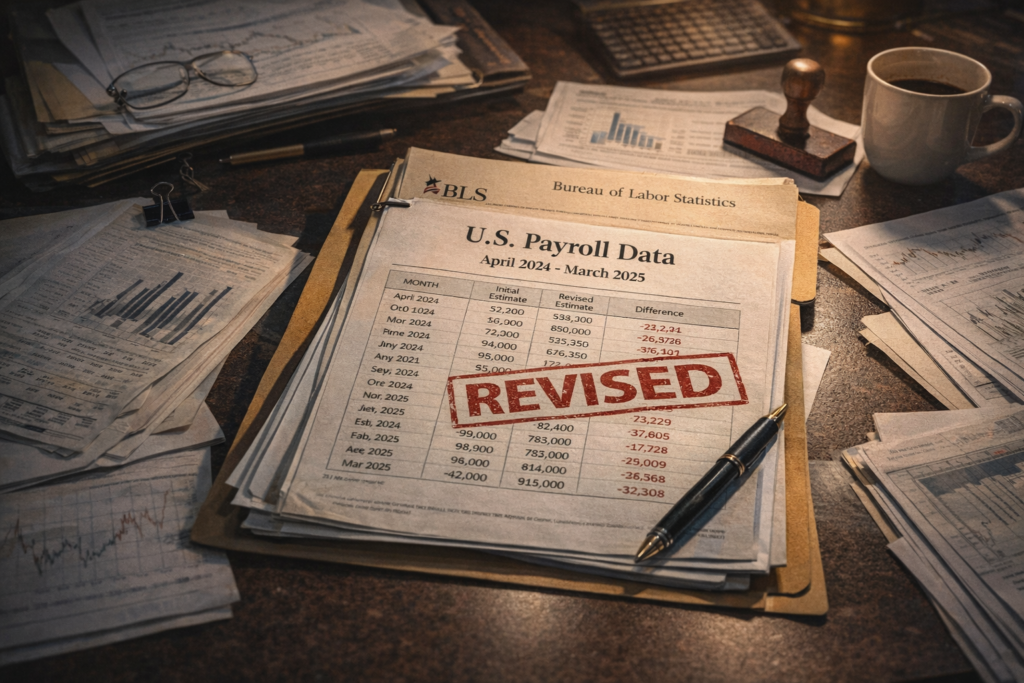
The Bureau of Labor Statistics will release January nonfarm payrolls on Wednesday ✅, delayed from Friday by the brief partial government shutdown. But the payroll number is almost a sideshow. The real event is the annual benchmark revision, which will reconcile 12 months of payroll data (April 2024–March 2025) against QCEW establishment survey data. Preliminary estimates flagged a potential 911,000-job downward revision ✅ (BLS preliminary data). Bank of America forecasts January payrolls at just 45,000 📊, well below the median Wall Street consensus of 70,000 📊 (Trading Economics). Unemployment is expected to hold at 4.4% 📊 (Bloomberg consensus). BofA economist Shruti Mishra expects the final benchmark revision to be “smaller than the preliminary 911,000” but still historically large ✅ (BofA Research). The updated Birth-Death model is projected to subtract 20,000-30,000 jobs from monthly payroll counts going forward 📊 (BofA Research).
What the sources say
“This is the Super Bowl of jobs reports.” — Shruti Mishra, Bank of America economist ✅
“The January unemployment rate will matter even more to the markets than payrolls.” — Shruti Mishra ✅
“This does not remotely look like a healthy labor market.” — Fed Governor Christopher Waller ✅
FINBEAR Take: The Statistical Exorcism
The BLS is about to perform an act of statistical cleansing that the market has been pricing in for months — but probably not completely. The Fed already assumed payrolls were overstated by ~60,000 per month. If the benchmark revision lands near 800,000, it confirms what everyone suspected: the 2024-2025 labor market was a mirage inflated by faulty birth-death model assumptions. That’s priced in.
What’s not priced in is the January print itself. A number below 45,000 — or, worse, negative — would force the market to confront the possibility that the labor market isn’t just cooling; it’s stalling. Markets are pricing two Fed cuts in 2026 with the first in June. A weak January number could pull that forward to May. A strong print above 100,000 kills the rate cut thesis for the summer.
The White House is pre-spinning furiously, with NEC Director Kevin Hassett invoking a “productivity boom” to explain why fewer jobs is actually fine. Cui prodest? The administration needs the narrative to be “efficient economy,” not “weak economy,” heading into midterms. The Fed needs data that doesn’t force its hand before a new Chair takes over.
→ FINBEAR Context: In the February 10 RADAR we flagged this week’s payrolls + CPI as “the calm before the data storm,” noting ADP’s dismal 22,000 private jobs (vs 45,000 expected) as a warning shot and advising against adding risk ahead of the macro data cluster. Wednesday’s report is the event we prepared for — the ADP miss now looks like the canary.
For investors
- Tickers: $SPY, $TLT, $DIA
- Opportunity: Bond rally if payrolls disappoint sharply — TLT could catch a bid on rate cut acceleration
- Risk: A strong print above 100K would slam rate-sensitive assets and reverse the recent yield decline
- Avoid: Trading the headline revision number — it’s backward-looking and largely discounted
- Bottom line: Watch the unemployment rate and January payrolls, not the benchmark revision. The u-rate is the real signal.
Impact: 🔴🔴🔴🔴 (4/5) — Event risk that could reset Fed expectations for the rest of 2026
🏛️ 2. House GOP Rebels Sink Tariff Shield — Democrats Set to Force Repeal Votes

What happened
Three House Republicans — Reps. Thomas Massie (R-KY), Kevin Kiley (R-CA), and Don Bacon (R-NE) — voted with all 214 Democrats to defeat Speaker Mike Johnson’s procedural rule 214-217 ✅ (multiple sources, February 10). The rule contained language blocking House votes on tariff disapproval resolutions through July 31 ✅. Johnson had argued Congress should wait for a pending Supreme Court ruling on the legality of Trump’s emergency tariff authority ✅. Democrats are now expected to force a vote as early as Wednesday on a resolution to repeal Trump’s 35% tariffs on Canada ✅ (Bloomberg, CNBC, Axios). The Senate has already passed at least three resolutions rebuking Trump’s tariffs ✅. The DXY dollar index fell to 96.65, down 0.22% ✅ (FXStreet).
What the sources say
“I think that it doesn’t really make sense to put something on the floor that’s not going to pass.” — Rep. Kevin Kiley (R-CA) ✅
“Tariffs have been a ‘net negative’ for the economy and are a significant tax that American consumers, manufacturers, and farmers are paying.” — Rep. Don Bacon (R-NE) ✅
“The President’s trade policies have been a great benefit to the country.” — Speaker Mike Johnson ✅
FINBEAR Take: The Cracks in the Wall
This is no longer a fringe rebellion. It’s the institutional immune response to an executive overreach that has now persisted for over a year. Johnson has burned through this play at least four times — blocking tariff votes to shield Trump — and each time the coalition of dissenters grows. The midterms are nine months away. Cost-of-living anxiety is the top issue. Republican lawmakers in competitive districts cannot keep voting to protect tariffs that are visibly raising consumer prices.
The real question is whether a tariff repeal resolution can survive a presidential veto. It can’t — not with these margins. But the political damage of a bipartisan House rebuke, coming on the heels of multiple Senate rebukes, would be severe. It would signal to markets that tariff policy is becoming legislatively contested, injecting uncertainty into every supply chain calculation.
Cui prodest? Democrats get a free attack ad for every Republican who votes to sustain tariffs. The Supreme Court gets political cover to rule narrowly. And the dollar, already at 96.65 and weakening, gets another reason to drift lower.
For investors
- Tickers: $UUP (dollar bull ETF), $EWC (Canada ETF), $DBA (agriculture)
- Opportunity: Short-dollar plays if tariff policy destabilizes further; Canadian equities on any rollback signal
- Risk: Trump could escalate tariffs as a political counterpunch, creating more volatility
- Avoid: Assuming tariffs will actually be repealed — the veto is still the wall
- Bottom line: The political calculus on tariffs has shifted. Legislative risk is now real, even if repeal isn’t imminent.
Impact: 🔴🔴🔴 (3/5) — Political fracture on trade adds uncertainty but no immediate policy change
🥇 3. Gold Consolidates Above $5,000 — JPMorgan Targets $6,300
What happened
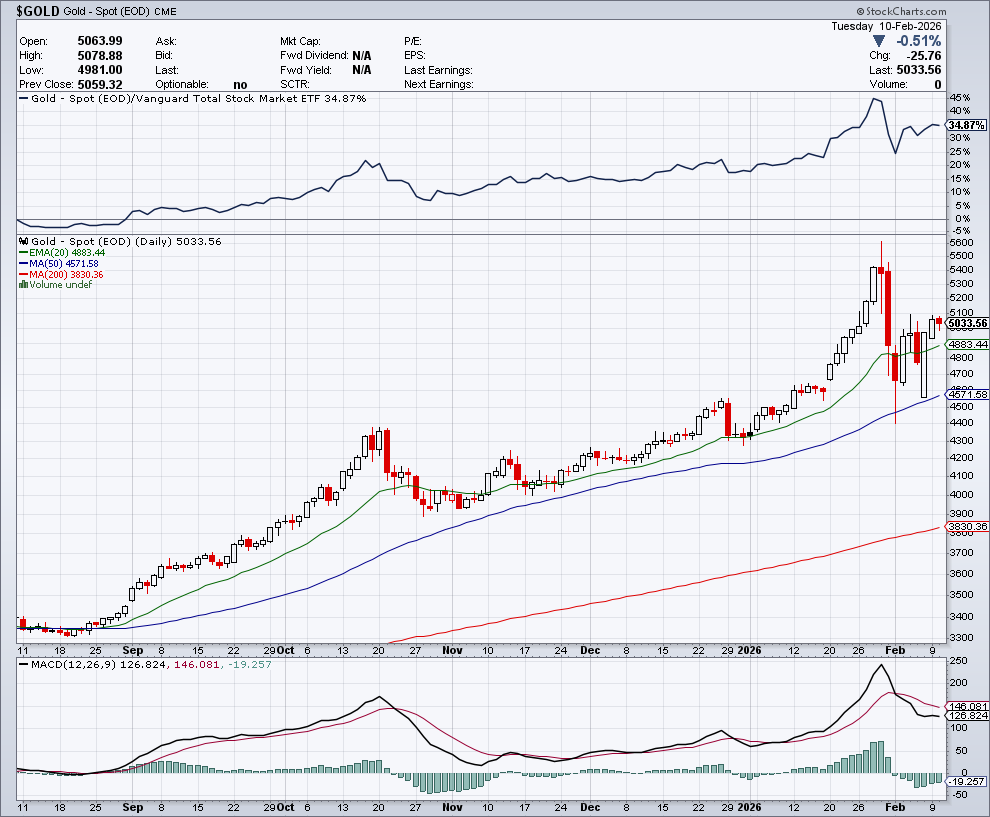
Spot gold traded between $5,024 and $5,038 on February 10 ✅ (FX Leaders), consolidating after a volatile start to the month that saw prices hit $5,594 in late January before crashing to $4,400 on the Kevin Warsh Fed Chair nomination ✅ (FinancialContent). JPMorgan raised its year-end 2026 target to $6,300/oz ✅ (JPMorgan, February 2), citing projected central bank purchases of 800 tons ✅. Deutsche Bank maintained its $6,000 target ✅. Wells Fargo lifted its target to $6,100-$6,300 ✅, up from $4,500-$4,700. Goldman Sachs raised its December 2026 forecast to $5,400 ✅ (Goldman Sachs research). The People’s Bank of China has bought gold for 15 consecutive months, with reserves now valued at ~$369 billion ✅ (multiple sources). UBS targets $6,200 by September 2026 📊.
What the sources say
“Gold is no longer just a commodity; it is acting as a premier debasement hedge against global debt levels.” — J.P. Morgan Global Commodities Strategy ✅
“This extreme volatility was only the third such instance in the past 50 years, dating back to 1975.” — Michael Hsueh, Deutsche Bank ✅
FINBEAR Take: The New Floor
$5,000 gold is no longer a ceiling — it’s a floor. The January crash to $4,400 was stress-tested and rejected within days. Every major bank is now targeting $6,000+ by year-end. Central banks are projected to buy ~800 tonnes in 2026 (JPMorgan), roughly double the pre-2022 annual average of ~400-500 tonnes. The structural case hasn’t changed: $37 trillion in US national debt, Fed independence under pressure, and a global de-dollarization trend that has moved from theory to execution.
The Warsh nomination flash crash was instructive. The market briefly panicked at the prospect of a hawkish Fed chair — but “smart money” treated the dip as a generational entry point. When an asset class has that kind of dip-buying muscle, the trend is unambiguous.
The risk now is not a collapse but a melt-up. If the jobs report disappoints Wednesday and rate cut expectations accelerate, gold could retest $5,100+ within days. Cui prodest? Central banks diversifying out of dollars, miners with expanding margins, and every investor who bought the Warsh dip.
→ FINBEAR Context: In the February 10 RADAR we tracked gold at $5,048 — stable but unremarkable. Twenty-four hours later, the consolidation has tightened to a $5,024-$5,038 range while JPMorgan, Wells Fargo, and Goldman all raised targets. The institutional consensus has accelerated faster than the price. This confirms our structural bull reading.
For investors
- Tickers: $GLD, $GDX, $NEM, $GOLD
- Opportunity: Dips toward $4,900 remain accumulation zones; miners offer leveraged upside
- Risk: Hawkish surprise from the Fed or a strong jobs print could trigger another short-term flush
- Avoid: Chasing at $5,300+ without stops — volatility remains extreme
- Bottom line: The bull case is structural, not speculative. But execution requires discipline on entry.
Impact: 🟢🟢🟢🟢 (4/5) — Historic breakout sustained; institutional consensus is now uniformly bullish
🧠 4. ByteDance Builds AI Chip with Samsung — The Silicon Sovereignty Play

What happened
China’s ByteDance is developing an AI inference chip, codenamed “SeedChip,” and is in manufacturing talks with Samsung Electronics ✅ (Reuters, February 11). ByteDance aims to receive sample chips by end-March and produce at least 100,000 units in 2026, with plans to scale to 350,000 ✅ (Reuters). ByteDance is also negotiating with Samsung for memory chip supply ✅. The company plans to spend over 160 billion yuan (~$22 billion) on AI-related procurement in 2026, with more than half allocated to Nvidia chips and in-house chip development ✅ (Reuters). A ByteDance spokesperson denied the in-house chip project details ✅. ByteDance’s chip design unit employs ~1,000 staff ✅ (SCMP). Chinese rivals Alibaba (Zhenwu chip) and Baidu (Kunlunxin unit) are ahead in AI chip development ✅. The chip is designed for AI inference tasks — the workloads that power recommendation systems, chatbots, and enterprise tools ✅.
What the sources say
ByteDance executive Zhao Qi told employees at a January all-hands that “the company’s AI investment would benefit all divisions” while acknowledging “AI models lagged behind global leaders like OpenAI.” ✅ (Reuters)
FINBEAR Take: The Great Decoupling Accelerates
ByteDance building its own chips is the inevitable consequence of a US export control regime that has made dependency on Nvidia existentially risky for every Chinese tech company. The SeedChip project isn’t about matching Nvidia’s performance — it’s about supply chain insurance. A 100,000-unit inference chip run is meaningful but modest. The real signal is the $22 billion capex commitment, half of which goes to AI chips.
Samsung as manufacturing partner is the interesting twist. TSMC would be the natural choice for advanced nodes, but US pressure on TSMC to limit Chinese client work makes Samsung the pragmatic alternative. Samsung gets desperately needed foundry revenue; ByteDance gets chip sovereignty. It’s a marriage of convenience that accelerates the semiconductor world’s bipolar split.
For Nvidia, this is a slow-motion erosion story. Every custom chip that ships is one fewer GPU sold. But the timeline is long — ByteDance’s chip won’t match H200 performance, and inference is a less demanding use case than training. The immediate loser is the dream of a unified global semiconductor market. That dream is already dead. Cui prodest? Samsung Foundry, Chinese semiconductor talent, and every nation that wants to de-risk from a single chokepoint supplier.
→ FINBEAR Context: In the February 10 RADAR (“RAMmageddon”) we called the memory chip crunch “AI’s invisible tax on everything” and identified Samsung as a primary beneficiary. ByteDance choosing Samsung as its foundry partner — over TSMC — validates that thesis from a new angle: Samsung benefits not just from memory pricing power but from becoming the de facto foundry for Chinese AI chip sovereignty.
For investors
- Tickers: $NVDA, $SSNLF (Samsung ADR), $AVGO, $TSM
- Opportunity: Samsung as the “other” foundry beneficiary of the AI chip race — underappreciated by markets still focused on TSMC
- Risk: US could expand export controls to include Samsung’s Chinese foundry operations
- Avoid: Assuming this kills Nvidia’s China business — H200 demand remains overwhelming
- Bottom line: Silicon sovereignty is the new arms race. Every major Chinese tech company will build chips. It’s a when, not an if.
Impact: ⚪⚪⚪ (3/5) — Strategic signal, limited near-term market impact
🧱 5. SMIC Beats Estimates, Warns on Margins — China’s Foundry Machine Keeps Growing

What happened
SMIC reported Q4 2025 revenue of $2.49 billion, up 4.5% quarter-over-quarter and 12.8% year-over-year, beating analyst estimates ✅ (Reuters/Investing.com). Net profit surged 60.7%, also above expectations ✅. Monthly production capacity reached 1.06 million 8-inch equivalent wafers, up 3.5% QoQ, with Q4 utilization at 95.7% (full-year average: 93.5%) ✅. SMIC plans to add ~40,000 12-inch equivalent wafers in monthly capacity this year, after adding 50,000 in 2025 ✅. Capital spending for 2025 reached $8.1 billion, up 10.5% YoY ✅, and 2026 capex is expected to remain at similar levels ✅ (Co-CEO Zhao Haijun on earnings call). Zhao warned that “high capital spending drove rapid revenue growth but also placed considerable depreciation pressure on gross profit margins” ✅. AI memory demand is squeezing supply to other sectors, particularly mid-to-low-end phones, causing memory shortages ✅ (Zhao Haijun).
What the sources say
“Strong AI memory demand was squeezing supply to other sectors, especially mid-to-low-end phones, causing memory shortages and cost increases for manufacturers.” — Co-CEO Zhao Haijun ✅
FINBEAR Take: The Factory Floor of Fortress China
SMIC at 95.7% Q4 utilization is running hot. The semiconductor supply chain’s migration to Chinese production — analog first, then display drivers, then image sensors, then memory — is accelerating faster than most Western analysts anticipated. SMIC is now the world’s third-largest foundry by revenue, and it’s growing at double-digit rates while constrained to mature nodes by export controls.
The margin warning is the hidden story. SMIC is in the classic capital-intensive trap: spend aggressively to capture domestic demand, but eat the depreciation costs that come with building fabs at wartime speed. $8.1 billion in capex with Q4 utilization at 96% means there’s almost no slack. When SMIC says AI memory demand is squeezing other sectors, that’s a supply chain alarm for every phone maker and consumer electronics company in the world.
Cui prodest? Chinese chip designers now have a domestic manufacturing option running at scale. SMIC shareholders benefit from revenue growth, but margin compression clouds the profit picture.
→ FINBEAR Context: In the February 10 RADAR we documented the memory crunch from the demand side — data centers consuming 70% of global memory, DRAM up 2,000% YoY, consumer electronics hemorrhaging. Today SMIC confirms it from the supply side: 95.7% Q4 utilization, AI demand squeezing phone sector memory. The two stories are the same structural force viewed from opposite ends of the supply chain.
For investors
- Tickers: $0981.HK (SMIC), $MU, $ASML, $LRCX
- Opportunity: Equipment vendors (ASML, Lam Research) benefit from SMIC’s sustained $8B+ capex
- Risk: Export control escalation could impair SMIC’s ability to maintain or expand advanced nodes
- Avoid: Assuming SMIC margins will expand near-term — depreciation pressure is structural
- Bottom line: SMIC is growing revenue at the cost of margins. The bet is that domestic demand justifies the investment.
Impact: 🟢🟢🟢 (3/5) — Strong earnings confirm China’s foundry momentum, margin headwinds remain
📊 6. Ford’s Worst Earnings Miss in Four Years — Tariffs and Fire Conspire

What happened
Ford reported Q4 2025 adjusted EPS of $0.13, missing analyst expectations of $0.19 by 32% ✅ (CNBC, LSEG). Revenue came in at $45.9 billion, beating the $44.2 billion consensus estimate ✅ (Investing.com). Automotive revenue (ex-Ford Credit) was $42.4 billion, above the $41.8 billion estimate ✅ (CNBC/LSEG). Full-year revenue hit a record $187.3 billion ✅, but full-year adjusted EBIT fell to $6.8 billion from $10.2 billion in 2024 ✅. The company posted a Q4 net loss of $11.1 billion and a full-year net loss of $8.2 billion due to $19.5 billion in EV restructuring charges ✅. Unexpected tariff costs of ~$900 million hit when auto parts credits took effect later than expected ✅. The Novelis aluminum supplier fire caused $2 billion in 2025 impact ✅. Model e EV unit lost $4.8 billion for the year ✅. Ford guided 2026 adjusted EBIT of $8-$10 billion ✅, with adjusted free cash flow of $5-$6 billion ✅. The company targets an 8% adjusted EBIT margin by 2029 📊 (Ford guidance). Ford shares rose 0.52% in after-hours trading ✅.
What the sources say
“We made critical strategic decisions that set us up for a stronger future.” — CEO Jim Farley ✅
“A disciplined approach to capital efficiency will drive stronger results in 2026 and beyond.” — CFO Sherry House ✅
FINBEAR Take: The Tariff Tax on Detroit
Ford’s miss tells you everything about how tariffs function in the real economy. The $900 million surprise wasn’t from new tariffs — it was from the White House communicating, in December, that existing tariff credits would take effect later than Ford had budgeted. One administrative decision, communicated with weeks’ notice, swung a full year’s earnings from “in-line” to “worst miss in four years.” That’s the tariff regime working as designed: maximum executive leverage, minimum business predictability.
The EV unit losing $4.8 billion is now chronic. Ford’s path to its target 8% EBIT margin extends to 2029 — three more years of burning cash on electrification while Toyota and Hyundai eat its lunch in hybrids. The constructive read is the 2026 guide: $8-$10 billion EBIT would represent a genuine improvement, driven by Ford Pro fleet strength and the Novelis normalization. But it requires tariff neutrality that the political environment may not deliver.
Cui prodest? GM, which reported on time and set more realistic expectations. Toyota, which skipped the EV money pit. And Ford’s own Ford Pro division, which is quietly becoming the real business.
→ FINBEAR Context: In the February 10 RADAR we flagged Ford reporting after-close Tuesday, warning to “avoid adding risk ahead of Wednesday-Friday macro data cluster.” The earnings miss confirms that caution was warranted — and the $900M tariff surprise connects directly to the broader tariff rebellion story unfolding in the House.
For investors
- Tickers: $F, $GM, $TM
- Opportunity: Ford Pro’s $6.5-$7.5B EBIT guidance makes the stock a fleet-business play, not an auto stock
- Risk: Tariff volatility means any quarter could see another $900M surprise
- Avoid: Treating the $8-$10B guide as a certainty — too many external variables
- Bottom line: Ford is a tariff hostage. Buy it if you believe the 2026 guide; don’t if you think tariff risk escalates.
Impact: 🔴🔴🔴 (3/5) — Largest EPS miss in four years, though 2026 guidance provides an offset
⚖️ 7. Bithumb’s $40 Billion “Ghost Bitcoin” Error — South Korea Tightens the Screws

What happened
South Korean exchange Bithumb accidentally credited ~620,000 bitcoins to 249 customer accounts — approximately 2,490 BTC each — during a routine promotional payout on February 6 ✅ (PYMNTS, Reuters, Korea Herald, Bloomberg). Bithumb restricted 695 accounts in total (CNBC/Reuters). The intended reward was 2,000 Korean won (~$1.40) per user; instead, 2,000 BTC were sent to each account ✅. The error created ~$40 billion in “ghost” bitcoin — coins that existed on Bithumb’s internal ledger but were never backed by actual reserves ✅. Bithumb’s actual BTC reserves are estimated at ~43,000 coins, with only 175 BTC owned by the exchange itself ✅ (Korea Herald). The exchange recovered 99.7% of the misallocated BTC, with ~125 coins still unretrieved ✅. Bithumb pledged full compensation for affected users plus 10% bonus and established a 100 billion won (~$68 million) protection fund ✅. The Financial Supervisory Service (FSS) expanded its audit, with FSS Governor Lee Chanjin warning of the need for legislative control over digital assets ✅ (Reuters/PYMNTS).
What the sources say
“There are many areas we are seriously looking into, and we are particularly worried about the issue of electronic systems.” — Lee Chanjin, FSS Governor ✅
“We would like to make it clear that this incident is unrelated to external hacking or security breaches.” — Bithumb statement ✅
FINBEAR Take: The Fat Finger That Moved $40 Billion
Let that number sink in. A single data entry error — 2,000 won confused with 2,000 BTC — created $40 billion in phantom assets on a centralized exchange. Not a hack. Not a rug pull. A typo. And for a few frenzied minutes, 249 people saw life-changing wealth in their accounts that never existed.
This is the structural fragility of centralized crypto exchanges laid bare. Bithumb’s internal ledger system — which updates balances without moving actual coins on-chain until withdrawal — is how every centralized exchange works. The only difference between Bithumb and every other exchange is that Bithumb’s error was big enough to notice. How many smaller errors go undetected?
South Korea’s regulatory response will be watched across Asia. The FSS is pivoting from monitoring to direct intervention, potentially requiring real-time AI monitoring of exchange systems and limits on individual ownership stakes (15-20% caps under discussion). This is the regulatory template that could spread to Japan, Singapore, and eventually the US.
Cui prodest? Regulators who want to bring exchanges under bank-like supervision. Coinbase and other publicly listed exchanges that already face US regulatory scrutiny — compliance becomes a competitive moat.
→ FINBEAR Context: In the February 10 RADAR we covered Bitcoin’s stabilization near $70K, with Bernstein calling the 45% drawdown “a mere crisis of confidence.” We noted the structural fragility: ETFs as net sellers, the basis trade collapse, the 365-day MA broken for the first time since March 2022. Bithumb’s $40B operational error adds a new dimension to that fragility — it’s not just market structure risk, it’s operational plumbing risk at the exchange level.
For investors
- Tickers: $COIN, $BTC-USD
- Opportunity: Compliance-first exchanges like Coinbase gain relative advantage as regulation tightens
- Risk: Broader crypto confidence hit, especially for centralized exchanges, at a time when the Crypto Fear & Greed Index is already at Extreme Fear (14)
- Avoid: Assuming this is a one-off — operational risk is the new systemic risk in crypto
- Bottom line: The biggest risk in crypto is no longer hackers. It’s human error at industrial scale.
Impact: 🔴🔴🔴 (3/5) — Regulatory acceleration risk; trust erosion in centralized exchanges
🧠 8. AI Bull Says Legacy Software Selloff Is “Real” — The Repricing Has Begun
What happened
EMJ Capital founder Eric Jackson said he is “very bullish” on AI but that the selloff in legacy software stocks is “real” and the space is seeing a “repricing” ✅ (Yahoo Finance, February 10). The iShares Expanded Tech-Software ETF ($IGV) has entered a technical bear market, falling more than 20% from recent peaks ✅ (Barchart). Deutsche Bank strategist Jim Reid noted “growing concern about [AI’s] disruption to existing business models” ✅. Microsoft shares fell ~10% after its latest earnings despite beating estimates, as Azure cloud growth decelerated from 40% to 39% ✅ (multiple sources). Approximately 70% of software providers now report that delivering AI features is eroding profitability ✅ (Yahoo Finance/Barchart analysis). $CRM (Salesforce) has fallen 42% in the past year ✅. Companies are being forced to pivot from subscriptions to usage-based pricing to absorb rising GPU costs ✅.
What the sources say
“The sell-off in legacy software stocks is real. This space is seeing a repricing.” — Eric Jackson, EMJ Capital ✅
“Software is contending with a steadily more bearish narrative, amplified by each new AI release.” — Kirk Materne, Evercore ✅
FINBEAR Take: Creative Destruction, Silicon Valley Edition
The market is performing a vivisection on the software sector. Every Anthropic tool release, every agentic AI demo, every Claude artifact that replaces a SaaS workflow — it all reads as a death sentence for the bloated incumbents. Salesforce down 42% in a year. The $IGV ETF in a death cross. And the numbers tell the structural story: 70% of software companies say AI features are eating their margins.
This is the AI paradox in real time. The same technology that sends Nvidia to the stratosphere is cratering the stocks of companies that built the last generation of enterprise software. The market is correctly identifying that many SaaS businesses were never about technology — they were about lock-in, inertia, and annual price increases. AI destroys all three.
But Evercore’s Kirk Materne makes the essential counterpoint: software sectors historically outperform the S&P once they find a bottom. The question is where that bottom is. At 20% below peaks, we may not be there yet.
Cui prodest? AI model builders (Anthropic, OpenAI, Google), hyperscalers selling AI infrastructure, and any software company nimble enough to reinvent its business model before the repricing is complete.
For investors
- Tickers: $IGV, $CRM, $MSFT, $ADBE, $GOOGL
- Opportunity: Selective bottom-fishing in software names that successfully integrate AI (watch for revenue acceleration signals)
- Risk: The repricing could extend further — death cross patterns typically play out over quarters, not days
- Avoid: Catching falling knives in legacy SaaS without a thesis for AI transformation
- Bottom line: The AI bull case and the software bear case are the same thesis. Know which side you’re on.
Impact: 🔴🔴🔴🔴 (4/5) — Structural repricing of a major tech subsector with broad index implications
📊 Aggregate Sentiment Table
| Cluster | Story | Sentiment | Score |
|---|---|---|---|
| 🧾 Corporate / Labor | Jobs Report “Super Bowl” | Bearish | -8 |
| 🏛️ Geopolitics / Institutions | House GOP Tariff Rebellion | Bearish | -6 |
| 🥇 Precious Metals | Gold Above $5,000 | Bullish | +8 |
| 🧠 AI & Tech | ByteDance AI Chip | Neutral/Strategic | +2 |
| 🧱 AI Infrastructure | SMIC Beats, Margin Warning | Mixed | +3 |
| 📊 Earnings / Results | Ford Worst Miss in 4 Years | Bearish | -5 |
| ⚖️ Regulation / Policy | Bithumb $40B Error | Bearish | -6 |
| 🧠 AI & Tech | Legacy Software Repricing | Bearish | -7 |
| Net Score | -19 |
🔗 Cross-Cutting Synthesis
Three threads bind today’s stories into a single tapestry — and none of them are comforting.
Thread One: The data reckoning. The jobs report on Wednesday is the culmination of months of whispered doubts about labor market health. The White House downplaying expectations, the Fed governor calling the market “not remotely healthy,” and the potential erasure of 800,000 jobs from official records — it all points to an economy that was weaker in 2024-2025 than the data said. Ford’s earnings miss confirms the microeconomic version of the same story: when tariff credits slip by a quarter, when a supplier plant burns down, the fragility of supposedly robust corporate earnings becomes visible. The Dow at 50,000 and gold at $5,000 are two very different bets on what comes next.
Thread Two: The sovereignty scramble. ByteDance building chips with Samsung, SMIC expanding at 96% Q4 utilization, and the House tariff rebellion are facets of the same geopolitical fracture. Every Chinese tech company is building chips because it has to. Every American lawmaker is questioning tariffs because the economic costs are becoming undeniable. The semiconductor ecosystem, the trade regime, and the political consensus that underpinned both are all under stress simultaneously. The tariff vote isn’t just about Canada — it’s about whether Congress is willing to let the executive branch run trade policy by emergency decree indefinitely.
Thread Three: The AI creative destruction cycle. Legacy software stocks in a bear market while AI infrastructure booms. ByteDance spending $22 billion on AI while acknowledging it lags OpenAI. The market is aggressively sorting winners from losers in the AI value chain, and the losers include some of the most celebrated SaaS businesses of the past decade. Bithumb’s $40 billion fat finger is the crypto version of the same lesson: yesterday’s infrastructure becomes tomorrow’s liability when the technology moves faster than the operators can adapt.
Cui prodest?
- Gold — the ultimate hedge against all three threads simultaneously
- AI model builders — they’re the ones eating legacy software for lunch
- Fed doves — weak labor data accelerates rate cuts
- Compliance-first crypto platforms — regulation is their competitive moat
🚨 Strategic Alerts for February 11
- Jobs Report Wednesday AM: Position for volatility. The combination of January payrolls + benchmark revisions creates an unusually wide range of possible outcomes. Hedge accordingly.
- Tariff Votes This Week: Democrats will force a Canada tariff resolution to the House floor. Every Republican vote becomes a midterm campaign ad. Watch for dollar weakness.
- Software Sector Death Cross: The $IGV ETF’s 50-day MA crossed below the 200-day. Historical precedent: software tends to underperform for 2-3 months after this signal. Reduce exposure or hedge.
- Catalyst: CPI data later this week (exact date TBD post-shutdown delay) will compound jobs data for a one-two punch on Fed expectations.
📜 Disclaimer & Fantiborsa Maxim™
🛡️ FINBEAR™ Disclaimer:
This document is not financial advice, nor an investment recommendation.
It is an independent analysis for educational and informational purposes only.
When the Dow hits 50,000 and the labor market is quietly erasing 800,000 jobs, someone should probably check if the scoreboard is plugged in.
🎭 Fantiborsa Maxim™ of the day:
“In a market where the index makes records and the data makes revisions, the only honest number is the one you haven’t published yet.”
📡 RADAR DAILY™ FINBEAR — February 11, 2026
© FINBEAR™ | Fantiborsa™ | Powered by Pythia™