RADAR DAILY™ FINBEAR — April 15, 2026

📑 Table of Contents
- ⚡ The Market in 30 Seconds
- 📌 Key Indicators Dashboard
- 🎯 Executive Summary
- 📊 News in Detail
- 🏛️◆ 1. Iran-USA: Talks Resume, but Hormuz Is Shut and the IMF Warns of Global Recession
- 🧠◆ 2. ASML Raises 2026 Guidance: AI Drives Record Revenue and Orders
- 🧠◆ 3. Amazon Buys Globalstar for $11.6 Billion — Satellite War with Musk
- 🧠◆ 4. Anthropic at $800 Billion Valuation — Private AI Surpasses the Banks
- 🏢◆ 5. Uber Bets $10 Billion on Robotaxi with Rivian, Lucid, and Nuro
- 🧱◆ 6. Meta Extends Custom Chip Deal with Broadcom Through 2029 — 1 GW of AI
- 🏦◆ 7. Yellen: a Fed Cut Possible This Year Despite the Oil Shock
- ⚖️◆ 8. US Launches Tariff Refund System on April 20 — $166 Billion at Stake
- 🧠◆ 9. OpenAI Launches Cyber Model Against Anthropic’s Mythos
- 🏢◆ 10. US Restaurants at Risk of Closure: Inflation Devours Main Street
- 📊 Aggregated Sentiment Table
- 🎭 Fear and Loathing on Wall Street™
- 🔗 Cross-Cutting Synthesis
- 🚨 Strategic Alerts
- 📜 Disclaimer & Maxim
⚡
The Market in 30 Seconds
2026 04 15
- Geopolitics & energy→The Iran-USA ceasefire expires April 21 and negotiations have restarted, but the Hormuz naval blockade is 100% operational. The IMF warns the war could push the world into recession. Oil swings between diplomatic hope and physical reality.
- AI & semiconductors→A monster day: ASML raises 2026 guidance to €36–40 billion on AI demand, Meta-Broadcom sign a custom chip deal for 1 GW through 2029, Anthropic draws offers at an $800 billion valuation, OpenAI launches a cyber model against Mythos. AI capex isn’t slowing — it’s accelerating.
- Corporate & mobility→Amazon acquires Globalstar for $11.6 billion and challenges Starlink in space, Uber takes its robotaxi commitment to $10 billion with a multi-partner ecosystem (Rivian, Lucid, Nuro, VW).
- Macro & policy→Yellen sees a Fed cut as possible this year; the IEEPA tariff refund system worth $166 billion launches April 20. US restaurants are closing at a 15% annual rate — inflation is devouring Main Street before it even shows up in the FOMC minutes.
🔴 High priorityTen stories, three tectonic fault lines — war, AI, and the cost of living. The market is pricing the hope of peace while Hormuz remains sealed. If that sounds coherent to you, you’ve already got your problem.
The Fantiborsa takeNo, today you really should find those five minutes 😉
No, today you’d better find those 5 minutes😉
📌 Key Indicators Dashboard
| Indicator | Value | Change | Signal |
|---|---|---|---|
| S&P 500 | 6,967.38 | +1.18% | 🟢 |
| Nasdaq | 23,639.08 | +1.96% | 🟢 |
| Dow Jones | 48,535.99 | +0.66% | 🟢 |
| VIX | 18.36 | -3.97% | 🟢 |
| US 2Y | 3.77% | — | ⚪ |
| US 10Y | 4.256% | -0.95% | 🟢 |
| Spread 2s10s | +50 bps | — | 🟢 |
| DXY | 98.13 | -0.24% | 🔴 |
| Gold (spot) | $4,834.40 | -0.32% | ⚪ |
| Silver (spot) | $79.38 | -0.20% | ⚪ |
| WTI | $90.87 | -0.45% | ⚪ |
| Brent | $94.87 | +0.08% | ⚪ |
| EUR/USD | 1.1786 | -0.04% | ⚪ |
| BTC | $73,672 | -1.23% | 🔴 |
| ETH | $2,312 | -2.79% | 🔴 |
| Crypto Fear & Greed | 12 | — | 🔴 |
Data: close 2026-04-15. Source: Yahoo Finance / StockCharts DATAPACK.
🎯 Executive Summary
Today’s RADAR moves along three axes: the Iran-USA war as the permanent substrate (Hormuz shut, negotiations reopened, the IMF invoking recession), an unprecedented acceleration across the AI ecosystem (ASML, Meta-Broadcom, Anthropic at $800B, OpenAI cyber, Uber robotaxi), and mounting stress signals on Main Street (restaurants closing, tariffs being refunded). The connective thread is dissociation: equities celebrate a fourth consecutive up day (+1.18% SPX) while the dollar drops for a seventh straight session, the Crypto Fear & Greed Index sits at 12 (Extreme Fear for 46+ consecutive days), and the most significant naval blockade since 1980 is operational. The market is pricing peace — but peace doesn’t exist yet.
📊 News in Detail
🏛️◆1. Iran-USA: Talks Resume, but Hormuz Is Shut and the IMF Warns of Global Recession
What happened
✅ The US naval blockade of the Strait of Hormuz has been operational since April 13; on the second day of operations, April 14, CENTCOM confirmed the closure of Iranian maritime commerce. ✅ Despite the collapse of the Islamabad talks over the weekend, President Trump declared on April 14 that US-Iran negotiations could resume in Pakistan “within the next two days.” ✅ Vice President Vance, the lead US negotiator, said he felt “positive about where things stood” and did not think it necessary to extend the two-week ceasefire expiring April 21. ✅ Separately, IMF economists issued a warning: the Iran-USA war could push the world into recession (CNN Business, April 15).
The sticking points remain: uranium enrichment (Iran insists it is a civilian program), Israeli strikes in Lebanon (which Iran considers covered by the ceasefire, while the US and Israel exclude them), and the reopening of Hormuz.
→ FINBEAR Thesis Status: In the March 31 RADAR the thesis was “permanent war regime rewriting global value chains” with invalidation on an operational ceasefire and Brent below $90 by April 15. Status: Brent is at $94.87 — trigger not activated → thesis confirmed and still operative. In the April 7 RADAR the thesis evolved to “dissociation at breaking point,” and in the April 13 Week Ahead the blockade thesis was upgraded: it is no longer Iran disrupting traffic — it is the United States Navy enforcing the closure. Today’s developments (negotiations reopened but Hormuz still sealed) maintain the thesis in its hardened form.
What the sources say
“I felt positive about where things stood. I don’t think it would be necessary to extend a two-week ceasefire that ends on April 21.” — Vice President JD Vance (CNBC, April 14)
“The two sides had reached an understanding on a number of issues, but ultimately the talks did not lead to an agreement.” — Iran Foreign Ministry statement (Reuters, April 12)
FINBEAR Take: The Most Important Naval Blockade Since 1980, and the Market Is Looking at the Finger
The market has chosen to price hope: flat futures, SPX on its fourth consecutive up day, VIX at 18.36. But the physical reality tells a different story. Hormuz is closed — not “at risk,” not “under pressure” — closed. Twenty percent of the world’s oil is not transiting. WTI hovers at $91 not because the market is pricing the blockade, but because it is pricing the reopening before it has even been negotiated.
It is the same dynamic as the April 8 ceasefire: the market celebrated peace, then the ceasefire collapsed within 12 hours. Today the script is identical — except this time a live naval blockade is the added variable. The IMF warning of recession is not alarmism: it is an institution preparing the ground to revise its World Economic Outlook estimates if the conflict extends past April.
Cui prodest? Non-OPEC producers (the US, Brazil, Guyana) collecting the war premium without logistical risk. Russia, cashing in the Brent rally in absolute terms — Urals discount included. And macro funds sitting long oil volatility — diplomatic hope compresses the premium, but the risk infrastructure is intact.
For investors
Instruments involved:
- Stocks: $USO, $XLE, $CVX, $XOM, $GLD, $TLT
Opportunities:
WTI-Brent spread as a proxy for Hormuz logistical risk; gold as a hedge if negotiations fail on April 21
Risks:
The ceasefire expires April 21 — a binary event. If not renewed, an oil gap up is probable
What to avoid:
Directional bets on oil without a hedge — intraday volatility is extreme with headline risk every hour
Bottom line:
The market prices peace; reality prices war. The April 21 deadline is the week’s binary catalyst.
Impact: 🔴🔴🔴🔴 (4/5) — Hormuz naval blockade operational, ceasefire deadline April 21, IMF invokes recession
🧠◆2. ASML Raises 2026 Guidance: AI Drives Record Revenue and Orders
What happened
✅ ASML reported Q1 2026 results on April 15: net income ✅ €2.76 billion (consensus €2.54B), net revenue ✅ €8.77 billion (consensus €8.5B). ✅ The company raised its 2026 revenue guidance to €36–40 billion, from the prior €34–39 billion. 📊 Q2 guidance: €8.4–9.0 billion. ✅ China system sales fell to 19% of Q1 revenue (from 36% in Q4 2025), reflecting the impact of export controls. ✅ Management stated that EUV machine revenue “will rise significantly” in 2026 versus 2025.
→ FINBEAR Context: In the March 24 RADAR we covered SK Hynix’s $8 billion ASML order — the largest disclosed order in ASML’s history — as structural validation of the AI capex cycle. Today’s beat-and-raise confirms the thesis from the supply side: the monopoly pickaxe seller is raising prices, and the gold rush buyers are paying.
What the sources say
“We see strong demand from our customers driven by the continued expansion of AI-related applications.” — ASML CEO (CNBC, April 15)
“The guidance range was sized to accommodate potential outcomes of ongoing discussions around export controls.” — ASML management (Investing.com, April 15)
FINBEAR Take: The Pickaxe Factory Raises Its Price — and the Gold Miners Pay
ASML is the monopolist pickaxe seller of the AI gold rush. It doesn’t sell dreams — it sells the only machines on earth capable of printing sub-5nm chips. When ASML raises guidance, it’s not an opinion: it’s a signed purchase order from TSMC, Samsung, and Intel. The message is clear: AI capex is not decelerating — it is accelerating.
The most telling data point is China’s slide to 19%. This isn’t just export controls — it’s a structural rebalancing. AI demand from Western clients is so robust that ASML doesn’t need China to fill the pipeline. The safety margin in the guidance range (€36–40B = a €4B spread) is sized to absorb the most severe restriction scenarios — and it still raises the floor.
Cui prodest? ASML shareholders and its direct clients (TSMC, Samsung, Intel) who confirm the capex cycle. And the entire AI “picks and shovels” ecosystem — from $LRCX to $KLAC to $AMAT.
For investors
Instruments involved:
- Stocks: $ASML, $TSM, $INTC, $LRCX, $KLAC, $AMAT, $NVDA, $SMH
Opportunities:
Semicap equipment as an AI cycle proxy — ASML confirms that capex is not slowing
Risks:
China export controls could tighten further; the wide guidance range (€4B) signals uncertainty
What to avoid:
Buying ASML on the headline without checking the multiple — the stock is already at all-time highs
Bottom line:
Beat and raise across the board. AI is not an expectation — it’s a purchase order.
Impact: 🟢🟢🟢🟢 (4/5) — Q1 beat + guidance raise, confirms the global AI capex cycle
🧠◆3. Amazon Buys Globalstar for $11.6 Billion — Satellite War with Musk
What happened
✅ Amazon announced on April 14 the acquisition of Globalstar at ✅ $90 per share in cash or stock, valuing the deal at ✅ $11.57 billion. The acquisition strengthens Project Kuiper, Amazon’s LEO satellite network, by integrating Globalstar’s operational infrastructure: ✅ 24 global ground stations and licensed spectrum in over 120 countries. ✅ Amazon and Apple signed a separate agreement under which Project Kuiper will continue to provide satellite features on iPhone and Apple Watch (Emergency SOS, Messages, Find My). 📊 The deal is expected to close in early 2027, subject to FCC approval.
→ FINBEAR Context: In the April 2 RADAR we covered SpaceX’s IPO filing at $1.75 trillion. Amazon’s Globalstar acquisition is the strategic counter-move: while Musk monetizes the satellite ecosystem through public markets, Bezos buys the ground infrastructure to compete on a different plane.
What the sources say
“This acquisition allows us to compress years of internal development into a single transaction while gaining licensed spectrum across more than 120 countries.” — Amazon (aboutamazon.com, April 14)
“Amazon to buy satellite operator Globalstar for $90 a share.” — Bloomberg, April 14
FINBEAR Take: Bezos Doesn’t Want Space — He Wants the Pipe
The surface-level read is “Amazon challenges Starlink.” The FINBEAR read is different: Amazon isn’t buying satellites — it’s buying ground infrastructure and spectrum. Globalstar’s 24 global gateways and licenses in 120 countries are the real prize. Project Kuiper had the sky but not the ground; now it has both.
The masterstroke is the Apple deal: Amazon supplies satellite connectivity to iPhone and Apple Watch, creating an Amazon-Apple-Globalstar triangle that excludes SpaceX from the consumer value chain. Musk has 10,000 satellites in orbit; Amazon just bought the right to talk to them from the ground in 120 countries. Classic Bezos: don’t compete on the product — control the infrastructure.
Cui prodest? Amazon, which buys the “last mile” of space. Apple, which diversifies its satellite supply chain away from SpaceX. And $GSAT shareholders, who collect $90 per share after years of sideways trading.
For investors
Instruments involved:
- Stocks: $AMZN, $GSAT, $AAPL, $RKLB
Opportunities:
The LEO satellite sector is consolidating — look for the next targets (operators with spectrum and ground stations)
Risks:
FCC approval is not guaranteed; integrating Globalstar into Project Kuiper is complex; SpaceX has a scale advantage
What to avoid:
Buying $GSAT above $90 hoping for a bidding war — the deal is at $90 cash/stock, there is no auction
Bottom line:
The satellite war is fought on the ground, not in orbit. Amazon just bought the trench.
Impact: 🟢🟢🟢 (3/5) — $11.6B M&A in the LEO satellite sector, accelerates competition with SpaceX
🧠◆4. Anthropic at $800 Billion Valuation — Private AI Surpasses the Banks
What happened
🔸 Anthropic has received multiple offers from VC investors for a new round at valuations up to $800 billion, according to Business Insider and Bloomberg (April 14). 🔸 The offers would more than double the $350 billion pre-money valuation from the $30 billion round closed in February 2026. ✅ Anthropic disclosed that annualized revenue has surpassed $30 billion. ✅ On the Caplight secondary market, the valuation has climbed to $688 billion (+75% in three months). 📊 An IPO is expected in October 2026.
→ FINBEAR Context: In the February 25 RADAR we covered the Pentagon/Anthropic standoff over Claude’s deployment on classified networks — the DPA threat that tested whether sovereign power can force an AI company to remove safety guardrails. In the March 5 RADAR, Anthropic’s ARR was ~$19B. Six weeks later, it has crossed $30B. The Pentagon dispute didn’t dent the growth trajectory — if anything, it underscored that Claude is a monopoly asset on classified infrastructure.
What the sources say
“Anthropic has received multiple offers to invest in the AI startup at valuations as high as $800 billion in recent weeks, which would more than double its current valuation.” — Business Insider (via Bloomberg, April 14)
“The company’s valuation has climbed to $688 billion on Caplight, marking a 75% surge over the past three months.” — Benzinga, April 14
FINBEAR Take: When a Private Company Is Worth More Than JPMorgan, the Market Is Saying Something
$800 billion. For a private company. That a year ago was valued at $18 billion. The trajectory is vertical — and the market is pricing it before the IPO. For context: JPMorgan’s market cap is roughly $650 billion. Anthropic — without a single day of public trading — would be worth more.
The number that matters is the revenue run rate: $30 billion annualized. This is not a projection — it is the current pace. Claude is generating revenue at a speed that makes the October IPO almost a cash operation rather than a capital raise. The real question isn’t “what is Anthropic worth?” but “what is the entire AI sector worth if the number-two player commands $800B and the number-one (OpenAI) is still behind on revenue?”
Cui prodest? The VCs already inside (Menlo Ventures, Spark Capital, Google) watching their investments multiply. And the entire AI sector, because an $800B Anthropic valuation recalibrates every comparable upward — from OpenAI to Mistral to Cohere.
For investors
Instruments involved:
- Stocks: $GOOGL, $AMZN, $MSFT
Opportunities:
Pre-IPO allocation on Anthropic (Caplight secondary market); halo effect on partner cloud providers
Risks:
The $800B valuation implies extreme multiples; the October IPO is 📊 an estimate, not confirmed
What to avoid:
Treating $800B as “fact” — these are 🔸 VC offers, not a closed round. The distinction is material
Bottom line:
Private AI is worth more than the banks. When a market prices like this, it’s either right — or building the biggest bubble in history.
Impact: 🟢🟢🟢 (3/5) — Valuation milestone for the entire AI sector; IPO expected October 2026
🏢◆5. Uber Bets $10 Billion on Robotaxi with Rivian, Lucid, and Nuro
What happened
✅ Uber has raised its minimum Lucid vehicle order to 35,000 for its global robotaxi service, with an additional ✅ $200 million investment in Lucid (total stake: $500 million). ✅ Testing of Lucid Gravity robotaxis running Nuro’s technology stack is underway in San Francisco, with the public launch 📊 expected by end of 2026. ✅ Previously, Uber announced an investment of up to $1.25 billion in Rivian for 10,000 robotaxis based on the R2 SUV (March 2026). ✅ Uber and VW/MOIA will launch a robotaxi service using electric ID.Buzz vans in Los Angeles by the end of 2026. ✅ Uber has also allocated $100 million for robotaxi charging hubs.
Total robotaxi commitments exceed $10 billion when all partners and infrastructure are included.
What the sources say
“Uber keeps upping the ante on its autonomous vehicle strategy, with a growing list of AV partnerships and increasingly big financial commitments.” — TechCrunch, April 14
“We’re shifting to a partnership-based model that allows us to scale faster by leveraging external expertise while reducing development risk.” — Uber (247 Wall St., April 14)
FINBEAR Take: The Scalpel, Not the Hammer
Uber learned the lesson of ATG (the self-driving unit sold in 2020 after burning billions). The strategy is now surgical: don’t build the technology — orchestrate the builders. Rivian for the R2, Lucid for the Gravity, Nuro for the software stack, VW for Europe. Four partners, four technologies, one dispatch platform.
It is the “asset-light factory” model applied to autonomous mobility. Uber owns nothing in the technology chain — it owns the demand. In a market where Waymo has the cars but not the scale, and Tesla has the scale but not the regulatory approval, Uber’s position as aggregator is unique. $10 billion in commitments sounds enormous — but it’s spread across four partners and three years. Risk diluted, upside concentrated.
Cui prodest? Uber, which becomes the default platform for multi-vendor robotaxi. Rivian and Lucid, which secure guaranteed orders and balance-sheet-stabilizing investments. And anyone investing in autonomous mobility as infrastructure rather than as a single-technology bet.
For investors
Instruments involved:
- Stocks: $UBER, $RIVN, $LCID, $GOOGL, $TSLA
Opportunities:
Uber as AV aggregator — less tech risk, more optionality. Rivian and Lucid with guaranteed backlog
Risks:
None of the four partners has commercial robotaxis on the road yet; the “end of 2026” timeline is aggressive
What to avoid:
Buying Lucid solely on the Uber deal — the company burns cash and robotaxi is only one business line
Bottom line:
Uber isn’t building the future — it’s orchestrating it. The right strategy, but the field test is still missing.
Impact: 🟢🟢🟢 (3/5) — $10B+ in multi-partner commitments, accelerates the autonomous mobility timeline
🧱◆6. Meta Extends Custom Chip Deal with Broadcom Through 2029 — 1 GW of AI
What happened
✅ Meta and Broadcom announced on April 14 an extension of their partnership for the design and production of custom AI chips through 2029. ✅ The initial commitment calls for over 1 gigawatt of computing capacity — enough to power approximately 750,000 American homes. ✅ The new MTIA (Meta Training and Inference Accelerator) chips will be the first custom chips for the AI industry manufactured on a 2-nanometer process. ✅ The first chip, MTIA 300, already powers Meta’s ranking and recommendation systems, with three successive models arriving by 2027. ✅ As part of the deal, Broadcom CEO Hock Tan will step down from Meta’s board to take an advisory role on chip strategy.
What the sources say
“The new MTIA chips will be the first custom silicon for the AI industry that uses a 2-nanometer process.” — Broadcom announcement (SiliconAngle, April 14)
“Meta doubles down on partnership with Broadcom, committing to 1 gigawatt of custom AI processors.” — SiliconAngle, April 14
FINBEAR Take: 1 Gigawatt — the Number That Scares Nvidia More Than Any Antitrust Case
One gigawatt. Not megawatts — a full gigawatt. Meta isn’t buying chips — it’s building a computational power plant. And it’s doing it with Broadcom, not Nvidia. That is the number that matters: the world’s largest GPU buyer is constructing its own alternative.
The 2nm process is the cherry on top: it means Meta is co-designing chips at the absolute cutting edge, not settling for fallbacks. Hock Tan stepping off the board to move into an advisory role signals the relationship is shifting from “supplier” to “peer-level strategic partner.” For Nvidia, every gigawatt of MTIA is a gigawatt of H100/B200 not sold. Not an immediate threat — but the direction is unmistakable.
Cui prodest? Meta, which reduces its Nvidia dependency and gets chips optimized for its own workloads. Broadcom, which consolidates as the second pole of AI silicon after Nvidia. And the entire custom silicon movement — from Google TPU to Amazon Trainium.
For investors
Instruments involved:
- Stocks: $META, $AVGO, $NVDA, $GOOGL, $AMZN
Opportunities:
Broadcom as a proxy for the de-Nvidianization trend — the custom silicon shift is structural
Risks:
The deal extends through 2029 but 2nm chips won’t arrive before 2027–28; execution risk is high
What to avoid:
Shorting Nvidia on this headline — the GPU market remains dominant for training; custom chips target inference
Bottom line:
1 GW of custom chips is a declaration of technological independence. Nvidia doesn’t lose today — but its monopoly has an expiration date.
Impact: 🟢🟢🟢 (3/5) — Multi-year partnership for 1 GW, accelerates AI silicon diversification
🏦◆7. Yellen: a Fed Cut Possible This Year Despite the Oil Shock
What happened
✅ Former Treasury Secretary Janet Yellen declared on April 15 at the HSBC Global Investment Summit in Hong Kong that a Fed rate cut is still possible this year, despite the oil shock from the Iran-USA war. ✅ Yellen acknowledged the conflict “puts upward pressure on inflation” and that “short-term inflation expectations have risen slightly,” but added the Fed has “an open mind.” ✅ For context: the Fed held rates at ✅ 3.50%–3.75% at the March 2026 meeting, and a majority of policymakers projected at least one cut in 2026. ✅ The next FOMC meeting is April 28–29.
What the sources say
“If I had to write one thing down on a piece of paper, if I’m going into the next FOMC meeting where the forecasts are produced, I suppose my guess would be that maybe there would be a cut later in the year.” — Janet Yellen, HSBC Global Investment Summit (Reuters, April 15)
“Short-term inflation expectations are up slightly, but they’re going to watch all of that very carefully, and I think they have an open mind.” — Janet Yellen (Bloomberg, April 15)
FINBEAR Take: The Former Central Banker Speaks as Though She’s Still Inside — and the Market Listens
Yellen is no longer at Treasury and no longer at the Fed. But when she speaks, the market listens — because she knows the machine from the inside. Her “maybe there would be a cut” is calibrated to the millimeter: not a forecast, but an indication of the internal conversation. With the FOMC meeting on April 28–29 just two weeks away, the timing is no coincidence.
The paradox is obvious: how do you cut rates with oil at $91 and Hormuz closed? The answer is in the DXY: the dollar falling for a seventh consecutive day, at 98.13, suggests the market is already pricing in easing. If the ceasefire holds, oil drops, expected inflation fades, and the Fed gets room to move. If the ceasefire collapses, oil spikes, and the cut vanishes. Everything depends on Hormuz — including monetary policy.
Cui prodest? Those long duration (bonds, growth, tech) — a Fed cut is pure oxygen. And the “soft landing is still alive” narrative that the market needs to hear to justify current multiples.
For investors
Instruments involved:
- Stocks: $TLT, $IEF, $QQQ, $XLK
Opportunities:
Duration as a hedge — if the cut comes, long bonds fly. A falling DXY favors emerging markets and gold
Risks:
The April 28–29 FOMC could disappoint if oil-driven inflation doesn’t recede; Yellen is no longer a decision-maker
What to avoid:
Pricing the cut as a certainty — the March dot plot projected ONE cut, not two; the market already prices one in
Bottom line:
Yellen is doing the Fed’s advance work: preparing the market. But the cut depends on Hormuz, not Hong Kong.
Impact: 🟢🟢 (2/5) — Forward guidance from ex-Treasury; limited impact but aligned with the April 28 FOMC
⚖️◆8. US Launches Tariff Refund System on April 20 — $166 Billion at Stake
What happened
✅ The Trump administration will launch on April 20 the CAPE system (Consolidated Administration and Processing of Entries) to refund $166 billion in IEEPA tariffs declared illegal by the Supreme Court in February 2026. ✅ CBP (Customs and Border Protection) has completed Phase 1 of the system, limited to unliquidated entries and entries within 80 days of liquidation. ✅ As of April 9, 56,497 importers have completed registration for electronic refunds, for a total of $127 billion. 📊 Refunds will be issued within 60–90 days of CAPE declaration acceptance. ✅ Separately, Fortune reported that cash-starved American companies are using tariff refund credits as collateral for bank loans.
What the sources say
“Valid IEEPA refunds will generally be issued within 60-90 days following acceptance of the CAPE Declaration.” — U.S. Customs and Border Protection (CBP.gov, April 2026)
“American companies are so cash-starved they are using tariff refund claims as collateral for loans.” — Fortune, April 12
FINBEAR Take: $166 Billion in Cash Incoming — the Biggest Fiscal Stimulus Nobody Is Calling a Stimulus
No politician will admit it, but refunding $166 billion in illegal tariffs is effectively a disguised fiscal stimulus. The money flows back to importers — the same companies that spent months passing the cost on to consumers. The uncomfortable question: when the refund arrives, will consumer prices drop? Experience says no.
The Fortune data point is the most eloquent: companies are using CAPE credits as loan collateral. That means US corporate cash flow is so strained that an unliquidated government credit is worth more than their ability to generate cash. This is the state of the real economy behind the equity market’s fourth consecutive rally day.
Cui prodest? Major importers (retail, tech, auto) recovering cash. Banks lending against CAPE credits. And the Trump administration, which transforms a legal defeat (the Supreme Court struck down the tariffs) into a “returning money to the people” narrative.
For investors
Instruments involved:
- Stocks: $WMT, $TGT, $COST, $HD, $AMZN, $XLF
Opportunities:
Large importers with refunds incoming have a Q2–Q3 cash flow tailwind; banks earn fees as intermediaries
Risks:
Phase 1 covers only “simple” entries — complex refunds will arrive later, on unknown timelines
What to avoid:
Expecting tariff refunds to translate into lower consumer prices — it won’t happen
Bottom line:
$166 billion in liquidity coming to corporations, zero to consumers. The profit cycle says thank you.
Impact: 🟢🟢 (2/5) — Significant corporate liquidity injection but diluted over time (60–90 days)
🧠◆9. OpenAI Launches Cyber Model Against Anthropic’s Mythos
What happened
✅ OpenAI released GPT-5.4-Cyber to participants in the Trusted Access for Cyber program, with initial access for hundreds of users and expansion to thousands in the coming weeks (Bloomberg, April 14). ✅ The model specializes in identifying software vulnerabilities and adopts a less restrictive approach to offensive use, focusing on user identity verification rather than model-level limitations. ✅ A week earlier, Anthropic had announced Project Glasswing with the limited release of Mythos Preview, an AI tool that identified “high-severity vulnerabilities in every major OS and browser.” ✅ Mythos is in use at Microsoft, Amazon, Apple, CrowdStrike, Palo Alto Networks, and roughly 40 other companies.
What the sources say
“OpenAI is shifting its approach to cyber risk to focus less on restricting what models can do and more on verifying who gets access to the most sensitive capabilities.” — Axios, April 14
“Mythos Preview was able to find high-severity vulnerabilities, including some in every major operating system and web browser.” — NPR, April 11
FINBEAR Take: AI Cybersecurity Is the New Battlefield — and the Doctrine Has Flipped
The story isn’t the model — it’s the doctrine. OpenAI has abandoned the “restrict what the model can do” approach in favor of “verify who uses it.” This is a paradigm shift: from safety-by-restriction to safety-by-identity. In practice: if you are a certified penetration tester, the model lets you do things it would block for a generic user.
Anthropic played its hand first with Mythos/Glasswing a week earlier, placing the tool in the hands of the 40 most important names in global cybersecurity. OpenAI responded in seven days with GPT-5.4-Cyber. The speed of the response says more than the product: this is an arms race in AI cybersecurity where the first-mover window is measured in days, not months.
Cui prodest? Traditional cybersecurity firms ($CRWD, $PANW) integrating these models into their stacks — they become more powerful. And paradoxically, both competitors: the rivalry accelerates development and legitimizes the market.
For investors
Instruments involved:
- Stocks: $MSFT, $GOOGL, $CRWD, $PANW, $ZS, $FTNT
Opportunities:
AI cybersecurity as an exploding vertical — vendors who integrate first have pricing power
Risks:
Offensive models can be used by malicious actors despite identity verification
What to avoid:
Treating AI cybersecurity as a winner-take-all — the market is enterprise, not consumer
Bottom line:
The AI cybersecurity arms race has begun. OpenAI and Anthropic are arming the good guys — hoping the weapons don’t change hands.
Impact: 🟢🟢 (2/5) — Opens a high-value AI vertical; market impact still in early stages
🏢◆10. US Restaurants at Risk of Closure: Inflation Devours Main Street
What happened
✅ According to Black Box Intelligence, 15% of US restaurant operators are at risk of closure in 2026 — with 9% of full-service and 4% of limited-service restaurants in danger. ✅ Restaurant operating costs are 30% above 2019 levels. ✅ 42% of operators said their business was not profitable in 2025. ✅ 60% of operators said business conditions have deteriorated. ✅ 53% of operators are still servicing pandemic-era debt (data as of November 2024). ✅ On the consumer side: 55% have cut spending on dining out and 57% eat at home more frequently than before the pandemic.
What the sources say
“15% of restaurants could close in 2026.” — Black Box Intelligence (Restaurant Dive, April 2026)
“42% of operators said their businesses weren’t profitable in 2025, while 60% of operators said their business conditions have deteriorated.” — National Restaurant Association (2026 State of the Restaurant Industry)
FINBEAR Take: The Canary in the Coal Mine Is Called the Restaurant Industry
Restaurants are the thermometer of the real economy — far more so than PMI or jobless claims. When 42% of operators say they are not profitable and 60% say things are getting worse, this is not a sector story: this is Main Street America. The cost of eating out has risen 30% since 2019, wages have risen less, and the consumer has stopped going out.
The most alarming number is the pandemic debt: 53% of operators are still servicing 2020–2021 loans. With rates at 3.50–3.75% and oil at $91, the cost of debt service isn’t coming down anytime soon. Inflation has a face: it’s the neighborhood restaurant that closes its doors. And when 15% of a sector employing 15.5 million Americans is at risk, the implications extend well beyond the menu.
Cui prodest? The large, well-capitalized chains (McDonald’s, Chipotle, Starbucks) that survive and collect market share from the small operators closing down. It is capital’s Darwinism: inflation kills the small and fattens the large.
For investors
Instruments involved:
- Stocks: $MCD, $CMG, $SBUX, $DRI, $EAT, $BLMN
Opportunities:
Chains with pricing power and scale survive — consolidation is a tailwind for the leaders
Risks:
If inflation persists with oil at $91+, even the large chains will see margin compression
What to avoid:
Small-cap restaurants without pricing power and carrying pandemic debt — 2026 will be a year of natural selection
Bottom line:
Main Street is hurting. Wall Street doesn’t see it because it’s watching big-cap earnings. But the canary is singing — loud.
Impact: 🔴🔴🔴 (3/5) — Leading indicator of consumer stress; implications for employment and discretionary spending
📊 Aggregated Sentiment Table
| Cluster | Story | Sentiment | Score |
|---|---|---|---|
| 🏛️ Geopolitics | Iran-USA: Hormuz shut, talks resumed, IMF recession warning | Bearish | -20 |
| 🧠 AI & Tech | ASML raises 2026 guidance on AI demand | Bullish | +20 |
| 🧠 AI & Tech | Amazon buys Globalstar $11.6B | Bullish | +12 |
| 🧠 AI & Tech | Anthropic $800B valuation | Bullish | +10 |
| 🧾 Corporate | Uber $10B robotaxi multi-partner | Bullish | +10 |
| 🧱 AI Infra | Meta-Broadcom custom chip deal 1 GW through 2029 | Bullish | +12 |
| 💰 Central Banks | Yellen: a Fed cut possible | Bullish | +5 |
| ⚖️ Regulation | US launches tariff refund $166B | Bullish | +5 |
| 🧠 AI & Tech | OpenAI cyber model vs Mythos | Bullish | +5 |
| 🧾 Corporate | US restaurants: 15% at risk of closure | Bearish | -12 |
| Net Score | +47 |
🎭 Fear and Loathing on Wall Street™
⚪ NEUTRAL — Index: -8
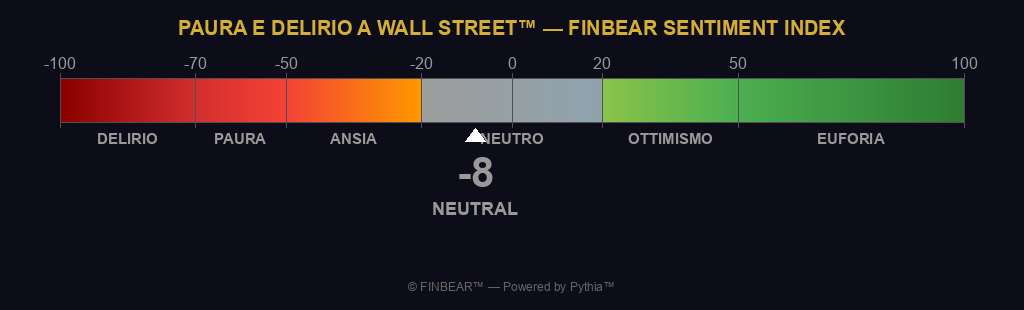
A sharp improvement from the -32 (🟠 ANXIETY) of April 13. The market has returned to neutral territory for the third time since February 18, driven by the reopening of negotiations and a stellar AI day. But the pattern is clear: every time the index has entered NEUTRAL (April 8–9), it lasted 48 hours before falling back. The naval blockade is operational, the ceasefire expires April 21, the Crypto Fear & Greed is at 12 Extreme Fear for 46+ consecutive days. The dissociation between equities and deep sentiment remains the structural data point: the stock market celebrates; everything else signals fear. Fragile NEUTRAL — not comfortable NEUTRAL.
🔗 Cross-Cutting Synthesis
Today’s RADAR tells the story of two markets living on the same calendar but in parallel universes.
On one side, the equity market celebrates: the S&P 500 on its fourth consecutive up day, the VIX settling below 19, ASML raising guidance on record AI demand, Amazon spending $11.6 billion to buy the ground beneath the satellites, Anthropic drawing offers at $800 billion, Meta signing a gigawatt of custom chips with Broadcom, Uber orchestrating $10 billion in robotaxi across four partners. The AI ecosystem is in “total capex” mode — nobody is hitting the brakes, everyone is spending. Yellen blesses the narrative with a “maybe a cut this year” calibrated to the millimeter.
On the other side, physical reality: the Strait of Hormuz is shut by a naval blockade, the ceasefire expires April 21 with no guarantee of renewal, the IMF invokes global recession, the Crypto Fear & Greed Index sits at 12 Extreme Fear for 46+ consecutive days, the dollar drops for a seventh straight session, and 15% of American restaurants are at risk of closure with operating costs up 30% since 2019. The $166 billion in tariff refunds launching April 20 is oxygen for corporations — nothing for consumers.
The connective thread is dissociation: equities price hope (negotiations reopened, AI boom, Fed cut), deep sentiment prices fear (crypto, dollar, restaurants, Hormuz). This tension is not new — it is the same dynamic that defined all of March — but today it reaches an almost textbook level of purity. Ten stories, seven positive for equities and three devastating for the real economy. The market chose the seven. History suggests the three will have the last word.
Cui prodest? Those who can straddle both sides of the dissociation: long equity with hedges on oil and duration. The fatal mistake is choosing one narrative and ignoring the other. The April 21 ceasefire is the test: if it holds, the market is right; if it collapses — as it did on April 8 — the correction will be proportional to the euphoria that preceded it.
📌 Thesis Invalidation — The dominant thesis of this RADAR is: the market is in dissociation between equity (hope) and deep sentiment (fear), with the test set for April 21. It is invalidated if: the ceasefire is extended AND Hormuz reopens to commercial traffic by April 25. By: 10 days. In that case: the FINBEAR reading shifts from “fragile dissociation” to “structural repricing of geopolitical risk” — and the equity rally becomes sustainable.
🚨 Strategic Alerts
🚨 Ceasefire deadline April 21:
monitor any statements from Vance, Zarif, or Pakistan/Qatar mediators. Every headline moves oil 3–5% in minutes.
🚨 FOMC April 28–29:
two weeks out. Yellen has prepared the ground — if inflation data worsens with oil at $91+, the cut vanishes and long bonds correct.
🚨 CAPE/Tariff refund April 20:
the system launch could generate volatility in retail-importer names. Watch $WMT, $TGT, $AMZN.
🚨 ASML post-earnings:
the European market’s reaction to the Q1 beat + guidance raise will set the tone for the semiconductor sector this week.
🚨 Bank earnings season:
after yesterday’s results, monitor forward guidance on recession provisioning and oil exposure.
🚨 Catalyst:
Initial Jobless Claims Thursday, April 16 (consensus 219K) — the first labor data point since the naval blockade began.
📜 Disclaimer & Maxim
The analysis in this RADAR is editorial opinion based on public sources, not financial advice. If, after reading that 15% of American restaurants are closing and the largest naval blockade since 1980 is operational, your first reaction is “buy the futures” — the problem isn’t the analysis, it’s the patient. FINBEAR accepts no liability for decisions made with the amygdala where the prefrontal cortex should have been.
When the VIX drops below 19 while Hormuz is sealed shut, that isn’t calm — it’s the market booking a table on the lower deck of the Titanic. The menu is excellent. The evacuation plan, less so.
© FINBEAR™ — Powered by Pythia™ — All rights reserved — 2026-04-15
‹ Torna all'Osservatorio