RADAR PRO ELITE™ FINBEAR — October 30, 2026
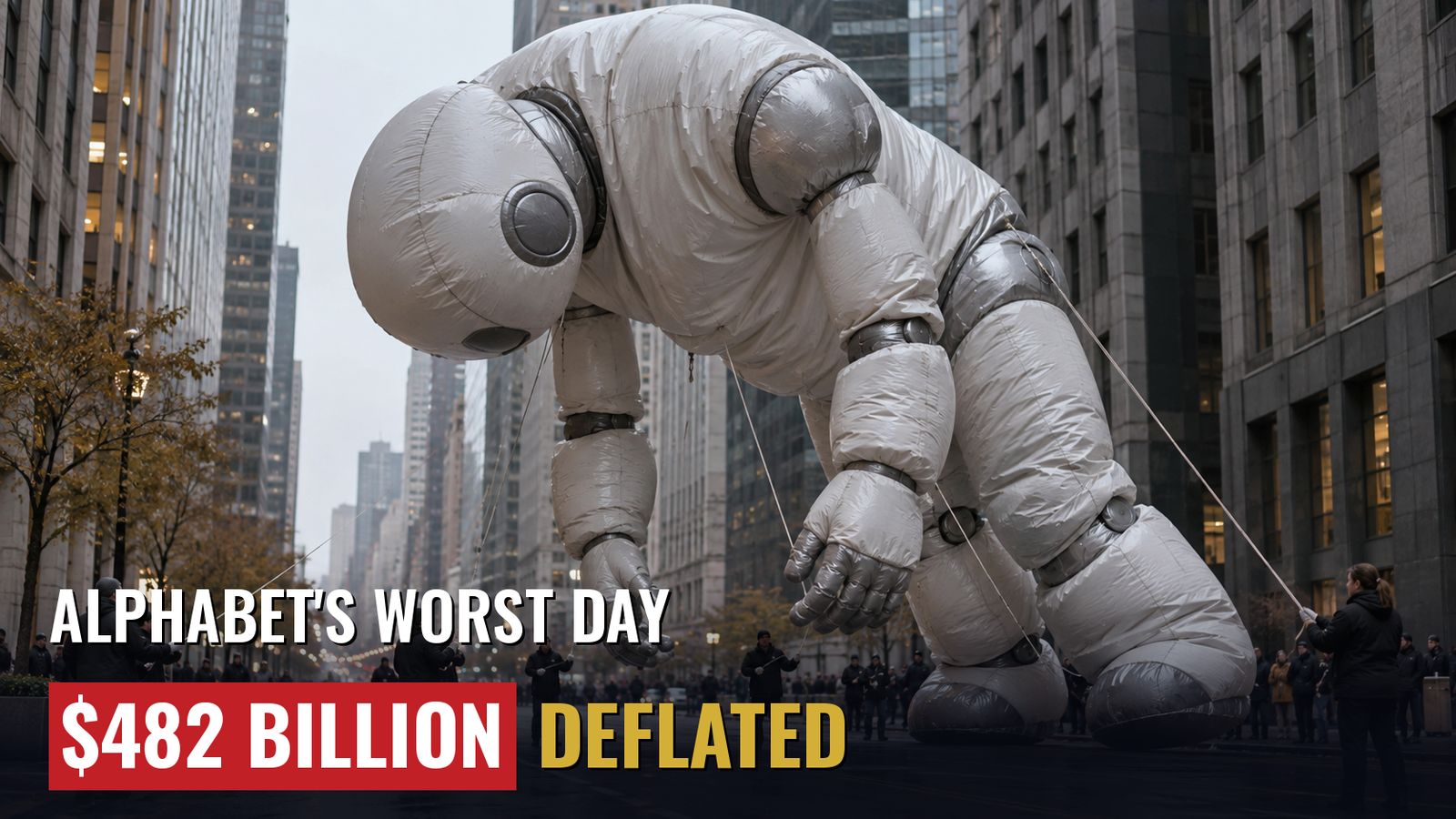
On Thursday Alphabet falls 12.64% and wipes out roughly $482 billion of market value: the worst session in its history as a listed company. After the close Amazon grows AWS by 39%, but misses on earnings per share and confirms capital spending of about $220 billion for the year, after spending $77.3 billion in the quarter alone; Intel beats estimates but disappoints on guidance: both slide after the close, and this morning Nasdaq-100 futures are down about 2%. ServiceNow closes down 26.95%, Fortinet down 20.09%. U.S. GDP grows 3.4%, PCE inflation rises to 3.6%, and yet the 10-year yield slips below 5%. Every central bank holds, except Canada’s, but none says it’s done; crude climbs again on signs of renewed strikes on Iran. Meanwhile banks and small caps gain about 1%.
Table of Contents
- 🧭 Before You Open the Terminal
- Key Indicators Dashboard
- 🗿 The Pretore Today
- 🗿 Breadth vs Concentration
- 🧭 Compass of the Day
- 📐 Yield Curve
- 🏦 Banks: Large vs Regional
- Executive Summary
-
News in Detail
- 1. Alphabet falls 12.64% and wipes out $482 billion: the worst session in its history as a listed company
- 2. Amazon: AWS grows 39%, its fastest pace in almost five years, but earnings disappoint; about $220 billion of 2026 spending confirmed
- 3. GDP grows 3.4%, just above expectations, and PCE inflation rises to 3.6%, in line: the 10-year yield slips below 5%
- 4. Software and chips on the canvas: ServiceNow −26.95%, Fortinet −20.09%, Intel disappoints on guidance and slides after the close
- 5. Crude closes lower and climbs again this morning on signs of renewed strikes on Iran; gold falls below the Pretore’s threshold, silver stays short
- 6. The rotation: the Nasdaq loses 1.38%, but banks and small caps gain about 1%
- 7. Central banks: the Fed, the ECB and the Bank of Japan hold, Canada hikes, and none says it’s done
- 📰 In Brief
- Aggregated Sentiment Table
- Fear and Loathing on Wall Street™
- Cross-Cutting Synthesis
- Strategic Alerts
- Disclaimer & Maxim
🧭 Before You Open the Terminal
🏢 Big Tech: the bill comes due
🔥 Alphabet closes down 12.64% and sheds roughly $482 billion in market value: no session in its history as a listed company had been worse. After the close Amazon reports AWS up 39%, but earnings per share come in at $1.89 against $1.97 expected, the quarter’s capital spending beats estimates and the full-year figure stays at about 220 billion: the stock loses about 7% before the open. This morning Nasdaq-100 futures are down 2.01%.
📉 Software and chips
ServiceNow closes down 26.95%, the worst day in its history, Fortinet down 20.09%. After the close Intel beats third-quarter estimates but guides revenue to between 15 and 16 billion against about 17 expected: before the open it’s down about 25%.
🏛️ Growth and inflation
Third-quarter GDP grows at an annualized 3.4%, September PCE inflation rises to 3.6% and core to 3.1%, both in line with expectations. The 10-year yield falls anyway, to 4.98% (−7 basis points).
🌍 Central banks
The Fed, the ECB, the Bank of Japan and New Zealand hold rates; Canada raises to 2.50%. FedWatch puts the odds of a Fed hike on December 9 at about 80%; the ECB discussed a hike, and Lagarde announces she’ll step down on February 7, 2027.
🛢️ Oil and metals
WTI closes at $102.00 (−0.8%) and this morning climbs back toward 103 on signs that U.S. strikes on Iran could resume after Tuesday’s vote. Gold falls to 4,031.40 and silver loses 2.37%: the Pretore’s signature is short on both.
Verdict
🔴 High priority — Fantiborsa’s take: for months the market begged Big Tech to spend; on Thursday it started asking who pays. Alphabet answered with cash flow in the red, Amazon with $77 billion of spending in a quarter, Intel with its guidance: three wrong answers in twenty-four hours. The money didn’t run from the market; it went to the bank, literally.
Trust me: today it’s worth finding five minutes to read the whole thing ☕
Key Indicators Dashboard
| Indicator | Value | Change | Reading | Signal |
|---|---|---|---|---|
| S&P 500 | 7,720.39 | −0.30% | RSI 50.8; above SMA50 (7,698.30) and SMA200 (7,306.49); Pretore active long; futures −0.89% this morning | |
| Nasdaq (COMPQ) | 26,184.72 | −1.38% | RSI 43.4; below SMA50 (26,586.75), above SMA200 (25,045.92); Pretore turns to active short | |
| Nasdaq-100 (NDX) | 29,402.51 | −1.38% | RSI 44.4; below SMA50 (29,812.87); Pretore attenuated long, invalidation at −0.72%; futures −2.01% this morning | |
| Philadelphia Semi (SOX) | 11,518.20 | −1.42% | RSI 46.2; below SMA50 (11,889.81), above SMA200 (10,766.46); Pretore attenuated long | |
| Dow Jones | 52,342.56 | −0.25% | RSI 53.6; above SMA50 (52,231.19) and SMA200 (50,592.34); Pretore active long | |
| Russell 2000 ETF (IWM) | 284.01 | +0.97% | RSI 58.2; on SMA50 (284.64), above SMA200 (278.64) | |
| VIX | 17.20 | +1.71% | Above SMA50 (16.11), below SMA200 (18.23); Pretore active short on its reference ETF | |
| US 2Y | 4.61% | −6 bp | The short end falls with the rest of the curve | |
| US 10Y | 4.98% | −7 bp | Back below the 5% threshold | |
| 2s10s spread | 37 bp | −1 bp | Positive, little changed | |
| DXY | 102.04 | −0.15% | RSI 52.0; above SMA50 (100.81) and SMA200 (99.63) | |
| Gold | 4,031.40 | −0.50% | December contract; below SMA50 (4,296.68) and SMA200 (4,519.79); Pretore turns to active short; 3,992.00 this morning | |
| Silver | 52.19 | −2.37% | RSI 25.2; below SMA50 (61.76) and SMA200 (70.89); Pretore active short; 50.81 this morning | |
| WTI | 102.00 | −0.76% | Above SMA50 (94.61) and SMA200 (86.34); Pretore active long; spot at 103.25 this morning | |
| Brent | 114.88 | −0.38% | December contract, expiring today; above SMA50 (103.16) and SMA200 (92.43); Pretore turns to attenuated short | |
| EUR/USD | 1.1186 | +0.10% | This morning; RSI 32.1; below SMA50 (1.14) and SMA200 (1.16) | |
| BTC | 78,119.06 | −2.03% | This morning; below SMA50 (81,914.20), above SMA200 (73,121.18); Pretore back to active short | |
| ETH | 2,233.49 | −3.18% | This morning; below SMA50 (2,525.91), above SMA200 (2,158.50); Pretore back to active short | |
| Crypto Fear & Greed | n/a | — | Current value not available in session |
Equity indices, VIX, dollar, gold, silver and crude at the close on Thursday, October 29, 2026 (StockCharts/Yahoo Finance; gold is the December contract). Treasury yields: official U.S. Treasury data for October 29 compared with October 28. Euro, crypto and this morning’s values: Yahoo Finance, screenshots taken between 8:48 and 8:51 a.m. CET.
The Pretore Today
U.S. index signatures. The S&P 500 and the Dow stay in active long; the Nasdaq-100 and semiconductors drop a notch, to attenuated long, because they close below their Consensus by more than the tolerance band (−0.83% and −1.60%); the Nasdaq Composite turns to active short; the VIX, read through its reference ETF, stays in active short. The SOX Consensus is still computed on uniform weights, because the index's volume isn't reliable.
Signature-consensus status: divergent for the Nasdaq-100, semiconductors and Brent — signature attenuated by one notch.
Polarity flip: yes. The Nasdaq Composite, gold, Brent, bitcoin and ether move from the long_attiva recorded on the close of Wednesday, October 28, to short_attiva.
The awkward signatures. The first is the Nasdaq split: the Composite, which spans the Nasdaq market across all sectors, turns short, while the large-cap Nasdaq-100 stays long, 0.72% from its own invalidation, with futures down 2.01% this morning. The second is Brent: it turns short, but closes 1.81% above its Consensus, so the signature reads as attenuated short; WTI, on the same day, stays long. The third is gold, which loses its long signature without yields rising: the 10-year falls seven basis points and the metal falls with it.
Macro convergence. The dollar, read through its ETF, stays in active long; the euro, also through its ETF, in active short. On rates the Pretore works off an ETF holding 7–10-year Treasuries, in active long: a long signature on the ETF means falling yields, and on Thursday the 10-year fell seven basis points. On crude the two benchmarks part ways: WTI in active long, Brent in attenuated short, on the December contract that expires today.
$SPX operating levels: close 7,720.39 · AVWAP Consensus 7,709.19 (+0.15%) · closing invalidation 7,616.58 (−1.34%). The AVWAP Consensus is the volume-weighted average the Pretore uses as a structural anchor for prices. The invalidation is the level below which, on a closing basis, the long signature lapses: it is not a stop-loss order.
The overall read. The signatures tell the same story as the news, a day ahead of this morning's prices: tech gives way, the rest of the market holds. The S&P 500 stays above its Consensus by just 0.15% and the Dow holds up, while the Composite turns short and the Nasdaq-100 edges toward its threshold. Today's thesis, the market putting AI spending on trial, agrees with the Composite's signature and diverges from the Nasdaq-100's attenuated one: that's where the Pretore has yet to have its say.
Snapshot as of October 30, 2026 (reference close October 29).
Breadth vs Concentration
$NDX and $COMPQ snapshot as of October 30, 2026 (Thursday, October 29 close).
Nasdaq 100 ($NDX): long_attiva (AVWAP Consensus 29,648.90, Δ −0.83%: signature attenuated by the modulator). Nasdaq Composite ($COMPQ): short_attiva (AVWAP Consensus 26,464.24, Δ −1.06%).
Reading: breadth gives way first. The Nasdaq-100's heavyweights still hold their long signature, but they close below their Consensus with a 0.72% cushion over the invalidation; the rest of the Nasdaq market has already turned. It's a decoupling setup, but a more fragile one than the classic version, because the large caps' signature isn't strong but attenuated, and this morning Nasdaq-100 futures are down 2%. The market is saying that doubts about AI spending have already reached the Nasdaq's smaller names and are now knocking on the leaders' door.
What to watch: a Nasdaq-100 close below 29,190.35, the level that invalidates the long signature, would bring the two indices back into agreement on the short side. To read it as a broad sell-off, it would also take an S&P 500 close below its Consensus at 7,709.19.
Compass of the Day
FINBEAR Compass™ · $SPX · Oct 29, 2026
  VERDICT           CONTRADICTED     — recent momentum contradicts the regime
  OPERATING REGIME  Moderate bear
  LINEARITY         Non-linear trends
  COHERENCE         SPLIT
  RELIABILITY       SUSPENDED
  POSITION          in band          — below the underlying trend
  UNDERLYING TREND  Persistent bull  — solid
The Compass captures an S&P 500 whose recent momentum, still positive over the week, contradicts an operating regime sliding toward a moderate bear: a fresh contradiction, whose staying power needs checking over the next few sessions. The signal is still scattered and the trend can't be read with confidence: the compass says to wait. Underneath, the underlying trend remains a solid bull, with price inside the band and just below the trend line: for now the operating regime's bear reads as a tactical correction within the bull, not the end of the cycle.
On the Nasdaq-100 and the Composite the Compass measures a strong-bear operating regime, with reliability suspended; on the Composite recent momentum challenges that regime, on the Nasdaq-100 it contradicts it. The financial sector remains the exception: a strong-bull operating regime, momentum that confirms it, high reliability.
Yield Curve
U.S. Treasury Curve · Oct 29, 2026
  SHAPE       flat
  MOVEMENT    unchanged
  MACRO       normal
For the economy: on Thursday the whole curve moves down together, from the 2-year to the 30-year, and its shape doesn't change. The market isn't changing its mind about the Fed's direction, which still leans toward a hike: it's buying Treasuries while it sells tech, and it's doing so across every maturity.
For banks: a flat, stationary curve doesn't widen the gap between funding costs and loan yields. On Thursday banks rise for another reason, as the next panel shows.
Banks: Large vs Regional
XLF · KBWB · KRE — financial sector
- XLF (sector) — at 56.94 (+1.44%), inside the 56.91–57.23 zone; the resistance it just cleared, at 56.52–56.59, now becomes the nearest support. The Pretore's signature on the sector stays in active long, with a closing invalidation at 56.555 (−0.68%).
- KBWB (large banks) — at 90.10 (+1.05%), inside the 90.04–90.17 resistance; the nearest support is at 88.70–89.24.
- KRE (regionals) — at 72.86 (+1.04%), back inside the 72.42–73.24 zone, below which it had closed on Wednesday; the next resistance is at 73.43–74.27.
For the first time in three sessions large and regional banks rise together, and by almost the same amount. The curve isn't driving them, flat and stationary as it is: what drives them is money leaving tech in search of near-term earnings that are easier to assess. The large banks move into resistance, the regionals win back the zone they lost on Wednesday: we're watching it, not betting on it.
KBWB and KRE under watch — a reading, not a signal.
Executive Summary
🎬 The day in one line
On Thursday the Nasdaq loses 1.38% and the S&P 500 0.30%, while the Russell 2000 ETF gains 0.97% and the financial sector 1.44%: the market isn’t selling everything, it’s selling tech and buying the rest. This morning Nasdaq-100 futures are down 2.01% and S&P 500 futures 0.89%.
🏢 Spending on trial
- 🔥 Alphabet −12.64%. The worst session in its history as a listed company and roughly 482 billion of market value wiped out, the second-largest one-day loss of market value ever for a U.S.-listed company. Behind the drop: negative free cash flow of 9.1 billion and search growing less than expected.
- Amazon after the close. AWS grows 39% and operating income beats expectations, but earnings per share fall short of estimates, the quarter’s capital spending beats estimates, the full-year figure stays at about 220 billion and guidance for the current quarter stays below consensus: the stock loses about 7% before the open.
- Software and chips. ServiceNow −26.95%, Fortinet −20.09%; Intel guides revenue below expectations and loses about 25% before the open.
🏛️ Growth, inflation and central banks
Third-quarter GDP grows 3.4%, just above expectations, September PCE inflation rises to 3.6% and core to 3.1%, in line: no shock, and the 10-year yield falls to 4.98%. Central banks almost all hold, but none closes the door: the Fed faces a hike the market puts at 80% odds for December, the ECB discussed raising, the Bank of Japan has a member who wanted to, Canada did it.
🛢️ Barrels and metals
WTI closes at $102 and this morning climbs back above 103 after reports that Trump was briefed on military options against Iran. Gold and silver fall on strong growth and a Fed leaning toward a hike: the Pretore’s signature turns short on gold and stays short on silver.
⏳ The bottom line
Yesterday’s RADAR wrote that the market rewards those who pay for AI spending out of cash and punishes those who fund it with debt. On Thursday the selection widened: the spending itself went on trial, even when revenue justifies it. The breadth balance records it: the Composite turns short, while the Nasdaq-100 holds on with an attenuated long signature.
Pretore vs thesis. Signature of the day on $NDX: long_attenuata (the long_attiva signature drops a notch because price closes below its Consensus). The RADAR’s bearish thesis on tech needs monitoring: if the signature turns to short_attiva, with a close below 29,190.35 by Tuesday, November 3, the thesis becomes the Pretore’s reading; a recovery of the Consensus at 29,648.90 would be a first sign to the contrary, and the thesis is invalidated by a close above 29,797.29.
News in Detail
1. Alphabet falls 12.64% and wipes out $482 billion: the worst session in its history as a listed company
What happened
✅ On Thursday, October 29, Alphabet’s Class A shares close at $283.82 (−12.64%), its Class C shares at 282.32 (−12.29%) (The Motley Fool; Yahoo Finance). ✅ Market value falls by roughly $482 billion: the worst session since the 2004 listing, beyond March 2020’s −11.6%, and the second-largest one-day loss of market value for a U.S.-listed company, after the roughly 593 billion Nvidia lost on January 27, 2025 (Fortune; Yahoo Finance).
✅ The session follows third-quarter results, released Wednesday evening: the company reports negative free cash flow of $9.1 billion for the second quarter running, with capital spending up to 51.4 billion from 24 billion a year earlier (Fortune; The Motley Fool). ✅ Search revenue grows 12% to 63.35 billion, against expectations of around 65 billion and 17% growth in the previous quarter (Fortune). 📊 The company confirms capital spending of 195 to 205 billion in 2026 and expects a significant increase in 2027, on which it will give more detail with fourth-quarter results (Alphabet, earnings call). ✅ Overnight, Nasdaq-100 futures fall about 2% (Yahoo Finance).
The October 29 RADAR had Alphabet down more than 9% after the close and identified cash burn as the item the market was doing its sums on: Thursday’s session confirmed it, with three more percentage points.
What sources say
“Google has now reported two quarters of negative cash flow, and this is unacceptable for investors.” — Kathleen Brooks, XTB (Sky News via Yahoo Finance)
“The bears will argue this is the first quarter that AI is starting to seriously hurt their search business.” — Jeffrey Wlodarczak, Pivotal Research (Fortune)
FINBEAR Take: the day AI bit the hand that feeds it
On Wednesday evening the market punished the cash burn. On Thursday it looked at the line that really matters, search, and saw growth slow from 17% to 12%. That’s where the evening’s −9% became the session’s −12.64%: not because spending went up, but because for the first time the artificial intelligence Alphabet pays for seems to be taking customers away from the machine that pays for it. A cloud that doubles is good news; a search business that slows is the news.
The record loss has a precedent worth remembering: the 593 billion Nvidia lost in January 2025, when a low-cost Chinese model cast doubt on chip spending. Back then the market feared AI would cost too little; today it fears it costs too much and earns less. Two opposite fears, one target: the return on investment.
Cui prodest? Those who sell Alphabet chips, power and computing capacity, because the company expects to raise spending further in 2027. The loser is the shareholder, who pays for the spending out of cash and watches the engine that was supposed to pay it back slow down.
For investors
Instruments involved:
- Stocks: $GOOGL, $GOOG, $MSFT, $META, $NVDA, $AVGO
- ETFs: $QQQ, $XLC, $XLK
- Futures/Commodities: Nasdaq-100 futures (NQ)
- Options/Structures: options on $QQQ to hedge against a further sell-off
Opportunities:
The cloud grows 103% and infrastructure suppliers see demand for the next two years confirmed
Risks:
Search slowing again next quarter would turn doubt into a downgrade of the whole business model
What to avoid:
Buying the dip just because the drop is a record: the record measures fear, not fair value
Bottom line:
The market isn’t challenging AI spending as such; it’s challenging spending that eats the business paying for it.
Impact: (3/5) — Alphabet’s worst session, AI spending on trial · against the grain: chip suppliers favored
2. Amazon: AWS grows 39%, its fastest pace in almost five years, but earnings disappoint; about $220 billion of 2026 spending confirmed
What happened
✅ Amazon ends the third quarter with revenue of $201.9 billion (+12%) and earnings per share of $1.89 (Amazon, release filed with the SEC), against expectations of around 202.2 billion and $1.97 (Yahoo Finance; The Motley Fool). ✅ AWS brings in $46 billion (+39%) with operating income of 17.8 billion; group operating income rises to 28.1 billion from 17.4 (Amazon), above the 26.2 expected (Proactive via Yahoo Finance).
📊 For the fourth quarter the company guides revenue to between 240 and 247 billion and operating income to between 28.5 and 33.5 billion (Amazon), against expectations of around 244.5 and 33 billion (Yahoo Finance). 📊 The company confirms capital spending of about $220 billion in 2026, the estimate it already gave with second-quarter results (Amazon); the quarter’s spending is 77.3 billion against 57.5 expected (Proactive via Yahoo Finance). ✅ Trailing twelve-month free cash flow is an outflow of 42.4 billion (Amazon).
✅ In Thursday’s session, before the results, the stock had already lost 4.25% to $243.79 (Yahoo Finance). ✅ This morning it’s down about 7% before the open (Yahoo Finance; Reuters via Investing.com).
Among the conditions that would have disproved its thesis, the October 29 RADAR listed an Amazon able to report rising capital spending without being punished: spending rose and the stock was punished, so the thesis stands and that branch of the invalidation wasn’t triggered.
What sources say
“There has never been a trillion dollar revenue business, and we may have two of them in the next 5-10 years.” — Andy Jassy, Amazon CEO (Proactive via Yahoo Finance)
“At this point, the market isn’t just asking how fast you can grow. It’s asking what you have to spend to get there.” — Jake Behan, Direxion (Reuters via Investing.com)
FINBEAR Take: even the best growth has a cover charge
Amazon gave the market what it had been asking for for two years: AWS accelerating, at its fastest pace in almost five years, and operating income above expectations. It wasn’t enough. The stock had already fallen 4.25% in the session, dragged down by Alphabet, and kept falling after the close, because to grow like this Amazon spends 77 billion in a quarter, twenty more than expected, and for twelve months has been burning more cash than it generates.
That’s Thursday’s shift in one line. Until Wednesday the market distinguished between those funding spending with cash and those funding it with debt; since Thursday it also looks at how many investment dollars each dollar of growth costs. Jassy promises two trillion-dollar revenue businesses; first, the market wants to know: how many more billions will he have to spend?
Cui prodest? Those who build and power data centers, because 220 billion of spending in a year means orders. The loser is the Amazon shareholder, who is now asked to pay for growth up front.
For investors
Instruments involved:
- Stocks: $AMZN, $MSFT, $GOOGL, $NVDA, $AVGO, $VRT
- ETFs: $XLY, $QQQ, $SMH
- Futures/Commodities: Nasdaq-100 futures (NQ)
- Options/Structures: options on $AMZN, with implied volatility high after earnings
Opportunities:
AWS is accelerating and has a 578 billion backlog: demand for computing isn’t in question
Risks:
Fourth-quarter guidance below consensus and negative free cash flow: another upward revision to spending would weigh further
What to avoid:
Confusing AWS growth with group profitability: today the market is looking at cash
Bottom line:
The growth is there, but the market wants to know what it costs.
Impact: (3/5) — Amazon punished despite AWS accelerating · against the grain: data-center suppliers favored
3. GDP grows 3.4%, just above expectations, and PCE inflation rises to 3.6%, in line: the 10-year yield slips below 5%
What happened
✅ In the advance estimate, U.S. GDP grows at an annualized 3.4% in the third quarter, after 2.2% in the second (BEA), against expectations of 3.2% (LSEG via Fox Business). ✅ In September the PCE price index rises 0.5% on the month and 3.6% on the year, from 3.4% in August; the core index rises 0.3% on the month and 3.1% on the year, from 3.0% (BEA). ✅ All four price readings match expectations (LSEG via Fox Business). ✅ Personal income +0.2%, spending +0.5% (BEA).
✅ The 10-year yield closes Thursday at 4.98%, from 5.05%; the 2-year at 4.61%, from 4.67% (U.S. Treasury). ✅ CME FedWatch puts the odds of a December rate hike at 79.6%, from 84.2% the day before (Fox Business).
What sources say
“But the lack of a shock does not mean the lack of a problem: Both headline and core PCE rose to their highest levels since May, underscoring that inflation remains a stubborn issue.” — Bret Kenwell, eToro (Fox Business)
“This is still elevated and too high for the Fed’s liking” — Cooper Howard, Schwab Center for Financial Research (Schwab)
FINBEAR Take: the data runs hot, the reaction runs cold
On paper, Thursday had everything needed to push yields higher: an economy accelerating to 3.4% and inflation at its highest since May, with a Fed that had two votes for a hike the day before. Instead the 10-year falls seven basis points and slips back below 5%. The gap between data and reaction says two things. First: the inflation figures were already in the price, matching expectations to the decimal, and GDP beat by a mere two tenths. Second: while tech was losing hundreds of billions, some of that money went looking for shelter in Treasuries.
The December hike is still on the table: FedWatch has slipped a few points, but stays close to 80%. It’s the saga we’ve been following since mid-October: the Fed doesn’t need surprises to tighten, it only needs inflation to stay where it is. On Thursday inflation stayed where it was.
Cui prodest? Those holding cash and short-dated paper, who keep getting paid more than core inflation. The loser is anyone hoping for weak data to push the hike back.
For investors
Instruments involved:
- ETFs: $TLT, $IEF, $SHY, $BIL, $TIP
- Futures/Commodities: 10-year Treasury (ZN) and fed funds futures
- Other instruments: the dollar via $UUP, banks via $XLF
Opportunities:
Short-term yields above core inflation: cash still earns its keep
Risks:
A December hike with inflation at 3.6% would push long-term yields back above 5%
What to avoid:
Reading the 10-year’s drop as a change of course by the Fed: it’s a flight to safety
Bottom line:
No surprise, and so no discount: December is still a hike.
Impact: (2/5) — Inflation at 3.6%, December still a hike · against the grain: short-dated cash favored
4. Software and chips on the canvas: ServiceNow −26.95%, Fortinet −20.09%, Intel disappoints on guidance and slides after the close
What happened
✅ ServiceNow closes Thursday at $109.67 (−26.95%), the worst day in its history: for the fourth quarter the company expects current remaining performance obligations—contracted revenue expected to be recognized over the next twelve months—to grow 18.5%, against 19.4% expected (Yahoo Finance). ✅ In the third quarter subscription revenue grows 21% to 3.99 billion (ServiceNow). ✅ Fortinet closes down 20.09%: the company cuts its full-year services revenue guidance to 5.15–5.17 billion, against 5.2 expected (Yahoo Finance).
✅ After the close Intel reports third-quarter revenue of $16.5 billion (+21%) and adjusted earnings per share of $0.52 (Intel, release filed with the SEC), above expectations of around 0.41 (MarketBeat). 📊 For the fourth quarter it guides revenue to between 15 and 16 billion and adjusted earnings per share to $0.25 (Intel), against expectations of around 17.07 billion and $0.43 (LSEG via Reuters; MarketBeat). ✅ The stock, which had lost 3.62% in the session to $92.07, slides about 20% after the close and about 25% this morning before the open (Yahoo Finance; MarketBeat; Reuters via Investing.com).
✅ Sandisk closes at $1,330.05 (−5.32%) and after the close reports revenue of 11.03 billion, an adjusted gross margin of 85.1% and an 8-for-1 stock split (Sandisk; Yahoo Finance).
The October 29 RADAR had ServiceNow down 15% after the close and Oracle up 10.73%: during the session ServiceNow’s drop almost doubled, and a split in software became a flight from software.
What sources say
“CRPO, while it’s a good metric that talks about what next year’s revenue will look like, it’s not perfect.” — Gina Mastantuono, ServiceNow CFO (Yahoo Finance)
“Our immediate priority is to unlock additional supply” — Lip-Bu Tan, Intel CEO (earnings release)
FINBEAR Take: nine tenths of a percentage point in growth can cost a quarter of the value
ServiceNow lost more than a quarter of its market value over nine tenths of a point on its contract guidance. It isn’t a verdict on the quarter, with subscription revenue up 21%: it’s a verdict on the future of software in a world of AI agents. Every slowdown, however small, is read as proof that AI is starting to replace the programs companies pay for by subscription. Fortinet’s services business gets the same verdict.
Intel tells the other half of the story. It has more demand than it can meet, and its CEO says so: the problem is supply, not customers. But for the fourth quarter it guides to lower revenue and adjusted earnings per share less than half the third-quarter level, with the PC market contracting. On Thursday the market punished both those who fear AI and those who can’t keep up with it.
Cui prodest? Competitors able to deliver chips when Intel can’t, and AI platforms angling to take the place of traditional software. The loser is subscription software, which has to prove it can’t be replaced.
For investors
Instruments involved:
- Stocks: $NOW, $FTNT, $CRM, $INTC, $AMD, $TSM, $SNDK
- ETFs: $IGV, $SMH, $SOXX
- Options/Structures: options on $IGV to hedge against a further software sell-off
Opportunities:
Drops of a quarter of their value at companies growing more than 20% a year: valuations compressed in a hurry
Risks:
More software results with guidance just below expectations would get the same treatment
What to avoid:
Buying software dips before a quarter disproves the replacement thesis
Bottom line:
In software, a miss of nine tenths of a percentage point is enough to wipe out a quarter of your value.
Impact: (3/5) — Software and chips punished, Intel slides after the close
5. Crude closes lower and climbs again this morning on signs of renewed strikes on Iran; gold falls below the Pretore’s threshold, silver stays short
What happened
✅ On Thursday December WTI closes at $102.00 (−0.8%), December Brent, which expires today, at 114.88 (−0.4%) and the more actively traded January contract at 110.80 (−0.8%) (Bloomberg via Rigzone). ✅ This morning WTI trades at 103.25 (StockCharts). ✅ It’s being pushed by reports that a senior U.S. commander briefed Trump on military options, reported by the Wall Street Journal, and by word, gathered by AP from diplomats, that Washington has asked Middle Eastern countries to prepare for a possible resumption of operations after the vote (Bloomberg; Rigzone). ✅ Pulling the other way, Tehran confirms it has received Vance’s letter and Iran’s chief negotiator says the country’s positions won’t be compromised (Bloomberg).
✅ December gold closes at $4,031.40 (−0.50%) (Yahoo Finance); in late U.S. trading spot is at about 4,024.60 (−1.03%) (Kitco). December silver loses 2.37% (Yahoo Finance). ✅ Weighing on both: GDP above expectations and PCE inflation, which keep a December Fed hike on the table (Kitco). ✅ This morning December gold is at 3,992.00 (Yahoo Finance).
The barrel saga that opened in October is back where the October 29 RADAR left it: Vance’s letter on one side, the warning to the Gulf on the other. For gold, the level flagged yesterday is triggered: the close below 4,047.13 flips the signature from long to short.
What sources say
No direct statements attributable to primary sources are available for this story.
FINBEAR Take: the market is pricing the calendar, not the war
Crude rises when there’s talk of strikes after the vote and falls when there’s talk of letters: the barrel doesn’t yet know whether Tuesday, November 3 marks the end of the election campaign or the start of a new military phase. It’s a risk premium tied to a date, and premiums tied to a date deflate fast if the date passes without incident. Until then, above $100.
Gold tells a different story from the one you’d expect. On a day of tech selling and falling yields a safe haven should rise; it falls, because the market reads 3.4% growth as a signal that the Fed will hike again. In this phase, shelter comes from Treasuries, not from the metal.
Cui prodest? Crude producers, who pocket more than $100 a barrel for as long as the uncertainty lasts. The loser is anyone holding gold and silver as protection: on Thursday the protection worked in reverse.
For investors
Instruments involved:
- Stocks: $XOM, $CVX, $OXY, $NEM
- ETFs: $USO, $BNO, $XLE, $GLD, $SLV
- Futures/Commodities: WTI (CL), Brent (BZ), gold (GC) and silver (SI) futures
- Options/Structures: options on $USO to manage the risk tied to the vote
Opportunities:
A barrel above $100 with a risk premium tied to a specific date
Risks:
A resumption of strikes after November 3 would push crude toward the Pretore’s resistance levels, Brent as far as 118.80
What to avoid:
Using gold as a hedge against tech in this phase: on Thursday it fell right along with it
Bottom line:
The barrel is waiting for Tuesday; gold has already lost its signature.
Impact: (2/5) — The barrel above 100 on signs of strikes · against the grain: crude producers favored
6. The rotation: the Nasdaq loses 1.38%, but banks and small caps gain about 1%
What happened
✅ On Thursday the Nasdaq Composite closes at 26,184.72 (−1.38%), the Nasdaq-100 at 29,402.51 (−1.38%) and semiconductors at −1.42%; the S&P 500 limits its loss to 0.30% and the Dow to 0.25% (StockCharts/Yahoo Finance). ✅ In the same session the financial-sector ETF gains 1.44%, the large-bank and regional-bank ETFs 1.05% and 1.04%, the Russell 2000 ETF 0.97% (Yahoo Finance). ✅ In Europe on Thursday the DAX closes up 1.31%, the CAC 40 up 1.05% and the Euro Stoxx 50 up 0.64% (Yahoo Finance). ✅ This morning in Asia the Nikkei loses 2.12% and the Kospi 3.48%, while Hong Kong gains 1.53% (Yahoo Finance).
The October 26 Week Ahead said its defensive thesis would be confirmed if the Nasdaq-100 failed to hold above 29,190.35 and the VIX stayed firmly above 18.19: on Thursday the Nasdaq-100 still closes above that level, at 29,402.51, and the VIX at 17.20. The conditions haven’t been triggered yet, but the cushion has shrunk to 0.72%.
What sources say
No direct statements attributable to primary sources are available for this story.
FINBEAR Take: not a stampede, a house move
An index losing 1.38% while small caps gain almost 1% and the financial sector 1.44% isn’t fleeing risk: it’s swapping it. The money leaving Alphabet and software isn’t going into cash; it’s going into companies with near-term earnings that are easier to assess and that don’t need to spend hundreds of billions to grow. In Europe, where tech carries less weight, the DAX and the CAC 40 gain more than 1%.
The rotation has a limit that this morning’s prices lay bare: with Nasdaq-100 futures at −2%, tech’s weight in the S&P 500 is such that the rest of the market, on its own, can’t hold it steady. If the move lasts, the index falls even when most stocks rise. It’s the mirror image of the months when a handful of stocks pulled the market and the rest looked on.
Cui prodest? Banks and mid- and small-cap companies, which take in the flows leaving tech. The loser is anyone holding the index as if it were diversified: its tech weighting exposes them more than they think.
For investors
Instruments involved:
- ETFs: $IWM, $XLF, $KBWB, $KRE, $RSP, $QQQ
- Futures/Commodities: Russell 2000 (RTY) and Nasdaq-100 (NQ) futures
- Options/Structures: options on $QQQ and $IWM for relative-value structures
- Other instruments: European indices via $EZU
Opportunities:
Sectors outside tech taking in flows with a long Pretore signature, like the financial sector
Risks:
A Nasdaq-100 correction below 29,190.35 could turn the rotation into a broad sell-off
What to avoid:
Treating the S&P 500 as a shelter: today its fate hangs on tech
Bottom line:
The market isn’t leaving the house, it’s moving to another room.
Impact: (2/5) — The market holds up thanks to banks and small caps · against the grain: Big Tech penalized
7. Central banks: the Fed, the ECB and the Bank of Japan hold, Canada hikes, and none says it’s done
What happened
✅ On Wednesday the 28th the Fed keeps rates in the 3.75%-4.00% range on a ten-to-two vote: Lisa Cook and Beth Hammack wanted a quarter-point hike (Federal Reserve); FedWatch puts the odds of a hike on December 9 at 79.6% (Fox Business). ✅ The same day the Bank of Canada raises its policy rate by a quarter point to 2.50%, its first hike in more than three years, and writes that further increases may be needed (Bank of Canada; Reuters). ✅ The Reserve Bank of New Zealand holds its rate at 2.75% on a four-to-three vote (Westpac IQ).
✅ On Thursday the 29th the ECB holds the deposit rate at 2.50%; at the press conference Lagarde confirms the decision was unanimous and that the Governing Council discussed whether a hike was appropriate, with euro-area inflation at 3.8% in September (ECB, press conference). ✅ According to three Governing Council members who spoke to Reuters, barring a collapse in energy prices a hike on December 17 is all but certain, followed by a pause (Reuters). ✅ Lagarde announces she’ll step down on February 7, 2027, after the February monetary policy meeting, about nine months before the end of her term (ECB, press conference; Euronews).
✅ On Friday the 30th the Bank of Japan holds its rate at 1.25% on an eight-to-one vote: Hajime Takata proposed 1.50% (Bank of Japan). ✅ From January 2027 it will sell its equity ETFs faster: about 860 billion yen a year at book value, against the previous 330 billion (Bank of Japan). ✅ After the announcement the dollar falls to 157.12 yen from 157.79 (Seoul Economic Daily). 📊 The Bank of England decides on Thursday, November 5, and the market almost fully prices a hike (Reuters).
The October 29 RADAR described a Fed on hold but divided: within twenty-four hours the same division showed up in Frankfurt and Tokyo.
What sources say
“So it does not indicate that we will not be hiking and our next meeting is in December.” — Christine Lagarde, ECB President (press conference)
“We must therefore be vigilant to the risk of inflation overshooting our target.” — Kazuo Ueda, Bank of Japan Governor (Reuters)
FINBEAR Take: all on pause, none on vacation
It looks like a week of waiting. It isn’t. Four central banks out of five hold rates, but each does so with a foot on the brake: two Fed dissenters favoring a hike, an ECB hike debated and seen as all but certain in December, a Bank of Japan member who wanted to hike immediately, and a Canada already back to raising rates. With energy at multi-month highs and inflation at 3.8% in the euro area and 3.6% in the United States, nobody wants to get caught sending a dovish message.
For markets the consequence is simple: the cost of money, worldwide, goes up again before it comes down. And companies that need to fund hundreds of billions of investment, like this week’s Big Tech, will do so at higher rates, not lower.
Cui prodest? Banks, which see margins supported by rates staying higher for longer, and those holding cash. The loser is anyone borrowing to grow, starting with the big investors in artificial intelligence.
For investors
Instruments involved:
- ETFs: $XLF, $EUFN, $EWJ, $FXY, $FXE, $TLT
- Futures/Commodities: fed funds and Euribor futures
- Currencies: currencies EUR/USD, USD/JPY, USD/CAD
- Options/Structures: options on the yen via $FXY ahead of the next meetings
Opportunities:
European and U.S. banks with rates higher for longer; the yen supported by expectations of further hikes
Risks:
Simultaneous hikes in December in an economy slowing outside the United States
What to avoid:
Reading the pauses as the end of hikes: every central bank says the opposite
Bottom line:
The world is stopping to catch its breath, not to change course.
Impact: (2/5) — Central banks on hold but ready to tighten · against the grain: banks favored
In Brief
- Bitcoin back to short. On the Pretore's close, bitcoin falls below the $81,172.62 threshold flagged by the October 29 RADAR and the signature flips back from long to short; this morning at 8:49 a.m. CET it's at 78,119.06 (−2.03%) (Pretore dei Mercati™, Yahoo Finance).
- Coinbase. Third-quarter revenue falls 35% to $1.22 billion, with transaction revenue down 44% (Coinbase, release filed with the SEC).
- Marvell and Lumentum. According to Bloomberg, Marvell is in advanced talks to acquire Lumentum, with a deal possible as soon as next week; the price hasn't been disclosed (Bloomberg via Phemex).
- Anthropic. The prospectus for its listing shows the company depends on its competitors Amazon, Google and Microsoft for computing capacity (Forbes).
Aggregated Sentiment Table
| Cluster | Story | Sentiment | Score |
|---|---|---|---|
| 🧠 AI & Tech | Alphabet −12.64%, worst session in its history | Negative / AI spending on trial | -15 |
| 📊 Earnings / Results | Amazon punished after earnings | Negative / growth too expensive | -10 |
| 💰 Central Banks | GDP at 3.4%, PCE at 3.6% | Negative / December still a hike | -5 |
| 🧾 Corporate | ServiceNow, Fortinet and Intel | Negative / software and chips punished | -10 |
| 🔋 Energy | Crude on signs of strikes, gold short | Negative / risk premium | -5 |
| 🧾 Corporate | The rotation into banks and small caps | Positive / the market holds up | +5 |
| 💰 Central Banks | Central banks on hold but ready to tighten | Negative / cost of money high | -5 |
| Net Score | -45 |
Fear and Loathing on Wall Street™
Optimism — Index: 22

Registry comparison: the latest recorded reading is +16 (⚪ NEUTRAL, ARMED NEUTRAL) on October 29. Since then the S&P 500 has lost 0.30% and the Nasdaq 1.38%, the VIX has risen to 17.20, and this morning Nasdaq-100 futures are down 2.01%.
Reading. The fear that yesterday hit one stock at a time has changed scale: on Thursday it took Alphabet, ServiceNow and Fortinet in the same session, and after the close Amazon and Intel. Yet the VIX rises just 1.71% and the broad market holds up, because money isn’t leaving the stock market, it’s rotating. It’s fear concentrated in a sector that weighs enormously on the indices: that’s why the number can stay calm while the S&P 500 risks not doing so.
Cross-Cutting Synthesis
Today’s seven stories are one, told from seven angles. Alphabet opens the trial of artificial-intelligence spending, Amazon extends it to the fastest grower of all, ServiceNow, Fortinet and Intel widen it to software that fears being replaced and to chips that can’t keep up with demand. The macro data, with GDP just above expectations and inflation in line, takes away the market’s alibi of an accommodative Fed, and the central banks confirm that the cost of money will stay high worldwide. For anyone who has to invest hundreds of billions, it’s the worst combination: rising costs, returns still to be proven, more expensive funding.
The market’s reaction is more interesting than the news. The money isn’t running: it goes from tech to banks and small caps, and partly to Treasuries, whose yield falls on a day of 3.6% inflation. Gold, which should be the safe haven, loses its long signature; crude stays above $100 waiting for Tuesday’s vote. The Pretore captures the same split: the Composite turns short, the Nasdaq-100 holds on with an attenuated long signature, and the S&P 500 stays just 0.15% above its Consensus.
The thresholds of recent days show where the thesis stands. The October 28 one, which expires tonight, wasn’t triggered: the S&P 500 closes at 7,720.39, between 7,616.58 and 7,799.45. The October 29 one was half-triggered: the Nasdaq-100 closed below 29,797.29, but the S&P 500 stayed above its Consensus, and the condition required both; the opposite branch, an Amazon not punished, was ruled out by the results. The October 26 Week Ahead’s plan remains pending: the defensive thesis isn’t confirmed, but the Nasdaq-100 is 0.72% from the 29,190.35 threshold.
Cui prodest? Those who own banks, small caps and cash, and those who sell chips and power to Big Tech, whose orders remain in place. The loser is the Big Tech shareholder, who since Thursday pays for growth up front, and anyone who bought the S&P 500 believing it was diversified.
📌 Thesis invalidation — This RADAR’s dominant thesis is: the market has stopped rewarding artificial-intelligence spending and has started putting it on trial, even when revenue justifies it; the selling stays concentrated in tech and money rotates into banks and small caps, while central banks keep the cost of money high.
- Holds because: Alphabet loses 12.64% and Amazon slides after earnings despite AWS at +39%; ServiceNow −26.95%, Intel about −20% after the close; the Nasdaq loses 1.38% while the financial sector and the Russell 2000 rise; the Composite turns short.
- Invalidated if: the Nasdaq-100 closes above 29,797.29, the nearest resistance flagged by the Pretore, absorbing this morning’s drop in futures; or if the Nasdaq-100 closes below 29,190.35, the level that invalidates the long signature, and at the same time the S&P 500 closes below its Consensus at 7,709.19: then the rotation turns into a broad sell-off.
- By: the close on Tuesday, November 3, the day of the midterm elections.
- In that case: above 29,797.29 the FINBEAR reading shifts to a trial that ends with the leaders acquitted; below 29,190.35, together with an S&P 500 close below 7,709.19, it shifts to a broad sell-off confirmed by price.
Strategic Alerts
active long on the 7,720.39 close; closing invalidation at 7,616.58 (−1.34%); the Consensus at 7,709.19 sits just below price (+0.15%).
attenuated long on the 29,402.51 close; closing invalidation at 29,190.35 (−0.72%), with futures at −2.01% this morning.
active short on the 26,184.72 close; the signature lapses on a close above 26,312.40 (+0.49%).
a Nasdaq-100 close below 29,190.35 would bring the two Nasdaq indices back into agreement on the short side.
attenuated long on the 11,518.20 close; closing invalidation at 11,207.91 (−2.69%).
active long on the 52,342.56 close; closing invalidation at 51,584.55 (−1.45%).
active long on the 56.94 close; closing invalidation at 56.555 (−0.68%).
active short on the 4,031.40 close; the signature lapses on a close above 4,047.13 (+0.39%).
active long on the 102.00 close; closing invalidation at 98.75 (−3.19%).
attenuated short on the 114.88 close; the signature lapses on a close above 118.80 (+3.41%).
Nasdaq-100 futures −2.01% and S&P 500 futures −0.89% at 8:50 a.m. CET; Amazon about −7% and Intel about −25% before the open.
on Tuesday, November 3, the midterm elections and the Reserve Bank of Australia’s decision; on Thursday, November 5, the Bank of England; on Wednesday, December 9, the Fed; on Thursday, December 17, the ECB.
Disclaimer & Maxim
This RADAR is independent analysis for a general audience, not advice and not a recommendation. If you read a buy order into it, take it up with a licensed adviser — ideally before you buy somebody else’s dip. And remember ServiceNow: subscription revenue up 21%, and a quarter of its value gone in one session over nine tenths of a point. Being right about the numbers isn’t enough; the market has to be in the mood to hear them. We write the numbers down; the money stays yours.