RADAR PRO ELITE™ FINBEAR — November 19, 2026
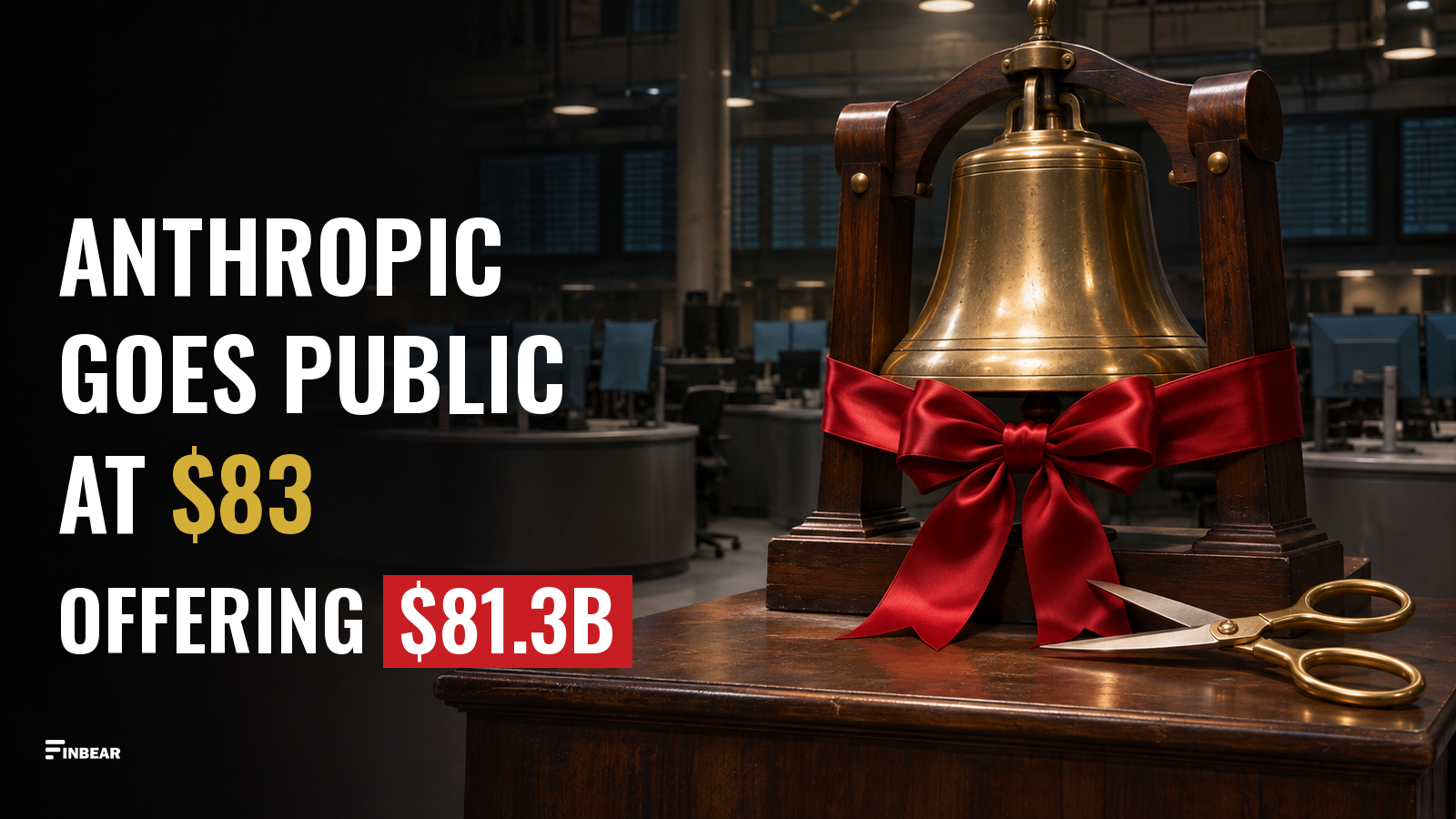
Wall Street split in two on Wednesday. The Dow lost 1.11%, dragged down by a slump in health insurers, while the Nasdaq rose 0.42%. The S&P 500 slipped 0.23% for a fifth straight losing session and stayed below its 200-day moving average. Nvidia gave back its post-earnings gain and fell 2.89%. The Fed minutes show that almost all participants at the October meeting see further rate hikes as likely, and gold fell to its lowest in more than a year. After the bell, Anthropic priced its IPO at $83 a share, above the range. It makes its Nasdaq debut today.
Table of Contents
- 🧭 Before You Open the Terminal
- Key Indicators Dashboard
- 🗿 The Pretore Today
- 🧭 Compass of the Day
- 📐 Yield Curve
- 🏦 Banks: Large vs Regional
- Executive Summary
-
News in Detail
- 1. Anthropic prices its IPO at $83 a share in a record base offering; trading starts today
- 2. Nvidia gives back its post-earnings gain; Trump opens the door to Blackwell sales to China in two or three years
- 3. Wednesday’s session: health insurers sink the Dow as the Nasdaq rises
- 4. The Fed: the minutes suggest more hikes are likely; Waller calls for weighing a 50-basis-point hike in December
- 5. Oil: WTI falls to its lowest since August as inventories outweigh the attacks in the Strait of Hormuz
- 6. Gold and silver at their lowest in more than a year: the Pretore’s signatures return to active short
- 7. Bitcoin below $64,000: the Pretore’s signature returns to active short after a single day
- 📰 In Brief
- Aggregated Sentiment Table
- Fear and Loathing on Wall Street™
- Cross-Cutting Synthesis
- Strategic Alerts
- Disclaimer & Maxim
🧭 Before You Open the Terminal
📜 Anthropic goes public
🆕 The IPO priced at $83 a share, above the $70-$78 range. The offering grew from a planned 825 million shares to 980 million, for a gross deal value of $81.3 billion. That makes it the largest IPO in history by base-offering size, ahead of the roughly $75 billion of SpaceX’s base offering. The shares start trading on the Nasdaq today under the ticker ANT.
🏢 Nvidia and Washington
The day after its results, Nvidia wiped out its post-earnings gain and closed at $150.96 (−2.89%), its lowest level since June 2025. Speaking from Shenzhen, where he is meeting Xi Jinping at the APEC summit, Trump said he could allow Blackwell sales to China in two or three years.
📉 Wednesday’s market
The Dow fell 1.11%, or 561.25 points, as UnitedHealth sank 10.21% on an anti-fraud rule proposed by the federal agency that runs Medicare. The Nasdaq Composite rose 0.42%. The S&P 500 slipped 0.23% for a fifth straight decline. This morning Nasdaq futures are up almost 2%.
🏛️ The Fed, gold and the dollar
The October minutes show that almost all participants at the meeting see further rate hikes as likely. The dollar rose, while gold lost 3.16% to its lowest in more than a year and silver dropped 4.84%.
Verdict
🔴 High priority — Fantiborsa’s take: the market has stopped selling everything; now it’s picking. It dumped health insurers, gold and Nvidia, went back into the rest of tech and put in orders for almost seven times Anthropic’s original offering. The Pretore records the turn in the tech indexes but treats it as fragile: the Composite’s signature has turned bullish with its invalidation level a step away.
Trust me: today it’s worth finding five minutes to read the whole thing ☕
Key Indicators Dashboard
| Indicator | Value | Change | Reading | Signal |
|---|---|---|---|---|
| S&P 500 | 7,323.63 | −0.23% | RSI 36.6; below the SMA50 (7,648.51) and SMA200 (7,346.55); Pretore active short; futures +1.11% before the open | |
| Nasdaq (COMPQ) | 24,429.88 | +0.42% | RSI 37.1; below the SMA50 (26,231.80) and SMA200 (25,152.21); Pretore active long (from short) | |
| Nasdaq-100 (NDX) | 27,116.26 | +0.42% | RSI 37.6; below the SMA50 (29,362.78) and SMA200 (28,062.77); Pretore active long (from short); futures +1.95% before the open | |
| Philadelphia Semi (SOX) | 9,652.80 | +0.10% | RSI 38.3; below the SMA50 (11,446.99) and SMA200 (10,908.25); Pretore active long (from short) | |
| Dow Jones | 50,198.17 | −1.11% | RSI 36.0; below the SMA50 (51,853.57) and SMA200 (50,782.24); Pretore active short; futures +0.69% before the open | |
| Russell 2000 ETF (IWM) | 270.12 | +0.40% | RSI 40.7; below the SMA50 (279.38) and SMA200 (279.55); Russell futures +0.65% before the open | |
| VIX | 24.56 | −3.53% | Above the SMA50 (17.82) and SMA200 (18.53); RSI 58.8; Pretore active long on its reference ETF (VIXY); 22.03 this morning | |
| US 2Y | 4.80% | unchanged | The short end isn’t moving | |
| US 10Y | 5.07% | −3 bp | Still above 5% | |
| 2s10s spread | 27 bp | −3 bp | Flat curve, flattening from the long end | |
| DXY | 103.86 | +0.36% | RSI 68.3; above the SMA50 (101.79) and SMA200 (99.98); Pretore active long on its ETF | |
| Gold | 3,741.90 | −3.16% | RSI 29.0; below the SMA50 (4,129.72) and SMA200 (4,451.80); Pretore active short (from long); spot gold 3,737.48 (+0.32%) this morning | |
| Silver | 45.00 | −4.84% | RSI 28.0; below the SMA50 (56.87) and SMA200 (67.69); Pretore active short (from long); spot silver 45.35 this morning | |
| WTI | 83.26 | −3.20% | RSI 34.7; below the SMA50 (94.45) and SMA200 (88.19); Pretore active short; 83.13 (−0.16%) this morning | |
| Brent | 91.95 | −1.28% | RSI 37.6; below the SMA50 (103.54) and SMA200 (94.46); Pretore active short; 92.15 (+0.22%) this morning | |
| EUR/USD | 1.0972 | −0.19% | Close taken from the StockCharts chart; change measured against Tuesday’s close (1.0993); RSI 29.8; Pretore active short on its ETF; 1.0984 this morning | |
| BTC | 62,987.27 | −2.94% | RSI 25.0; below the SMA50 (78,181.94) and SMA200 (72,645.93); Pretore active short (from long); 63,741.92 (+1.20%) this morning | |
| ETH | 1,774.75 | −2.64% | RSI 27.8; below the SMA50 (2,307.78) and SMA200 (2,132.69); Pretore active short (from long); 1,803.56 (+1.62%) this morning | |
| Crypto Fear & Greed | n/a | — | No verified source provides an up-to-date reading |
Closing levels for Wednesday, November 18, 2026. Prices, RSI and moving averages come from StockCharts and Yahoo Finance, with gold and silver taken from the futures series. Closes and changes for the VIX, WTI, Brent and EUR/USD are checked against StockCharts charts; the relative strength index (RSI) for WTI, Brent and EUR/USD is the one on this morning’s chart. Treasury yields are official U.S. Treasury data for November 18, with changes measured against November 17. Bitcoin and ether show the daily close of Wednesday, November 18, with the change measured against the close on Tuesday, November 17; their RSI and moving averages are calculated on this morning’s data. Futures and morning quotes: Yahoo Finance, as of about 9:45 a.m. CET, before the Wall Street open; spot gold, spot silver, WTI, Brent, EUR/USD, bitcoin and ether from this morning’s StockCharts charts.
The Pretore Today
U.S. index signatures. The Nasdaq Composite, Nasdaq-100 and semiconductor signatures move into active long, while the S&P 500 and Dow signatures stay in active short. Every index is still below its Consensus AVWAP: the S&P 500 by 2.27%, the Dow by 2.12%, the Composite by 2.79% and the Nasdaq-100 by 2.81%. For semiconductors the Consensus uses equal weights because the index's volume data aren't reliable; the price sits 3.73% below that Consensus. The VIX signature, read through its reference ETF, VIXY, stays in active long.
Polarity flip: yes. Since the November 18 RADAR, the Composite, Nasdaq-100 and semiconductor signatures have flipped from short to active long. Gold, silver, bitcoin and ether have gone the other way, from long to active short.
The awkward signatures. First is the Composite. It turned to active long on a close just 0.35% above 24,343.74, the level below which the signature lapses, so a session like Tuesday's would be enough to undo it. Second is the financial sector. XLF stays in active short, but its price is only 0.23% below $56.5475, the level above which that signature lapses. Third is bitcoin, back in active short on Wednesday's close of $62,987.27, even though this morning the price has already climbed back to $63,741.92.
Macro convergence. The dollar, read through its ETF, stays in active long and the euro in active short. For rates, the Pretore tracks an ETF of 7- to 10-year Treasuries, whose signature stays in active long: bond prices are rising, so yields, which move the other way, are falling. WTI, Brent and copper stay in active short, and gold and silver return to active short. A strong dollar, long-term yields edging lower and precious metals in retreat: the market is bracing for a Fed that may raise rates again.
$SPX operating levels: close 7,323.63 · AVWAP Consensus 7,493.89 (−2.27%) · closing invalidation 7,608.27 (+3.89%) · support 7,282.93 (−0.56%). The Consensus AVWAP is the volume-weighted average price the Pretore uses as a structural anchor. The active short signature lapses on a close above the invalidation level; that level is not a stop-loss order.
The overall read. The Pretore records a market split down the middle. Tech has turned higher, while the S&P 500 and the Dow stay in active short. It's a partial turn, and a fragile one, because the Composite's invalidation level is less than half a percentage point below its close. On the macro side the signatures say the same thing as the Fed minutes, with the dollar in active long and precious metals back in active short.
Snapshot as of November 19, 2026 (reference close November 18).
Compass of the Day
FINBEAR Compass™ · $SPX · Nov 18, 2026
  VERDICT           CONFIRMED          — recent momentum confirms the regime
  OPERATING REGIME  Strong bear
  LINEARITY         Non-linear trends
  COHERENCE         full
  RELIABILITY       SUSPENDED
  POSITION          --- far below      — below the underlying trend
  UNDERLYING TREND  Persistent bull    — solid
The Compass reads the S&P 500 exactly as it did yesterday. Recent momentum confirms the strong-bear operating regime, and the signals across time horizons point the same way. Reliability stays suspended because the medium-term signal is too scattered to read with confidence. Price remains well below the underlying trend, which is still rising, persistent and solid. The short-term regime runs against that trend: this is a correction inside a positive long-term trend.
The Nasdaq-100, the Composite and semiconductors are still in a strong-bear regime, with medium reliability. The turn the Pretore sees in Wednesday's session isn't visible to the Compass yet. The Dow moves from a bear to a strong-bear regime. For the financial sector, recent momentum contradicts the bullish regime and reliability stays suspended. The large banks (KBWB) are in a strong-bear regime and the regionals (KRE) in a moderate-bear one, both with reliability suspended. Gold, finally, is in a strong-bear regime with high reliability, inside a falling underlying trend.
Yield Curve
U.S. Treasury Curve · Nov 18, 2026
  SHAPE       flat
  MOVEMENT    bull flattening
  MACRO       normal
For the economy: On Wednesday long-dated yields fell while the two-year stayed put, so long bonds gained and the curve flattened. The market reads that as a sign of weaker growth, not of lower rates ahead. The short end didn't move because the further hikes the Fed minutes describe as likely were already priced in.
For banks: A curve that flattens from the long end squeezes banks' net interest margins even further. That margin is the gap between what they earn on loans and what they pay on deposits. On Wednesday the financial sector closed lower again, as the next section shows.
Banks: Large vs Regional
XLF · KBWB · KRE — financial sector
- XLF (sector) — at $56.42 (−1.14%), RSI 46.4, still above its 50- and 200-day averages ($55.95 and $54.00). The Pretore's signature stays in active short, with invalidation at $56.5475, just 0.23% higher; the price is 1.73% below the Consensus.
- KBWB (large banks) — at $85.90 (−1.29%), RSI 39.1, below its 50- and 200-day averages ($89.13 and $89.09). The Pretore's signature is in active short, with invalidation at $87.439 (+1.79%). The first support is at $85.4283, 0.55% lower, and the price is 1.95% below the Consensus.
- KRE (regionals) — at $70.52 (−0.47%), RSI 41.6, below its 50- and 200-day averages ($71.53 and $71.24). The Pretore's signature is in active short, with invalidation at $71.2025 (+0.97%). The first support is at $70.094, 0.60% lower, and the price is 1.30% below the Consensus.
As we wrote in the November 18 RADAR, the Pretore's financial sector signature was in active short; on Wednesday the large-bank and regional-bank signatures joined it. The big banks fell more than the regionals. A flattening curve helps neither group, but the large lenders also feel the slump in equities, because their brokerage and advisory businesses depend on the stock market. The regionals are holding up better, yet they remain below their averages. The sector has nothing to hold on to.
Executive Summary
🎬 The day in one line
On Wednesday the Nasdaq rose 0.42% and the Dow fell 1.11%, splitting the market in two, while the S&P 500 closed lower for a fifth straight session, below its 200-day average. After the close, Anthropic priced an $81 billion IPO at $83 a share.
📜 Anthropic and Nvidia
- Anthropic. 🔥 The IPO is worth $81.3 billion gross, with shares priced at $83, above the range; as early as Sunday, orders were close to seven times the original offering. The shares debut on the Nasdaq today.
- Nvidia. The stock gave back its post-earnings gain and closed at $150.96, its lowest since June 2025. Trump opened the door to Blackwell sales to China, but only in two or three years.
🏛️ The Fed and the havens
The October minutes show that almost all participants see further hikes as likely, and that for some of those who favored holding rates steady the decision was a close call. Waller wants a 50-basis-point hike considered for December. The dollar rose, and gold lost 3.16% to its lowest in more than a year.
⏳ The bottom line
As we wrote in the November 18 RADAR, Nvidia’s results put the demand fears to rest but didn’t stop the correction. That thesis has not been invalidated. Invalidation required two closes in the same session: the Composite above 24,343.74 and the S&P 500 above 7,608.27. The Composite made it; the S&P 500 stopped at 7,323.63. Only the first half of the condition was met, and the Pretore records it by turning the Composite’s signature bullish.
Pretore vs thesis. Signature of the day on $SPX: active short — in line with today’s thesis of a correction that isn’t over but is no longer led by tech; invalidation is at 7,608.27, 3.89% higher. The Composite, Nasdaq-100 and semiconductor signatures, now in active long, agree with the second half of the thesis: tech is showing signs of life. The thesis is invalidated if, by Friday, November 20, the Composite closes below 24,343.74.
News in Detail
1. Anthropic prices its IPO at $83 a share in a record base offering; trading starts today
What happened
✅ Anthropic priced its IPO of Class A shares at $83 apiece. The offering totals 980 million shares: 956,351,354 sold by the company and 23,648,646 by selling shareholders, whose proceeds don’t go to Anthropic. The stock debuts today, November 19, on the Nasdaq Global Select Market under the ticker ANT, and the offering is expected to settle on November 20 (Anthropic).
✅ The price came in above the $70-$78 range set last week, and the share count rose from the 825 million originally planned (CNBC). ✅ The deal raises $81.3 billion gross, of which about $79.4 billion goes to Anthropic and the rest to the selling shareholders (Anthropic). ✅ Measured by the size of the base offering, it is the largest IPO ever, ahead of the roughly $75 billion of SpaceX’s base offering in June (CNN); with its additional shares, SpaceX eventually reached $85.7 billion (SpaceX). ✅ A separate $26 billion private placement will lift the total to about $107 billion gross (Technology.org). ✅ According to Bloomberg, by Sunday investors had already placed orders for nearly seven times the 825 million shares originally on offer (Yahoo Finance).
📊 On a fully diluted basis, which also counts shares that options and convertible securities may create, the valuation is about $1.5 trillion (CNBC; Associated Press). 📊 Axios puts the initial market value at $1.08 trillion (Axios). The gap comes down to which shares are counted.
✅ In today’s session, Asian markets drew no boost from the IPO price (Reuters), while this morning tech stocks are lifting Europe’s STOXX 600 (Reuters). ✅ Democratic officials from five states, including treasurers and public finance chiefs, are asking Anthropic for more transparency before the debut; Senator Elizabeth Warren has also demanded answers (Axios).
As we wrote in the November 18 RADAR, orders were running at about six times the shares on offer. That demand forced the company to raise both the price and the size of the deal.
What sources say
“The higher-than-anticipated pricing signals broad investor enthusiasm for AI stocks” — Associated Press
FINBEAR Take: the market sells Nvidia and buys Anthropic
On Wednesday Nvidia slid to a 17-month low, and Anthropic reached its final price with an order book that, as early as Sunday, was close to seven times the original offering. That isn’t a contradiction. It’s a choice. The market hasn’t stopped believing in artificial intelligence. It has stopped paying for it where the leadership is in crisis and margins are shrinking, and it’s looking for it where the growth still lies ahead.
The price tells us two things. First, the demand was real: raising price and size at the same time is the clearest signal an order book can send. Second, the company raised the price without overreaching. It left room for a first-day gain, and the first day is the one that takes the market’s temperature. Today’s opening price will show whether an $81 billion IPO is also a good deal for the people buying the shares.
Cui prodest? Anthropic, which will raise more than $100 billion between the IPO and the private placement, along with its early shareholders and the underwriting banks. OpenAI benefits as well, because it gets a price tag on a rival before going public itself. The risk falls on anyone who buys at the open without a price limit.
For investors
Instruments involved:
- ETFs: $QQQ, $IGV
- Options/Structures: options on $ANT not yet listed
- Other instruments: Anthropic ($ANT, from today), $AMZN, $GOOGL, $MSFT, $NVDA (among Anthropic’s shareholders)
Opportunities:
The first company of this size devoted entirely to generative AI goes public, with demand outstripping supply
Risks:
A valuation of up to about $1.5 trillion on a fully diluted basis; the usual first-day volatility; new share offerings from OpenAI and other rivals
What to avoid:
Buying at the open with a market order and no price limit
Bottom line:
Demand set the price. From today, the market sets it.
Impact: (3/5) — Record demand for AI despite the market correction
2. Nvidia gives back its post-earnings gain; Trump opens the door to Blackwell sales to China in two or three years
What happened
✅ On Wednesday, its first full session after the results, Nvidia lost 2.89% (CNBC) and closed at $150.96, its lowest level since June 2025 (Techi, citing Nasdaq data). ✅ Before the open the stock had been up almost 4% (Yahoo Finance). ✅ It has lost more than 13% in a week (CNBC), and ✅ it has fallen in seven of the eight sessions since November 6, for a cumulative drop of 19.1% (Techi). ✅ According to Euronews, the stock is heading for a seventh straight weekly decline, its longest losing streak since July 2008 (Euronews). ✅ AI data-center operators fell alongside Nvidia; CoreWeave closed down 4.13% (CNBC).
✅ Trump is in Shenzhen for the APEC summit, and in an interview with Fox News he said the United States could allow Blackwell chips to be sold to China once they are no longer among the most advanced: “in two or three years” (Bloomberg). ✅ Trump meets Xi Jinping today (Daily Sabah). ✅ According to Bloomberg, he touted his excellent relationship with the Chinese leader and played down the Nvidia-related spying scandal (Bloomberg).
✅ Tim Scott, chairman of the Senate Banking Committee, has asked Jensen Huang and Commerce Secretary Howard Lutnick to testify on chip export controls, with Huang’s hearing requested for December 3 (Fortune). ✅ According to Scott, Huang and Lutnick have agreed to testify in public, though the December 3 date for Huang is still being discussed (CNBC).
As we wrote in the November 18 RADAR, the results put the demand fears to rest but not the worries about the leadership. A day later, the market sold the stock on exactly those worries.
What sources say
“Huang’s departure creates a leadership vacuum which nature (and investors) abhor(s)” — Rich Schafer, Oppenheimer analyst (Yahoo Finance)
“In two or three years, I’ll say, go do the Blackwells because they’ll be able to do it” — Donald Trump, President of the United States (Bloomberg)
FINBEAR Take: one quarter can’t buy back trust
On Tuesday evening Nvidia reported revenue above expectations, and on Wednesday the stock closed at a 17-month low. The reaction matters more than the numbers. The market looked at the revenue and found it excellent. Then it sold anyway. Investors buy a company worth trillions of dollars for what it will do over the next five years, and those five years depend on who runs it, what it will be allowed to sell to China and how hard Washington wants to dig into its dealings with Beijing.
Trump’s words help less than they seem to. Opening the door to Blackwell sales “in two or three years” means offering chips that will be outdated by then: a door to the past, not to the present. The Senate hearing, meanwhile, keeps the story alive through December. The stock is pricing in a leadership team that still has to be rebuilt, not a company in trouble.
Cui prodest? Nvidia’s direct competitors, which gain time while the company looks for a new chief executive, and Anthropic, which collects the money leaving the stock. The losers are data-center operators like CoreWeave, which depend on Nvidia’s chips.
For investors
Instruments involved:
- Stocks: $NVDA, $AMD, $AVGO, $CRWV, $TSM
- ETFs: $SMH, $SOXX
- Other instruments: $NVDA options
Opportunities:
The stock has lost almost a fifth of its value in eight sessions while revenue and guidance beat expectations: the price already reflects a lot
Risks:
The succession at the top, the Senate hearing, unconfirmed reports of an SEC investigation and China sales that remain blocked
What to avoid:
Treating Trump’s Blackwell overture as a green light for sales in China: it covers chips that will be outdated in two or three years
Bottom line:
The numbers are there. Confidence in the leadership isn’t. Not yet.
Impact: (2/5) — Leadership crisis and Senate hearing outweigh the record quarter
3. Wednesday’s session: health insurers sink the Dow as the Nasdaq rises
What happened
✅ On Wednesday the Dow closed at 50,198.17 (−1.11%), down 561.25 points; the S&P 500 at 7,323.63 (−0.23%), still below its 200-day moving average (7,346.55); and the Nasdaq Composite at 24,429.88 (+0.42%) (StockCharts; Yahoo Finance). ✅ It was the S&P 500’s fifth straight losing session (CNBC). ✅ The Nasdaq-100 rose 0.42%, the semiconductor index 0.10% and the Russell 2000 ETF 0.40%, while the VIX fell 3.53% to 24.56 (StockCharts).
✅ The drag on the Dow came from UnitedHealth, which sank 10.21% to $349.91 (Gotrade News; The Financial). ✅ On Monday the federal agency that runs Medicare and Medicaid (CMS) proposed an anti-fraud rule called CRUSH. It would change how the agency extrapolates improper payments from its audits of Medicare Advantage plans run by private insurers, starting with payment year 2018 (The Financial). ✅ The agency estimates it could recover about $9 billion for each audited year (The Financial).
✅ The proposal is open for public comment until January 19, 2027 (Yahoo Finance). ✅ Humana fell even more than UnitedHealth (Yahoo Finance). ✅ Democratic Senator Elizabeth Warren called for breaking up UnitedHealth, CVS Health and Cigna (Yahoo Finance). ✅ CVS lost 5.20% (Beinsure).
✅ Futures are higher this morning ahead of the Wall Street open, with S&P 500 futures up 1.11% and Nasdaq futures up 1.95% (Yahoo Finance). ✅ Walmart reports third-quarter results today, before the Wall Street open (Walmart, release on Business Wire).
As we wrote in the November 18 RADAR, the correction had spread from tech to the rest of the market. On Wednesday tech stopped falling; the rest didn’t.
What sources say
“take a cut at every step” — Elizabeth Warren, Democratic senator, on the big health care groups (Yahoo Finance)
FINBEAR Take: the market no longer sells everything; it picks what to sell
On Tuesday the selling was across the board. On Wednesday the market chose. It sold the health insurers, hit by a rule that could reopen the last eight years of payments, and it bought tech, which had led the selling for two weeks. The Dow weights its stocks by price rather than market value, so it suffers most when a high-priced stock like UnitedHealth falls. Its 1.11% drop tells the story of one sector, not of the market.
The rule is still only a proposal, yet the market has already priced in the worst case before anyone knows how far the rule will go. The real signal lies elsewhere. The S&P 500 closed lower for a fifth straight session, but only slightly, and this morning futures are rising firmly: the correction is losing steam. Anthropic’s debut and Walmart’s results will show whether that’s enough to stop it.
Cui prodest? Those who held on to tech through two weeks of selling and now see it bounce; funds betting against the health insurers; and taxpayers, if the crackdown really does recover overpayments. The losers are shareholders of UnitedHealth, Humana and CVS.
For investors
Instruments involved:
- Stocks: $UNH, $HUM, $CVS, $CI, $ELV
- ETFs: $XLV, $DIA, $SPY, $QQQ
- Futures/Commodities: S&P 500 and Nasdaq-100 futures
- Other instruments: $UNH options
Opportunities:
The rule is still a proposal open for public comment, and insurers’ share prices already reflect the harshest scenario
Risks:
Extrapolated recoveries on payments from 2018 onward and political pressure to break up the big groups; the S&P 500 still below its 200-day average
What to avoid:
Reading the Dow’s drop as a market crash: health insurers account for most of it
Bottom line:
The correction is slowing down and changing victims. This time it’s health care’s turn.
Impact: (2/5) — Health care plunges, S&P 500 still below its 200-day average
4. The Fed: the minutes suggest more hikes are likely; Waller calls for weighing a 50-basis-point hike in December
What happened
✅ On Wednesday the Fed released the minutes of its October 27-28 meeting, at which it held the fed funds rate in a 3.75%-4% range (CNBC). ✅ Almost all participants judged that further hikes “would likely be appropriate” (CNBC). ✅ For some of the participants who favored holding rates steady, the decision was “a close call”; the vote was 10 to 2 (Federal Reserve). ✅ Governor Lisa Cook and Cleveland Fed President Beth Hammack would have preferred a quarter-point hike as early as October (Trading and Investment News). ✅ Artificial intelligence was one of the main topics: the race to build data centers is creating cost pressures in some industries, and participants discussed the risks to financial stability if that investment disappoints (Federal Reserve).
✅ Governor Christopher Waller told CNBC that the Fed should consider raising rates by 50 basis points in December instead of 25 basis points, unless the Fed clearly signals another hike in January (Yahoo Finance). ✅ In Waller’s view the Fed needs to reverse the three quarter-point cuts it made in 2025, and possibly go further (Yahoo Finance). ✅ According to Bloomberg, rate futures pointed to quarter-point hikes in December, in January and by April (AdvisorHub). The next meeting is on December 8 and 9 (Yahoo Finance).
✅ The dollar index (DXY) closed at 103.86 (+0.36%) (Yahoo Finance). ✅ The 10-year yield fell 3 basis points to 5.07%, while the two-year held at 4.80% (U.S. Treasury). ✅ Outside the United States, Bank of Japan Governor Kazuo Ueda said he expects consumer spending to recover after its recent weakness and repeated that the bank will keep raising rates if the economy and prices evolve as forecast. According to Reuters, a hike could come as early as December (Reuters).
As we wrote in the November 18 RADAR, New York Fed President John Williams had ruled out a drastic rate hike in December. The minutes and Waller now move the debate from whether to hike to how much.
What sources say
“It’s kind of headed in the wrong direction, and it’s spreading out” — Christopher Waller, Fed governor, on inflation (CNBC, via Yahoo Finance)
“would likely be appropriate” — minutes of the Fed’s October 27-28 meeting, on future hikes (Federal Reserve)
FINBEAR Take: the Fed’s question is no longer whether, but how much
The minutes show that, for some participants, holding rates steady in October was a close call. The Fed is now debating how fast to hike. Waller says it plainly: either December brings a clear signal of a January hike, or the Fed raises by 50 basis points right away. It’s the same message at two different speeds, and the market got it. The short end of the curve didn’t budge, while the dollar climbed and gold tumbled.
The real news is in a single paragraph. Artificial intelligence enters the Fed minutes as a source of cost pressure and financial risk. The data-center race is pushing up costs in some industries and moving sums of money that worry those in charge of financial stability. This came on the same day Anthropic priced an IPO that, together with its private placement, will bring in more than $100 billion: the Fed is watching with concern the very trend the market is celebrating.
Cui prodest? Those holding cash and short-dated government bonds, which yield more with every hike, and the dollar. The losers are gold, indebted sectors and anyone who had bet on a Fed ready to stop after December.
For investors
Instruments involved:
- Stocks: $EURUSD, $USDJPY
- ETFs: $SHY, $IEF, $TLT, $UUP
- Futures/Commodities: fed funds futures
- Other instruments: $TLT options
Opportunities:
Treasuries maturing in up to two years yield between 4.1% and 4.8%, and the market expects more hikes
Risks:
A 50-basis-point hike in December isn’t priced into rate futures: it would catch stocks and long-dated bonds by surprise
What to avoid:
Lengthening portfolio duration by buying long-dated bonds on the bet that the Fed pauses after December
Bottom line:
The Fed is getting ready to run. The market has stopped to watch.
Impact: (3/5) — More hikes likely, 50 basis points on the table in December · The other side: dollar favored
5. Oil: WTI falls to its lowest since August as inventories outweigh the attacks in the Strait of Hormuz
What happened
✅ On Wednesday WTI closed at $83.26 a barrel (−3.20%), its lowest level since August 26, and Brent at $91.95 (−1.28%) (Reuters). ✅ U.S. crude inventories rose by 3.4 million barrels to 417.8 million in the week ended November 13, more than expected (Reuters, citing Energy Information Administration data). ✅ Attacks on ships in the Strait of Hormuz limited the losses (CNBC). ✅ This morning oil is steady, with Brent around $92 a barrel (Reuters, via Business Recorder). The December WTI contract expires on Friday (Reuters, via Business Recorder).
✅ In China, crude imports are recovering faster than expected: lower prices are pushing refiners to use the import quotas granted by the government and to rebuild their stockpiles. ✅ Estimates for fourth-quarter imports have been raised to between 9.8 and 10.2 million barrels a day by Energy Aspects, FGE NexantECA and Rystad Energy (Bloomberg). ✅ The closure of Iraq’s Al-Sheeb border crossing with Iran threatens a much bigger economic crisis (Oilprice.com).
As we wrote in the November 18 RADAR, excess supply was outweighing the attacks in the Gulf. On Wednesday WTI lost another 3.2%.
What sources say
No direct statements attributable to primary sources are available for this story.
FINBEAR Take: the market has stopped fearing the war
Ships are being attacked in the Strait of Hormuz, a border crossing between Iraq and Iran is shut, and oil has fallen to a three-month low. The reaction says more than the events. The market figures the oil will keep flowing anyway, and that there’s too much of it. U.S. inventories are rising, and the demand propping up prices comes from China, which is buying because crude is cheaper.
For the Fed, this is only partly good news. Falling oil cools the energy component of inflation, but the minutes point to price pressures from other sources, including the data-center race. WTI below $85 a barrel takes one argument away from the hawks. It doesn’t persuade them to stop.
Cui prodest? China, which is rebuilding its stockpiles at lower prices, along with airlines and American consumers. The losers are crude producers and funds that had bet on a war-driven spike.
For investors
Instruments involved:
- Stocks: $XOM, $CVX, $COP
- ETFs: $XLE, $USO, $BNO
- Futures/Commodities: WTI and Brent futures
- Other instruments: $USO options
Opportunities:
Cheaper crude eases costs for transport and chemicals, while Chinese demand underpins prices
Risks:
A successful attack in the Strait of Hormuz could reverse the trend in crude in a single session; the December contract expires on Friday
What to avoid:
Buying crude on the Gulf attacks alone: the market is ignoring them
Bottom line:
Crude is falling because of inventories, not because of peace.
Impact: (1/5) — Less energy inflation despite tensions in the Gulf · The other side: crude producers hurt
6. Gold and silver at their lowest in more than a year: the Pretore’s signatures return to active short
What happened
✅ On Wednesday gold fell more than 3% to its lowest in over a year, under pressure from a strong dollar and expectations of further Fed hikes (Reuters, via MarketScreener). ✅ Gold futures closed at $3,741.90 an ounce (−3.16%) and silver at $45.00 an ounce (−4.84%) (Yahoo Finance). ✅ Spot silver lost 5% to $45.03 (Reuters, via MarketScreener). ✅ During the session spot gold dropped as low as $3,719.10 and silver as low as $44.64 (Kitco). ✅ For gold it is the lowest level since September 2025 (USAGold). ✅ Since its January 29 record, gold has lost about a third of its value (24/7 Wall St.). ✅ This morning spot gold is up 0.32% at $3,737.48 (StockCharts).
✅ The Pretore’s gold signature returns to active short after a single day in active long, with its invalidation level at $3,959.20; the silver signature also returns to active short, with invalidation at $48.3375 (Pretore dei Mercati).
As we wrote in the November 18 RADAR, the long signature on gold called for caution, with the price just above the level below which the signature would lapse. Within hours, the session proved the signature wrong.
What sources say
“Higher rates increase the opportunity cost of holding non-yielding gold.” — Reuters
FINBEAR Take: gold is no shelter when the enemy is interest rates
Gold protects against many things, but not against a Fed that is raising rates. Every hike makes it costlier to hold a metal that pays no interest, and a strong dollar makes it more expensive for buyers using other currencies. On Wednesday both forces hit at once: a rising dollar and Fed minutes suggesting further hikes are likely. Gold went into free fall.
One detail matters more than the price. Ships are under attack in the Strait of Hormuz, yet fear of war isn’t moving gold: the market has decided the risk to worry about is the Fed, not the Gulf. Silver, which is also an industrial metal, fell even further, pricing in high rates and a slowing economy at the same time.
Cui prodest? The dollar and those holding short-dated government bonds. The losers are miners, gold ETFs and anyone who read the long signature of November 18 as a sign of recovery.
For investors
Instruments involved:
- Stocks: $NEM, $AEM, $PAAS
- ETFs: $GLD, $SLV, $GDX
- Futures/Commodities: gold and silver futures
- Other instruments: $GLD options
Opportunities:
RSI below 30 on both metals: they are oversold, and the drop is already very large
Risks:
A 50-basis-point hike in December would push the dollar higher still and weigh on the metals
What to avoid:
Buying gold as a hedge against tensions in the Gulf while the Fed keeps raising rates
Bottom line:
With the Fed in play, gold doesn’t protect you. It pays the price.
Impact: (1/5) — Metals slide on the Fed; limited effect on the broader market
7. Bitcoin below $64,000: the Pretore’s signature returns to active short after a single day
What happened
✅ On Wednesday bitcoin closed at $62,987.27, 2.94% below Tuesday’s close, and ether at $1,774.75 (−2.64%) (Yahoo Finance). ✅ During the day bitcoin dipped to just above $62,000, back at the levels of Sunday’s low, the lowest in more than four months (Yahoo Finance; Blockhead). ✅ This morning it has climbed back to $63,741.92 (+1.20%), with ether at $1,803.56 (StockCharts).
✅ According to Yahoo Finance, the pressure comes from expectations of a Fed hike in December, regulatory uncertainty over crypto after the Democrats won the midterm elections, and Strategy’s removal from the MSCI indexes, expected at the end of November. ✅ Bitcoin ETFs saw outflows in the three weeks ended November 13 (Yahoo Finance). ✅ Some large miners, the companies that produce bitcoin, including Riot Platforms and MARA, have sold bitcoin as they build up AI data-center businesses (Decrypt). ✅ CoinShares sold its entire ether position and half of its Solana holdings from its own treasury to fund a share buyback (Decrypt).
✅ The Pretore’s bitcoin signature returns to active short, with its invalidation level at $65,104.82, 3.36% above the close the Pretore uses; the ether signature also returns to active short (Pretore dei Mercati).
As we wrote in the November 18 RADAR, the long signature on bitcoin was fragile, with bitcoin oversold and its price well below the Consensus. The signature lasted one session.
What sources say
No direct statements attributable to primary sources are available for this story.
FINBEAR Take: bitcoin is losing its most loyal holders
Bitcoin is pricing in everything that weighs on the riskiest assets: a Fed that is raising rates, a less friendly Congress and money heading for Anthropic’s IPO. But the most telling news is about who is selling. Some large miners, which spent years accumulating bitcoin, are now selling it while they build data centers. Even the people who produce bitcoin would rather bet on artificial intelligence.
This morning’s rebound doesn’t change the Pretore’s verdict, which rests on Wednesday’s close. For the short signature to lapse, bitcoin needs a close above $65,104.82, 3.36% above Wednesday’s close and still above this morning’s price.
Cui prodest? Investors in companies that build data centers using sites and power capacity already set up for mining, and Anthropic’s IPO, which draws in speculative capital. The losers are the miners that haven’t switched businesses yet and anyone who read the long signature of November 18 as a sign of recovery.
For investors
Instruments involved:
- Stocks: $BTCUSD, $ETHUSD, $MARA, $MSTR
- ETFs: $IBIT, $FBTC, $ETHA
- Futures/Commodities: CME bitcoin futures
Opportunities:
This morning’s RSI stands at 25: bitcoin is oversold and far from its averages
Risks:
ETF outflows, selling by miners and a Fed that keeps raising rates
What to avoid:
Reading this morning’s rebound as the end of the slide: the Pretore’s signature is in active short
Bottom line:
Bitcoin is losing its most loyal holders: the miners.
Impact: (1/5) — Bitcoin near four-month lows, limited effect on the stock market
In Brief
- Cybersecurity. ✅ Palo Alto Networks reported fiscal first-quarter revenue up 39% to $3.44 billion (expected: $3.31 billion) and adjusted earnings of $1.05 a share (expected: $0.97) (Investing.com). ✅ The company raised its full-year revenue forecast to $14.52 billion-$14.57 billion (Seeking Alpha) and announced a deal to buy AI company Applied Compute for $4.5 billion in stock (CNBC). ✅ The shares had closed the session up 9.9% and rose further after the close (Seeking Alpha).
- Target and TJX. ✅ Target's comparable sales grew 5.6% including digital (+4.6% in stores alone), and the company raised its full-year sales growth forecast to about 6% (Target, SEC filing). ✅ Analysts had expected comparable sales growth of 3.8% (StreetAccount, via CNBC). ✅ Adjusted earnings of $2.65 a share include 50 cents a share from tariff refunds (24/7 Wall St.). ✅ The stock was up as much as 7.8% during the session and closed 4.0% higher (Quantellect). ✅ TJX's comparable sales rose 4%, above the company's own forecast (TJX, SEC filing).
- Alibaba. ✅ On the eve of its results, Alibaba's ADRs closed at $84.37 (−2.63%) (BeInCrypto; Yahoo Finance).
- OpenAI. ✅ Chief executive Sam Altman told the New York Times DealBook Summit that OpenAI intends to go public at some point, without giving a date (Yahoo Finance).
- Housing. ✅ The pending home sales index fell 4.7% in October to 63.0, its lowest since the series began in 2001, and is down 16.7% from a year earlier (National Association of Realtors, via Reuters). ✅ Economists polled by Reuters had expected a 2.0% decline (Reuters).
Aggregated Sentiment Table
| Cluster | Story | Sentiment | Score |
|---|---|---|---|
| 🧠 AI & Tech | Anthropic, record IPO at $83 | Positive / record demand | +15 |
| 📊 Earnings | Nvidia gives back its post-earnings gain | Negative / leadership in crisis | -10 |
| 📈 U.S. Equities | Dow down on health care, Nasdaq up | Negative / correction losing steam | -5 |
| 💰 Central Banks | Fed minutes, Waller | Negative / more hikes likely | -15 |
| 🔋 Energy | WTI at its lowest since August | Positive / less energy inflation | +5 |
| 🥇 Precious Metals | Gold and silver at one-year lows | Negative / havens in retreat | -5 |
| 🪙 Crypto | Bitcoin near four-month lows | Negative / signature back to short | -5 |
| Net Score | -20 |
Fear and Loathing on Wall Street™
Anxiety — Index: -24

Registry comparison: the last recorded reading is −29 (Anxiety), from November 18, based on Tuesday’s close (November 17). One session has gone by since then. On Wednesday the Dow fell 1.11% and the S&P 500 0.23%, while the Nasdaq rose 0.42%. The VIX eased from 25.46 to 24.56, and the Composite, Nasdaq-100 and semiconductor signatures flipped from short to active long. The Fed minutes pointed to further hikes as likely, and after the close Anthropic priced its IPO above the range.
Reading. Fear has changed targets. It is no longer about tech, which rose on Wednesday, but about the Fed and the sectors hit by policy, such as health insurance. A VIX above 24 says the market is still tense. Futures rising sharply this morning and orders for almost seven times Anthropic’s original offering say the appetite for risk hasn’t gone away. This is a market that has stopped fleeing and started choosing.
Cross-Cutting Synthesis
Today’s seven stories describe a market that has stopped selling everything and started choosing. Anthropic priced an $81 billion IPO above the range, with orders close to seven times the original offering as early as Sunday. On the same day Nvidia fell to a 17-month low: the market buys artificial intelligence where the growth lies ahead and sells it where the leadership is in crisis. The session split in two, as tech rose while health insurers collapsed on a proposed federal rule and dragged the Dow down. The Fed let it be known that more hikes are likely, and the havens paid for it: gold and silver fell to their lowest in more than a year and bitcoin to near four-month lows. Oil fell despite the attacks in the Strait of Hormuz.
What ties the stories together is how selective the market has become. On Tuesday the selling was across the board; on Wednesday the market sold only what had a specific problem: Nvidia’s leadership, the health care rule, interest rates for gold. The Pretore records the turn in tech, with the Composite, Nasdaq-100 and semiconductor signatures turning bullish, but keeps the S&P 500 and the Dow in active short. The Compass still measures a short-term correction inside a rising underlying trend.
The November 18 thesis holds, but only halfway: the Composite cleared its level and the S&P 500 didn’t. Today, Anthropic’s debut and Walmart’s results will show whether the market’s new selectivity marks the start of a recovery or just a change of target.
Cui prodest? Anthropic and its shareholders, those who bought tech back after two weeks of selling and those holding dollars and short-dated government bonds. The losers are health insurers, Nvidia, gold and anyone who read the November 18 long signatures on precious metals and bitcoin as a sign of recovery.
📌 Thesis invalidation — This RADAR’s dominant thesis is: the correction isn’t over, but tech is no longer leading it. The Nasdaq is showing signs of life and the Pretore’s tech-index signatures are turning bullish, while the S&P 500 stays below its 200-day average and the Fed minutes show that more hikes are likely.
- Holds because:
- on Wednesday the Composite and the Nasdaq-100 rose 0.42% while the Dow lost 1.11%, dragged down mostly by health insurers;
- the Pretore’s Composite, Nasdaq-100 and semiconductor signatures move into active long, while those on the S&P 500 and the Dow stay in active short;
- the counterweight: the Fed minutes suggest more hikes are likely, and the S&P 500 closed lower for a fifth straight session.
- Invalidated if: the Nasdaq Composite closes below 24,343.74, the level below which its active long signature lapses.
- By: the close on Friday, November 20, after Anthropic’s debut and Walmart’s results on the 19th.
- In that case: FINBEAR’s read would return to a correction led by tech, and Wednesday’s gain would have been a pause, not a turn.
Strategic Alerts
active short on the 7,323.63 close; closing invalidation at 7,608.27 (+3.89%); support at 7,282.93 (−0.56%); below the 200-day average (7,346.55).
active long on the 24,429.88 close; the signature lapses on a close below 24,343.74 (−0.35%); first target at 24,997.67 (+2.32%).
active long on the 27,116.26 close; the signature lapses on a close below 26,593.64 (−1.93%); first target at 28,745.85 (+6.01%).
active long on the 9,652.80 close; the signature lapses on a close below 8,442.54 (−12.54%); first target at 10,841.40 (+12.31%).
active short on the 50,198.17 close; closing invalidation at 50,529.66 (+0.66%); support at 49,969.21 (−0.46%).
active long on its reference ETF, VIXY (close 20.40); the signature lapses on a VIXY close below 18.4467 (−9.57%).
active short on the 56.42 close; closing invalidation at 56.5475 (+0.23%); support at 55.77 (−1.15%).
active short on the 85.90 close; closing invalidation at 87.439 (+1.79%); support at 85.4283 (−0.55%).
active short on the 70.52 close; closing invalidation at 71.2025 (+0.97%); support at 70.094 (−0.60%).
active short on the 3,741.90 close; closing invalidation at 3,959.20 (+5.81%).
active short on the 45.00 close; closing invalidation at 48.3375 (+7.42%).
active short on the 83.26 close; closing invalidation at 84.125 (+1.04%); support at 79.7133 (−4.26%).
active short on the 91.95 close; closing invalidation at 93.27 (+1.44%); support at 90.405 (−1.68%).
active short; Pretore close 62,987.27; closing invalidation at 65,104.82 (+3.36%); support at 61,991.13 (−1.58%).
active short; Pretore close 1,774.75; closing invalidation at 1,812.27 (+2.11%); support at 1,722.55 (−2.94%).
at about 9:45 a.m. CET, S&P 500 futures +1.11%, Dow futures +0.69%, Nasdaq futures +1.95%, Russell 2000 futures +0.65% (Yahoo Finance).
Walmart’s results today at 1 p.m. CET; Anthropic’s Nasdaq debut; the expiry of the December WTI contract on Friday the 20th; the Fed meeting on December 8 and 9.
Disclaimer & Maxim
This RADAR is independent analysis written for a general audience, not advice and not a recommendation. You are readers, not clients. Anyone who buys Anthropic at the open with a market order “because the RADAR said so” will be charged with aggravated naivety, with greed as an accessory. The order book was filled seven times over by Sunday, and the people ahead of you in line have no intention of giving up their place. The judge, as always, is the price: court opens at 3:30 p.m. CET, and there are no appeals.