RADAR PRO ELITE™ FINBEAR — November 17, 2026
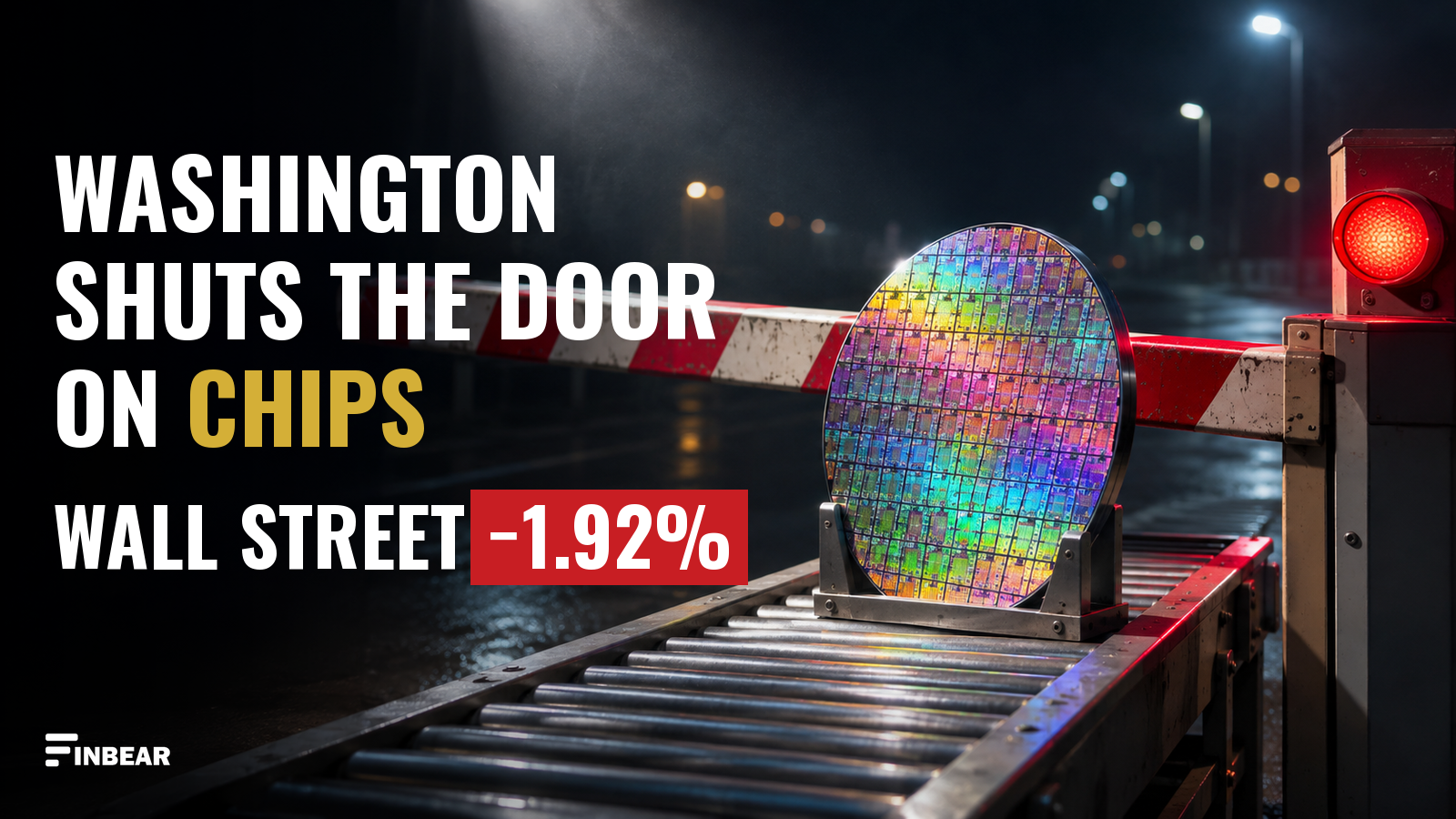
On Monday Wall Street sold artificial intelligence before it had even heard the case. The S&P 500 lost 1.92%, the Nasdaq 2.49% and the semiconductor index 5.28%, while the VIX jumped 18.70%. The same day, the Commerce Department closed the route that carried American chips into China through data centers in Southeast Asia. Every one of the Pretore’s index signatures flipped from long to active short. Nvidia reports tonight after the close, and Anthropic’s IPO prices tomorrow.
Table of Contents
- 🧭 Before You Open the Terminal
- Key Indicators Dashboard
- 🗿 The Pretore Today
- 🧭 Compass of the Day
- 📐 Yield Curve
- 🏦 Banks: Large vs Regional
- Executive Summary
-
News in Detail
- 1. Nvidia heads into its results with a national-security committee and without Huang
- 2. Washington shuts the chip back door: licenses for five countries
- 3. Monday’s session: S&P 500 −1.92%, and Warsh puts falling stock prices on the table
- 4. The Fed and the dollar: a December hike priced in and the dollar at its highest since April 2025
- 5. Oil: the supply glut outweighs the attacks in the Gulf
- 6. Bitcoin below $65,000, with fear at its peak
- 7. Tuesday’s earnings: Disney and Home Depot beat, PepsiCo downgraded
- 📰 In Brief
- Aggregated Sentiment Table
- Fear and Loathing on Wall Street™
- Cross-Cutting Synthesis
- Strategic Alerts
- Disclaimer & Maxim
🧭 Before You Open the Terminal
📉 Monday’s session
The S&P 500 fell 1.92% to 7,416.59, the Nasdaq Composite 2.49% and the Dow 1.41%. The semiconductor index lost 5.28%, and Nvidia dropped 4.12% to $156.14. The VIX jumped 18.70% to 22.91. Overnight, Taiwan’s stock market had fallen 6% and South Korea’s 3.6%.
📜 The new chip rule
🆕 Selling advanced AI chips to data centers in Singapore, Malaysia, Thailand, Indonesia and Brazil will require a Commerce Department license. The requirement also covers large data centers that give Chinese companies remote access to computing power. The crackdown lands days before Trump and Xi meet in Shenzhen.
🏢 Nvidia tonight
Nvidia reports quarterly results after the close, its first without Huang; the company had guided to revenue of $108 billion. Today the board set up a standing committee on national security and export controls. On Monday several sources reported that the board is not considering bringing Huang back.
🏛️ The Fed and the dollar
Fed Chair Kevin Warsh laid out three scenarios for artificial intelligence, and in one of them stock prices fall while unemployment rises. A December rate hike is still fully priced in, and the dollar index reached its highest level since April 2025.
Verdict
🔴 High priority — Fantiborsa’s take: On Monday the market passed sentence before the trial. It sold Nvidia without waiting for the numbers, sold chips without reading the rule and bought dollars without waiting for clarity from the Fed. Tonight the numbers get their say. The Pretore, meanwhile, has already flipped every index signature.
Trust me: today it’s worth finding five minutes to read the whole thing ☕
Key Indicators Dashboard
| Indicator | Value | Change | Reading | Signal |
|---|---|---|---|---|
| S&P 500 | 7,416.59 | −1.92% | RSI 40.2; below the SMA50 (7,661.42), above the SMA200 (7,342.71); Pretore active short; futures +0.08% before the open | |
| Nasdaq (COMPQ) | 24,509.76 | −2.49% | RSI 37.1; below the SMA50 (26,310.13) and SMA200 (25,142.65); Pretore active short | |
| Nasdaq-100 (NDX) | 27,197.15 | −2.67% | RSI 37.6; below the SMA50 (29,459.00) and SMA200 (28,047.57); Pretore active short; futures +0.46% before the open | |
| Philadelphia Semi (SOX) | 9,610.65 | −5.28% | RSI 37.8; below the SMA50 (11,537.46) and SMA200 (10,892.27); Pretore active short | |
| Dow Jones | 51,608.17 | −1.41% | RSI 45.5; below the SMA50 (51,937.75), above the SMA200 (50,770.69); Pretore active short; futures −0.41% before the open | |
| Russell 2000 ETF (IWM) | 272.94 | −1.66% | RSI 42.9; below the SMA50 (280.30) and SMA200 (279.48); Russell futures −0.40% before the open | |
| VIX | 22.91 | +18.70% | Above the SMA50 (17.61) and SMA200 (18.50); RSI 57.0; Pretore active long on its reference ETF (VIXY); 22.41 before the open | |
| US 2Y | 4.83% | −5 bp | The short end eases after a week of sharp gains in yields | |
| US 10Y | 5.12% | −3 bp | Still above 5%; RSI 58.0 | |
| 2s10s spread | 29 bp | +2 bp | The curve is still flat, with the short end falling more than the long end | |
| DXY | 103.55 | +0.14% | RSI 68.2; above the SMA50 (101.60) and SMA200 (99.92); Pretore active long on its ETF | |
| Gold | 3,853.00 | −0.86% | RSI 35.3; below the SMA50 (4,157.54) and SMA200 (4,463.84); Pretore active short; futures 3,871.00 (+0.47%) before the open | |
| Silver | 46.78 | −4.58% | RSI 32.1; below the SMA50 (57.72) and SMA200 (68.08); Pretore active short | |
| WTI | 85.72 | −3.21% | Below the SMA50 (95.12) and SMA200 (88.00); Pretore active short; 86.18 (+0.53%) before the open | |
| Brent | 92.44 | −3.55% | Below the SMA50 (104.09) and SMA200 (94.24); Pretore active short; 92.86 (+0.46%) before the open | |
| EUR/USD | 1.1001 | −0.24% | Close taken from the StockCharts chart; change measured against Friday’s close (1.1027); Pretore active short on its ETF; 1.0994 before the open | |
| BTC | 64,820.54 | −0.05% | RSI 24.0; below the SMA50 (78,989.38) and SMA200 (72,797.88); Pretore active short | |
| ETH | 1,817.98 | −0.07% | RSI 25.9; below the SMA50 (2,343.32) and SMA200 (2,137.96); Pretore active short | |
| Crypto Fear & Greed | 10 | — | Extreme fear, reading for November 16; the lowest since June 2026, according to Cointelegraph |
Closing levels for Monday, November 16, 2026. Prices, RSI and moving averages come from StockCharts and Yahoo Finance, with gold and silver taken from the futures series. Closes and changes for the VIX, WTI, Brent and EUR/USD are checked against StockCharts charts; their moving averages come from Yahoo Finance. Treasury yields are official U.S. Treasury data for November 16, with changes measured against November 13. Bitcoin and ether show Monday’s close, which is the latest daily close available this morning. Futures and quotes before the Wall Street open: Yahoo Finance, as of about 1:15 p.m. CET; WTI, Brent and EUR/USD from the StockCharts chart.
The Pretore Today
U.S. index signatures. The S&P 500, Nasdaq-100, Composite, Dow and semiconductor signatures have all flipped from long to active short. Every index closed below its Consensus AVWAP: the S&P 500 by 1.64%, the Dow by 1.08%, the Composite by 3.07% and the Nasdaq-100 by 3.12%. For semiconductors the Consensus uses equal weights, because the index's volume data aren't reliable, and the index sits 4.89% below it. The VIX signature, read through its reference ETF, VIXY, stays in active long.
Polarity flip: yes. Since the November 16 RADAR, the signatures on the S&P 500, Nasdaq-100, Composite, Dow, semiconductors, WTI and Brent have flipped from long to active short. The signature on the Treasury ETF has gone the other way, from short to active long.
The awkward signatures. First is the Dow. Its signature turned to active short while the index was still 0.06% above 51,579.35. Until Friday that level would have invalidated the old signature; today it is the first target. The Pretore spoke before price broke it. Second is gold: active short, with the price just 0.11% below $3,857.25 an ounce, the level above which the signature lapses. Third is the financial sector (XLF), the only sector whose signature is in active long, with price 0.67% above the Consensus AVWAP.
Macro convergence. The dollar, read through its ETF, stays in active long and the euro in active short. For rates, the Pretore tracks an ETF of 7- to 10-year Treasuries, now in active long: bond prices rise as yields fall. Gold, silver and copper stay in active short, and WTI and Brent move into active short. A stronger dollar and falling yields in the same session: that is what a flight to safety looks like.
$SPX operating levels: close 7,416.59 · AVWAP Consensus 7,540.16 (−1.64%) · closing invalidation 7,593.44 (+2.38%) · support 7,319.48 (−1.31%). The Consensus AVWAP is the volume-weighted average the Pretore uses as a structural anchor for prices. The active short signature lapses on a close above the invalidation level; that level is not a stop-loss order.
The overall read. In one session the Pretore reversed its verdict on every index, including the Dow, which had been propping up the market on Friday. The macro picture moves with the turn: the dollar up, yields down, commodities down. Only the financial sector is still standing. This is a market that has stopped betting on AI holding up and is taking cover before Nvidia reports.
Snapshot as of November 17, 2026 (reference close November 16).
Compass of the Day
FINBEAR Compass™ · $SPX · Nov 16, 2026
  VERDICT           CONFIRMED          — recent momentum confirms the regime
  OPERATING REGIME  Strong bear
  LINEARITY         Non-linear trends
  COHERENCE         full
  RELIABILITY       SUSPENDED
  POSITION          --- far below      — below the underlying trend
  UNDERLYING TREND  Persistent bull    — solid
After Monday's session, the Compass sees the S&P 500's recent momentum lining up again behind its strong-bear regime, so the verdict moves from contested to confirmed. Coherence is full, meaning signals across the different time horizons point the same way. Reliability stays suspended, though, because the medium-term signal isn't clear-cut. The short-term regime runs against an underlying trend that is still rising, persistent and solid. Put simply, this is a correction inside a long-term uptrend that remains intact, with price well below the trend line.
The Nasdaq-100 and the Composite show the same picture, except that the Composite's price path is smoother. In semiconductors, momentum confirms the strong-bear regime with medium reliability, and price sits far below an underlying trend that is still rising. The Dow is in a bear regime rather than a strong-bear one, with reliability suspended and price below its own rising underlying trend. The financial sector goes its own way. It is in a strong bull regime, climbing unusually fast, and recent momentum neither confirms nor contradicts that regime. Its signals across horizons disagree and reliability is suspended; price is within its usual range, and the underlying uptrend is fragile.
Yield Curve
U.S. Treasury Curve · Nov 16, 2026
  SHAPE       flat
  MOVEMENT    bull steepening
  MACRO       normal
For the economy: On Monday the curve steepened a little because two-year and 10-year yields both fell, the two-year more than the 10-year. That is the typical pattern on a day of heavy stock selling, when money looks for shelter in government bonds. Fed expectations haven't moved, though. A December hike is still fully priced in, and the 10-year yield is still above 5%.
For banks: Between two and 10 years the curve tilts up slightly, but the very short end, which drives funding costs, isn't coming down. For net interest margins the signal is weak. In any case, the financial sector fell with the rest of the market on Monday, as the next section shows.
Banks: Large vs Regional
XLF · KBWB · KRE — financial sector
- XLF (sector) — at $58.18 (−0.85%), RSI 57.9, above its 50- and 200-day averages ($55.97 and $53.97). The Pretore's signature stays in active long, with invalidation at $56.6875, 2.57% lower; price is 0.67% above the Consensus.
- KBWB (large banks) — at $88.81 (−1.51%), RSI 48.6, below its 50- and 200-day averages ($89.53 and $89.11). Price is resting on support around $88.65, 0.18% lower; resistance is around $90.46, 1.86% higher.
- KRE (regionals) — at $72.19 (−0.76%), RSI 49.9, above its 50- and 200-day averages ($71.66 and $71.24). Price has slipped below the middle of the zone that served as support on Friday but stays inside the band between $71.93 and $72.92. The first level above is around $72.52, 0.46% higher, and support is around $71.24, 1.31% lower.
On Monday the large banks fell twice as much as the regionals, which is the opposite of what you would expect if rates were the problem. This was indiscriminate selling, not a verdict on margins. The big banks are more exposed to the stock market and to trading, so they took a bigger hit from the selloff in AI stocks.
KBWB and KRE under watch — a reading, not a signal.
Executive Summary
🎬 The day in one line
On Monday the S&P 500 fell 1.92%, semiconductors 5.28% and Nvidia 4.12%. The Commerce Department required licenses for chips bound for five countries, Warsh sketched a scenario in which stock prices fall, and the Pretore moved every index signature to active short.
🏢 Nvidia and Washington
- The rule. 🆕 Advanced chips headed to Singapore, Malaysia, Thailand, Indonesia and Brazil will need a license, as will giving Chinese companies remote access to computing power.
- The company. 🆕 The board sets up a standing committee on national security and export controls; according to several sources, it isn’t considering a return by Huang.
- Beijing. China’s foreign ministry promises countermeasures, days before Trump and Xi meet in Shenzhen.
📉 The market and the Fed
The VIX rose to 22.91, the dollar index hit its highest since April 2025, and bitcoin stayed below $65,000. Warsh sketched a scenario of disappointing AI investment, falling stock prices and rising unemployment. A December rate hike is still fully priced in.
⏳ The bottom line
As we wrote in the November 16 RADAR, the thesis would be invalidated if, in the same session, the Composite closed below 24,997.67 and the Dow closed below 51,579.35. On Monday the Composite closed at 24,509.76, below that threshold. The Dow closed at 51,608.17, still 28.82 points above its own. On paper the thesis survives, but the Pretore has already reversed its verdict on every index: the pause in chips has turned into a correction across the tech sector.
Pretore vs thesis. Signature of the day on $SPX: active short — in line with today’s thesis of a tech correction spreading to the broader market; invalidation is at 7,593.44, 2.38% higher. The Nasdaq-100, Composite, Dow and semiconductor signatures, all in active short, agree. The thesis is invalidated if, by Friday, November 20, the S&P 500 closes above 7,593.44 and, in the same session, the Composite closes above 24,997.67.
News in Detail
1. Nvidia heads into its results with a national-security committee and without Huang
What happened
✅ Nvidia’s board of directors today created a standing committee on national security and export controls, chaired by director Suzanne Nora Johnson. The company’s national-security and export-compliance teams will report to the committee and to interim chief executive Colette Kress (Reuters; ANI).
✅ On Monday, reports said the board is not considering a return by Jensen Huang (Yahoo Finance; Decrypt). ✅ The same day, Trump said he would have no objection if Huang came back (The Hill).
✅ The stock fell 4.12% on Monday to close at $156.14, and was up 0.76% before today’s open (Yahoo Finance).
✅ Results for the quarter ended in October are due tonight, after the market closes. The company had guided to revenue of $108 billion, plus or minus 2%, and a gross margin of around 74%. ✅ Analysts expect about $109 billion in revenue, above the midpoint of that range, and adjusted earnings of $2.47 to $2.49 a share (Forex.com; Earnings Whispers).
As we wrote in the November 16 RADAR, the Treasury had given Nvidia ten days to explain how its chips ended up in China and had called for a chief executive from outside the company. Today’s committee is the company’s first answer, and it arrives hours before the results.
What sources say
“We are committed to working constructively with government and industry partners” — Harvey Jones, Nvidia’s board chair (Reuters)
FINBEAR Take: the committee talks to Washington, the results talk to the market
The committee won’t sell a single extra chip. Its job is to show the Treasury, the Commerce Department and Congress that the board has taken charge of export compliance. It’s a defensive move, made the day after Washington cracked down on sales to the very countries through which chips were allegedly reaching China. Nvidia is speaking the regulator’s language before anyone forces it to.
Tonight the market will be listening for something else. The quarter closed before the scandal broke, and the numbers may well be good. The weak spot is expectations. According to estimates compiled by Forex.com and Earnings Whispers, analysts are already looking for more than the midpoint of the company’s guidance. On Monday the stock fell 4.12% without waiting for the results. Selling ahead of the results means investors doubt the outlook for the current quarter, not the numbers for the one just ended.
Cui prodest? The board, which shows up in Washington with oversight already in place, before anyone makes it mandatory, and rivals that can pitch themselves to customers as suppliers with nothing to hide. The losers are those who bought Nvidia betting on Huang’s return: the board has closed that door.
For investors
Instruments involved:
- Stocks: $NVDA, $AMD, $AVGO
- ETFs: $SMH, $SOXX, $QQQ
- Other instruments: $NVDA options for tonight’s results
Opportunities:
A quarter that closed before the scandal, with revenue above guidance, could remind the market how much the company still sells
Risks:
Cautious guidance for the current quarter or a margin below expectations: if analysts’ estimates really sit above the midpoint of the range, it won’t take much to disappoint
What to avoid:
Buying in the hope that Huang comes back: reports say the board isn’t considering it
Bottom line:
The committee reassures Washington; tonight the guidance has to reassure the market.
Impact: (3/5) — Decisive results, high expectations and leadership in transition
2. Washington shuts the chip back door: licenses for five countries
What happened
✅ On Monday the Commerce Department’s Bureau of Industry and Security released an interim rule, drafted at the direction of the Treasury and the National Security Council. Exporting advanced AI chips to Indonesia, Malaysia, Singapore, Thailand and Brazil will now require a license (Fortune; The Next Web).
✅ Large data centers in any country will also need a license to give China-based companies remote access to computing power, and those that already have such customers get 90 days to comply. Recipients headquartered in the United States are exempt, very likely including Microsoft, Oracle and Amazon, although the limits on remote access still apply to them (Fortune). ✅ The rule takes effect when it is published in the Federal Register, the U.S. government’s official journal; publication is expected on Thursday, November 19 (Converge Digest).
✅ It is the administration’s first response to the scandal that engulfed Huang (Nextgov). At the center of the investigation is Megaspeed, a Singapore company suspected of funneling Nvidia chips into China; the company denies the allegations (Fortune).
✅ On Tuesday China’s foreign ministry said it would take the steps needed to defend the country’s interests (Bloomberg). 🔸 According to Bloomberg, Xi has to decide how to respond before he meets Trump this week at the APEC summit in Shenzhen (Bloomberg).
✅ The semiconductor index fell 5.28% on Monday to 9,610.65 (StockCharts). ✅ Before the open, CoreWeave and Nebius were already down more than 5% (TipRanks).
As we wrote in the November 16 RADAR, Nvidia’s rivals had given back part of their gains on Friday. On Monday the rule caught up with all of them. It isn’t aimed at one company; it targets the routes by which chips reach China.
What sources say
“For Malaysia, the controls could be disastrous” — Joshua Kurlantzick, Council on Foreign Relations (Fortune)
“necessary measures” — China’s foreign ministry (Bloomberg)
FINBEAR Take: the back door shuts, the store stays open
The rule doesn’t ban chip sales. It requires permission to sell in the places through which Chinese demand, barred from buying directly, used to flow. For American companies running data centers abroad, little changes. For local operators in Singapore and Malaysia, a great deal does. In effect it’s a toll on Southeast Asian demand, in a region whose data centers grew fast on the back of the very customers they now need a license to serve.
The market read it as broadly as it could and sold the whole semiconductor index, not just the companies selling into those five countries. That’s how investors react when they fear this is only the first rule. According to experts quoted by Fortune, proposals in Congress for tougher controls now stand a better chance of passing. The real cost will become clear at the Shenzhen summit, once Xi has decided how to respond.
Cui prodest? The big American data-center operators, which are exempt from the licensing requirement and become the gateway anyone seeking computing power in Southeast Asia has to go through. The losers are local operators in Singapore and Malaysia and the chipmakers that were counting on that demand.
For investors
Instruments involved:
- Stocks: $NVDA, $AMD, $AVGO, $MU
- ETFs: $SMH, $SOXX, $EWS, $EWM
- Futures/Commodities: Nasdaq-100 futures
- Other instruments: AI cloud providers $CRWV, $NBIS, U.S. data-center operators $MSFT, $ORCL, $AMZN
Opportunities:
The exempt U.S. operators can capture Southeast Asian demand that now has to go through licensing
Risks:
A Chinese response before the summit, on rare earths or through probes of American companies, would hit the whole sector
What to avoid:
Treating Monday’s selloff as a buying opportunity: the rule has been issued, and its effect on revenue hasn’t reached the financial statements yet
Bottom line:
Washington now controls the sales routes, not just the product: the risk lies in where chips get sold.
Impact: (3/5) — Licenses in five markets and the risk of a Chinese response before the summit
3. Monday’s session: S&P 500 −1.92%, and Warsh puts falling stock prices on the table
What happened
✅ On Monday the S&P 500 lost 145.08 points, or 1.92%, to 7,416.59. The Nasdaq Composite shed 626.51 points, or 2.49%, to 24,509.76, and the Dow dropped 739.38 points, or 1.41%, to 51,608.17 (Reuters). ✅ The VIX rose 18.70% to 22.91 (StockCharts). ✅ MSCI’s index of world stocks fell 1.8%. Overnight in Asia, South Korea’s market had lost 3.6% and Taiwan’s 6%; in Europe, stocks closed less than 0.3% lower (Reuters).
✅ The same day, in San Francisco, Fed Chair Kevin Warsh described three hypothetical scenarios for artificial intelligence. In one of them, AI investment disappoints, bringing lower expected returns, falling valuations, a slower economy and higher unemployment (Axios; Financial Markets). ✅ The Fed’s Financial Stability Report, released on Friday, November 13, devotes a section to how data-center construction is being financed (Axios).
✅ Futures were mixed before the open. S&P 500 futures were up 0.08% and Nasdaq futures 0.46%, while Dow futures were down 0.41% (Yahoo Finance). ✅ On Tuesday European markets slipped on worries about artificial intelligence, with the DAX down 0.62% and Deutsche Bank lower (Reuters, via Yahoo Finance).
What sources say
“equity valuations could fall” — Kevin Warsh, Fed Chair, in one of the three scenarios (Financial Markets)
FINBEAR Take: the Fed puts the worst case on paper
Three things weighed on stocks at once on Monday: the chip rule, the uncertainty around Nvidia and a Fed chair publicly describing a scenario in which the bet on artificial intelligence goes wrong. Warsh didn’t present it as a forecast. Still, a central banker who walks through the worst case, days after the Fed gave data-center financing its own section in a report, is already working out what it would cost.
Then there’s Anthropic. An offering of more than $57 billion needs buyers, and buyers often sell something else to make room. On Monday the market sold exactly what looks most like Anthropic: the AI stocks that are already listed.
Cui prodest? Those who were already hedged, as the VIX jumped 18.70% and the dollar hit its highest since April 2025. The losers are funds holding leveraged bets on AI stocks and anyone who bought chip stocks on Friday counting on a rebound.
For investors
Instruments involved:
- Stocks: $SPY, $QQQ, $SMH, $IWM
- Futures/Commodities: S&P 500 and Nasdaq-100 futures
- Other instruments: volatility $VIXY, S&P 500 put options as a hedge
Opportunities:
With the VIX above 22, hedging costs more, but selling options pays better for those with cash on hand
Risks:
Another session like Monday’s would take the S&P 500 below 7,319.48, the first target of its active short signature
What to avoid:
Chasing the bounce in futures ahead of Nvidia’s results: Dow futures were still down before the open
Bottom line:
On Monday the market sold the risk before sizing it up.
Impact: (4/5) — Broad-based selling, with every index signature in active short
4. The Fed and the dollar: a December hike priced in and the dollar at its highest since April 2025
What happened
✅ On Monday the dollar index hit its highest level since April 2025 (Reuters). ✅ A December rate hike is fully priced in (Reuters). ✅ Rate futures price in at least three hikes by the end of 2027 (Reuters).
✅ On Friday Chicago Fed President Austan Goolsbee told CNBC that inflation is rising and proving much more persistent than expected (CNBC). ✅ On Saturday Boston Fed President Susan Collins said she favors gradual, modest hikes and opposes a more aggressive step (Reuters).
✅ On Monday the 10-year Treasury yield slipped to 5.12% and the two-year to 4.83% (U.S. Treasury). ✅ The minutes of the Fed’s last meeting come out on Wednesday the 18th (Federal Reserve). ✅ The October PCE price index, the next inflation reading before the December 8-9 meeting, is due on Wednesday, November 25, at 2:30 p.m. CET, together with the second estimate of third-quarter GDP (BEA).
As we wrote in the November 16 RADAR, the 10-year yield had climbed to 5.15% after the producer price data. On Monday it eased slightly, but only because investors were running for safety, not because they expected fewer hikes.
What sources say
“a steady, gradual path seems appropriate to me at the moment” — Susan Collins, Boston Fed President (Reuters)
FINBEAR Take: the dollar up, yields down, and nobody talking about a cut
On Monday the dollar rose while yields fell. The two usually move together. When they split like this, the dollar is rising not on rates but as a safe haven, which is how a market behaves when it dumps stocks and goes looking for cash in the world’s reserve currency.
The catch is that lower yields don’t open the door to easing. A December hike is still fully priced in, and the Fed is only debating how far to go. Goolsbee talks about inflation that is more persistent than expected; Collins wants a gradual pace, but a gradual pace of hikes. For AI stocks, valued on earnings far in the future, it’s the worst of both worlds: rising rates and a Fed that, through Warsh, admits it doesn’t know whether the investment will pay off.
Cui prodest? Holders of dollars, and of short-dated Treasuries that yield more than the Fed’s own rate. The losers are companies borrowing to build data centers and emerging markets carrying dollar debt.
For investors
Instruments involved:
- Stocks: $UUP, $FXE, $SHY, $IEF, $TLT
- Futures/Commodities: two-year and 10-year Treasury futures and fed funds futures
- Other instruments: EUR/USD and USD/JPY
Opportunities:
Short-dated Treasuries: the two-year yields about 4.8%, above the Fed’s target range (3.75%–4.00%)
Risks:
A hotter-than-expected PCE reading on November 25 would put a half-point hike back in play and push the 10-year yield higher again
What to avoid:
Reading Monday’s dip in yields as the start of a cutting cycle: no Fed official is hinting at one
Bottom line:
The dollar is rising on fear, and rates are staying high on inflation: two different reasons, one loser — riskier assets.
Impact: (2/5) — December hike priced in and the dollar at its highest since April 2025
5. Oil: the supply glut outweighs the attacks in the Gulf
What happened
✅ On Monday Brent fell 3.55% to $92.44 a barrel and WTI 3.21% to $85.72, and both closed below their 200-day moving averages (StockCharts). ✅ According to Reuters, prices fell on signs that traffic through the Strait of Hormuz is resuming, even as attacks on tankers continue. According to Dennis Kissler of BOK Financial, global supplies remain steady (Reuters).
✅ ExxonMobil has started production at its Uaru field, lifting Guyana’s production capacity to 1.1 million barrels a day (Oilprice.com). ✅ In the United States, gasoline prices at the pump have fallen to their lowest since March as supply recovers (Bloomberg). ✅ Copper fell 1.43% to $13,207.50 a metric ton (Reuters).
✅ Before the open, Brent was up 0.46% at $92.86 and WTI 0.53% at $86.18 (StockCharts).
As we wrote in the November 16 RADAR, the Pretore’s Brent signature was in active long, with invalidation at $93.7833. On Monday Brent closed below that level, and the Brent and WTI signatures both flipped to active short.
What sources say
“we do not see a case for further hikes in 2027” — Mohit Kumar, Jefferies, in a scenario with a ceasefire and oil below $80 (Reuters)
FINBEAR Take: the oil market has stopped being afraid
On Monday Brent closed below its 200-day average and more than $11 a barrel below its 50-day, and none of the attacks on tankers was enough to stop the slide. When bad news from the Gulf no longer lifts the price, the market is watching supply instead: Hormuz reopening, Guyana pumping more, American gasoline at its lowest since March.
For the Fed it’s the only good news of the week, since cheaper crude takes some pressure off energy inflation. It isn’t enough to call the December hike into question, though. In Jefferies’ view, it would take a ceasefire in the Middle East and oil below $80 a barrel to remove the case for more hikes in 2027.
Cui prodest? American consumers, who pay less at the pump, along with airlines and freight carriers. The losers are crude producers and the funds that bet on a Hormuz crisis when Brent was above $100.
For investors
Instruments involved:
- Stocks: $XOM, $CVX, $COP
- ETFs: $XLE, $USO, $BNO
- Futures/Commodities: WTI and Brent futures
- Other instruments: airlines $JETS
Opportunities:
Airlines and freight carriers benefit from cheaper fuel at a time when the market is selling growth stocks
Risks:
A fresh attack in the Strait could push Brent back above $93.27, the level above which its active short signature lapses
What to avoid:
Chasing the decline with leveraged positions: news from the Gulf can turn the price around in a single session
Bottom line:
Oil is no longer pricing the war. It’s pricing supply.
Impact: (1/5) — Crude lower, less pressure on prices · The other side: crude producers hurt
6. Bitcoin below $65,000, with fear at its peak
What happened
✅ Bitcoin closed Monday at $64,820.54 (−0.05%) (StockCharts). ✅ It is down about 16% since the start of November, its second-worst start to November since 2016 (Yahoo Finance).
✅ U.S. bitcoin ETFs took in net inflows of $7.9 million on Monday, ending seven straight sessions of outflows (Farside Investors). ✅ The Crypto Fear & Greed Index stayed at 10 on Monday the 16th (Alternative.me), its lowest level since June according to Cointelegraph (Cointelegraph). ✅ Forced liquidations of leveraged crypto positions reached $2 billion over the weekend (Decrypt).
✅ The Lighter platform temporarily suspended withdrawals after an operator’s access keys were compromised. Analysts estimate the losses at about $15.5 million, though the company hasn’t confirmed that figure. Withdrawals have since resumed (The Block).
As we wrote in the November 16 RADAR, bitcoin had fallen as low as $62,112 after seven days of ETF outflows. The Pretore’s signature stays in active short.
What sources say
No direct statements attributable to primary sources are available for this story.
FINBEAR Take: the outflows have stopped, the fear hasn’t
On Monday bitcoin did something unusual: it held still while the Nasdaq fell 2.49%. For an asset that has amplified every tech selloff this fall, that counts as a signal. According to Farside, ETF outflows gave way to an inflow, however small. According to Cointelegraph, the Crypto Fear & Greed Index is at its lowest since June, deep in extreme-fear territory.
None of that means bitcoin has hit bottom. The signature is still in active short, with the price just over half a percent below the level above which it lapses, and the Lighter incident is a reminder that the industry is still paying for its fragility. A Crypto Fear & Greed reading of 10 describes an exhausted market, not one that has started buying again.
Cui prodest? Patient buyers, who step in when fear is at its peak and, if Farside’s figures hold up, when outflows are on pause. The losers are companies holding bitcoin bought at higher prices and traders using leverage on the less protected platforms.
For investors
Instruments involved:
- Stocks: $BTCUSD, $ETHUSD, $COIN, $HOOD, $MSTR, $CRCL
- ETFs: $IBIT, $FBTC
- Futures/Commodities: CME bitcoin futures
Opportunities:
With fear at an extreme and, according to Farside, outflows on pause, buying in stages may make sense for long-term holders
Risks:
A close below $62,148, the first target of the active short signature, would open the way to a new low for the year
What to avoid:
Using leverage on platforms just hit by security incidents
Bottom line:
Bitcoin has stopped falling with the Nasdaq. It hasn’t started rising on its own yet.
Impact: (2/5) — Bitcoin below $65,000, RSI at 24 and extreme fear
7. Tuesday’s earnings: Disney and Home Depot beat, PepsiCo downgraded
What happened
✅ Disney closed its fiscal year with fourth-quarter revenue of $25.9 billion, up 16%, against estimates of $25.2 billion. ✅ Adjusted earnings came to $1.77 a share, versus $1.68 expected (Disney, letter to shareholders). ✅ Streaming revenue grew 19% to $6.1 billion, and the total number of guests at its parks and on its cruises rose 11%, or 4% excluding the fiscal year’s extra week. New chief executive Josh D’Amaro is targeting $3 billion in savings (Yahoo Finance).
✅ Home Depot reported adjusted earnings of $3.86 a share on revenue of $43.4 billion, with comparable-store sales up 2.2% (Home Depot, SEC filing). ✅ Estimates were $3.84 and $42.8 billion (Kiplinger; Yahoo Finance). ✅ On November 23 chief financial officer Richard McPhail becomes chief executive, and Ted Decker stays on as chairman (Bloomberg). ✅ The stock was down 1.94% before the open (Yahoo Finance).
✅ JD.com’s revenue rose 3.5% to 309.6 billion yuan, and adjusted net income jumped 44% to 8.3 billion yuan; the stock was down about 2.7% before the open (Yahoo Finance). ✅ Amer Sports grew revenue 24% and raised its 2026 forecasts (InvestorsHub).
✅ Bernstein downgraded PepsiCo to underperform and cut its price target from $131 to $128, expecting earnings below estimates in North America (Stocktwits).
What sources say
No direct statements attributable to primary sources are available for this story.
FINBEAR Take: the consumer holds up, the companies selling to it a little less
Away from artificial intelligence, the American consumer is still spending: more Disney park tickets, more subscriptions, more money on the home. Yet the market isn’t rewarding anyone. Home Depot beat estimates and slipped before the open; Disney beat estimates and was still flat at 1:15 p.m. CET. On a day of broad selling, even good results only help you lose less.
PepsiCo shows the other side of the same consumer, who is still buying but is choosier about what to buy: Bernstein expects earnings below estimates in North America. The leadership change at Home Depot, meanwhile, is an orderly internal succession, the exact opposite of Nvidia’s.
Cui prodest? Investors who went looking for shelter in consumer stocks during the tech selloff and found results that hold up. The losers are consumer-staples brands that raised prices beyond what their customers will pay.
For investors
Instruments involved:
- Stocks: $DIS, $HD, $JD, $AS, $PEP
- ETFs: $XLY, $XLP
- Other instruments: $DIS options
Opportunities:
Companies beating estimates while their stocks stand still could become a refuge for money leaving tech
Risks:
A consumer slowing under high rates: Home Depot depends on housing, the part of the economy most sensitive to mortgage rates
What to avoid:
Buying PepsiCo as a defensive stock regardless: Bernstein expects earnings below estimates in North America
Bottom line:
Consumer spending is holding up, but on days like this the market doesn’t reward even the companies that beat.
Impact: (1/5) — Consumer results above estimates, but the market isn’t rewarding them
In Brief
- Anthropic. ✅ As we wrote in the November 16 RADAR, the IPO prices tomorrow evening and trading starts on Thursday on the Nasdaq under the ticker ANT. The offering is 825 million shares in a price range of $70 to $78, for a valuation of up to about $1.4 trillion (Yahoo Finance). ✅ At that range, the Anthropic shares sold in FTX's bankruptcy would be worth about $31 billion to $35 billion; the buyers back then included Jane Street, the Ford Foundation and a vehicle linked to Mubadala (Fortune).
- Nvidia's holdings. ✅ In the third quarter Nvidia cut its stake in Intel by 25%, to 161.1 million shares, and its stake in Nokia by 56%. ✅ It raised its SpaceX stake by 6%, to 130.5 million shares, which is now its largest disclosed holding (Nvidia, Form 13F filed with the SEC).
- AMD. ✅ AMD has closed its $8.2 billion acquisition of World Labs (AMD).
- Power bills. ✅ American voters are demanding action on rising electricity bills, and the issue is turning political: Democrats are looking for an answer that doesn't slow investment in artificial intelligence (Fortune).
- S&P 500 earnings. ✅ According to Oppenheimer, with 91% of S&P 500 companies having reported, earnings for the quarter are up 27.4% from a year earlier (Oppenheimer).
Aggregated Sentiment Table
| Cluster | Story | Sentiment | Score |
|---|---|---|---|
| 🧠 AI & Tech | Nvidia’s national-security committee ahead of results | Negative / leadership uncertainty | -15 |
| ⚖️ Regulation | Chip licenses for five countries | Negative / tighter control of sales routes | -20 |
| 🏛️ Geopolitics / Institutions | Monday’s session and Warsh’s scenario | Negative / broad-based selling | -20 |
| 💰 Central Banks | December hike priced in, dollar at its highest | Negative / high rates | -10 |
| 🔋 Energy | Oil below its 200-day average | Positive / less energy inflation | +5 |
| 🪙 Crypto | Bitcoin below $65,000 | Negative / extreme fear | -10 |
| 📊 Earnings | Disney and Home Depot beat, PepsiCo downgraded | Positive / consumer holding up | +5 |
| Net Score | -65 |
Fear and Loathing on Wall Street™
Anxiety — Index: -23

Registry comparison: the last recorded reading is +3 (Neutral), from November 16, based on the close on Friday, November 13. One session has gone by since then. On Monday the S&P 500 fell 1.92% and the semiconductor index 5.28%, the VIX rose from 19.30 to 22.91, and every index signature flipped from long to active short.
Reading. On Monday fear stopped being a hypothesis. The Commerce Department tightened the rules, the Fed chair described the case in which artificial intelligence disappoints, and the Pretore flipped every index signature. It isn’t panic yet: the VIX is still below 23, and Nasdaq futures were bouncing before the open. This is a market that has already sold and is waiting for tonight to learn whether it sold too much or too little.
Cross-Cutting Synthesis
Today’s seven stories tell the same day from seven angles. Washington tightens the chip rules exactly where Chinese demand used to pass through. Nvidia answers with a national-security committee and heads into its results without its founder. The market sells anything that smells of artificial intelligence, while Warsh describes the case in which AI investment disappoints. Meanwhile the dollar rises as a safe haven, oil falls on a supply glut, bitcoin holds still with fear at its peak, and consumer earnings hold up without anyone rewarding them.
What ties them together is faith in artificial intelligence as the market’s only engine. For two years the market paid in advance for the gains the technology would bring. On Monday, in a single session, it watched the regulator narrow the sales routes, saw the sector’s leading company without a leader and heard the central bank describe a case in which the investment doesn’t pay off. The Pretore records the turn: every index signature flips from long to active short, and the Compass confirms a strong-bear regime inside an underlying trend that is still rising.
The November 16 thesis stopped 28.82 points short of invalidation, because the Composite broke its threshold and the Dow didn’t. Today’s thesis is a different one, though, and the calendar offers no breathing room. Nvidia reports tonight, Anthropic’s IPO prices tomorrow alongside the Fed minutes, and Trump and Xi meet in Shenzhen later this week.
Cui prodest? Those who were already hedged, with the VIX up 18.70%; holders of dollars and short-dated Treasuries; and the American data-center operators exempt from the new licensing requirement. The losers are chipmakers exposed to Southeast Asia, those who bought AI stocks with leverage, and those waiting for Huang to come back.
📌 Thesis invalidation — This RADAR’s dominant thesis is: the tech correction has spread to the broader market, and the Pretore’s index signatures have flipped to active short. Nvidia’s results, the pricing of Anthropic’s IPO and the Shenzhen summit will show whether this is a short-term correction inside a rising underlying trend or the start of a wider decline.
- Holds because:
- on Monday the S&P 500 fell 1.92%, the Nasdaq 2.49% and semiconductors 5.28%, and the Pretore’s signatures on every index flipped to active short;
- the Commerce Department imposed licenses on chips bound for five countries, and China promised countermeasures;
- the counterweight: the Dow is still above its old invalidation level, the Compass sees an underlying trend that is still rising, and Nasdaq futures were bouncing before the open.
- Invalidated if: the S&P 500 closes above 7,593.44, the level above which its active short signature lapses, and in the same session the Nasdaq Composite closes above 24,997.67, the level above which its own signature lapses.
- By: the close on Friday, November 20, after Nvidia’s results on the 17th, the pricing of Anthropic’s IPO and the Fed minutes on the 18th, and Anthropic’s market debut on the 19th.
- In that case: FINBEAR’s read would shift from a correction that is spreading to a one-day selloff absorbed by Nvidia’s results. The market would have sold the fear, not the fundamentals.
Strategic Alerts
active short on the 7,416.59 close; closing invalidation at 7,593.44 (+2.38%); support at 7,319.48 (−1.31%).
active short on the 27,197.15 close; closing invalidation at 28,745.85 (+5.69%); support at 27,162.59 (−0.13%); below the 200-day average (28,047.57).
active short on the 24,509.76 close; closing invalidation at 24,997.67 (+1.99%); support at 24,382.59 (−0.52%).
active short on the 9,610.65 close; closing invalidation at 10,841.40 (+12.81%); support at 8,442.54 (−12.15%).
active short on the 51,608.17 close; closing invalidation at 52,860.32 (+2.43%); support at 51,579.35 (−0.06%).
active long on its reference ETF, VIXY (close 19.56); the signature lapses on a VIXY close below 18.4467 (−5.69%).
active long on the 58.18 close; closing invalidation at 56.6875 (−2.57%).
active short on the 3,853.00 close; the signature lapses on a close above 3,857.25 (+0.11%).
active short; Pretore close 46.785; the signature lapses on a close above 48.3375 (+3.32%).
active short on the 85.72 close; the signature lapses on a close above 86.9333 (+1.42%); support at 84.125 (−1.86%).
active short on the 92.44 close; the signature lapses on a close above 93.27 (+0.90%); support at 90.405 (−2.20%).
active short; Pretore close 64,855.84; the signature lapses on a close above 65,206.27 (+0.54%); support at 62,148.54 (−4.17%).
active short; Pretore close 1,819.28; the signature lapses on a close above 1,855.87 (+2.01%).
at about 1:15 p.m. CET, S&P 500 futures +0.08%, Dow futures −0.41%, Nasdaq futures +0.46%, Russell 2000 futures −0.40%; VIX 22.41; gold 3,871.00 (+0.47%) (Yahoo Finance).
Nvidia’s results tonight after the close; the Fed minutes and the pricing of Anthropic’s IPO on Wednesday the 18th, with its Nasdaq debut on Thursday the 19th; the Trump-Xi meeting at the APEC summit in Shenzhen later this week; around November 25, the end of the ten days Treasury Secretary Scott Bessent gave Nvidia; the October PCE price index on Wednesday, November 25; the Fed meeting on December 8 and 9.
Disclaimer & Maxim
This RADAR is independent analysis for a general audience, not advice and not a recommendation. If you read it as a buy order, the problem isn’t the RADAR. On Monday the market sold before it knew anything. If you make any move today before Nvidia reports, at least know that you’re doing it in the dark.