Own Nvidia and your hands are shaking? Or watching it slide and smelling a bargain? Read this before the November 17 earnings.
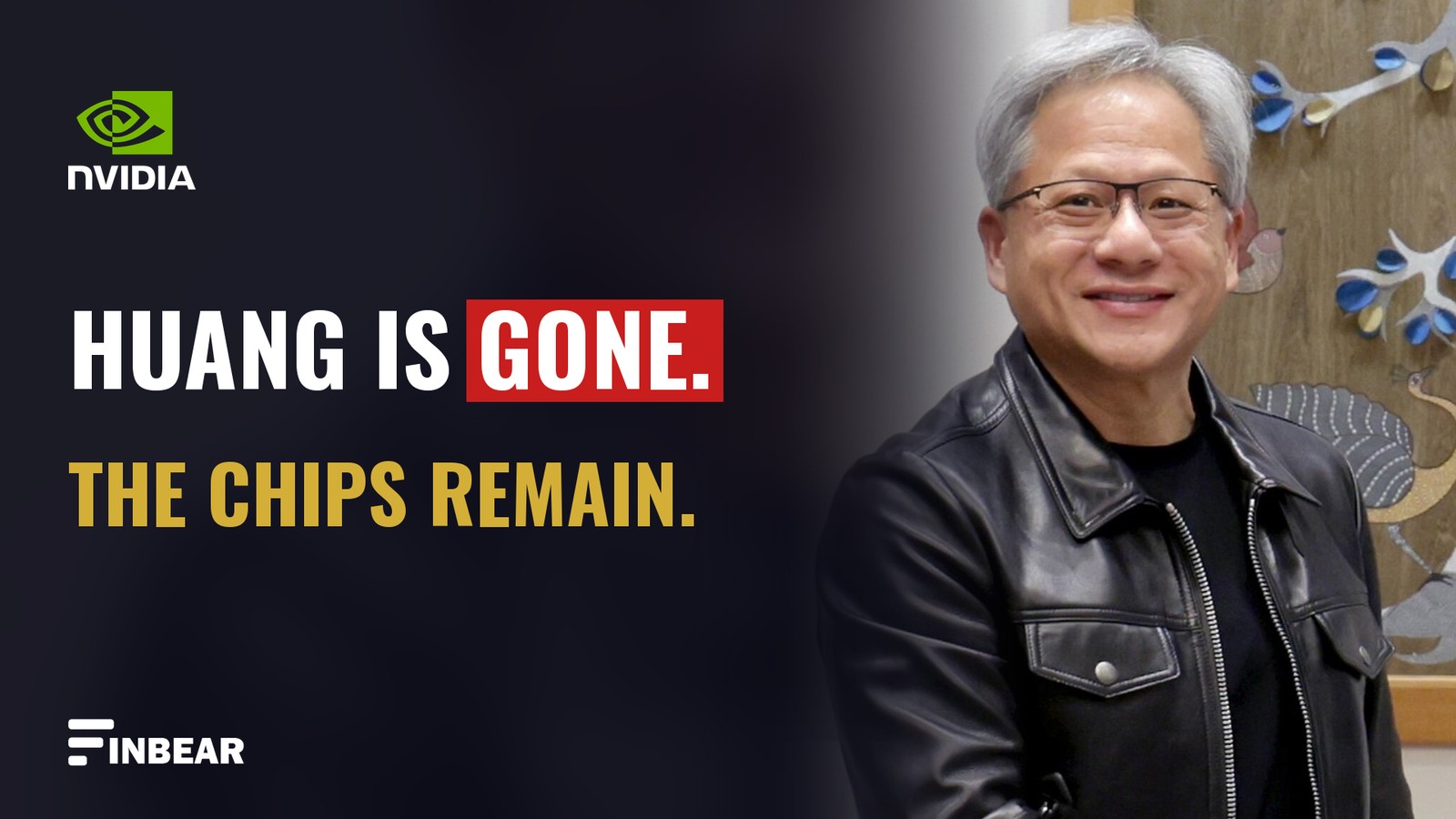
For two weeks the world talked about Jensen Huang’s love life, which is exactly where someone wanted the public looking: at the bedroom, not the control room. Because out of that control room walked the man who decided who got to buy the machines that run artificial intelligence, China included. In 14 days he lost the top job at Nvidia and his board seat (SEC filing). The stock lost a third of its value from its October highs.
Whether you hold the shares or think this price makes them a buy, you need two things, and the order matters. The first is to see that none of this happened by chance; the second is to know what to do before November 17, when Nvidia reports the quarter.
Nothing happens by chance
Here’s the thesis up front. The scandal was a weapon, wielded in America’s fight for control of artificial intelligence. I’m not saying it was invented; I’m saying it was used. Nvidia’s chips train civilian models, and they serve armies too. Calling them products is accounting-speak: they’re an arsenal. Huang wanted to sell them in China as well, arguing that shutting Beijing out would only push it to build its own. The other camp, the one that has been writing export controls since 2022, sees the same sales as handing power to a rival.
Huang had won that round in December 2025, when the White House opened the door to H200 sales. His leverage came down to one thing: Trump’s ear. Then came November 3, when Trump’s party lost the midterms, and both chambers of Congress with them (results); the very next day, November 4, three Republican committee chairs signed a letter summoning Huang to a closed-door briefing (letter). With Huang’s protector weakened, the first shot came from Trump’s own party.
Line up the dates:
- October 29: the New York Times reports that Huang may have been the target of a Chinese operation;
- November 7: the Financial Times reports the affair;
- November 8: Huang admits it;
- November 10: The Information, citing its own sources, ties the woman to $7.5 billion in shipments to China;
- November 11: a second affair surfaces, this one with an executive, and the board accepts his resignation.
Each installment landed with a different audience: the national security establishment, employees, customers, the board. A siege never has to breach the walls. It just waits for the food to run out.
Officials in Washington had known about the suspicions since 2025, and a memo had been making the rounds since the spring (CNN). The file sat in a drawer for months. Then, right around the vote, someone decided it was time to open it.
As for proof of espionage, we’re still waiting. It’s a bit like the evidence for Saddam’s weapons of mass destruction: good enough to start a war in 2003, though the weapons were never found, and in 2004 the New York Times itself admitted it had reported the claims without enough scrutiny (study of the Times review). Today, according to CNN, US intelligence can’t even agree on whether the woman was a spy. While the agencies argue, the corner office already sits empty.
The script is an old one: Profumo in 1963, the FBI’s campaign against Martin Luther King Jr., Petraeus in 2012. Petraeus, like Huang, fell right around an election. Each time, private conduct, real or inflated, became the lever that brought down a public figure. And by the time the charges collapse, it’s too late. The Strauss-Kahn case was dropped in August 2011, but Christine Lagarde had already been chosen to replace him in June. Once the seat is filled, dropping the charges doesn’t turn back the clock.
Which brings us to the question the papers somehow always forget: cui prodest?
- The security establishment benefits. It has been writing the export controls since 2022, and in Huang it saw an obstacle with the president’s number in his phone.
- The congressional hawks benefit. They now want new controls written into the year-end defense bill (Yahoo Finance), and three bills are ready to go, from the AI Overwatch Act to the Chip Security Act (Reuters).
- Treasury, the Pentagon and the State Department benefit. They’d been pushing for a crackdown for months, waiting for Commerce to pick up the pen (AP).
Huang pays, and he loses everything. Trump pays: he loses the man behind his China policy, and the policy goes with him. The final paradox is the sweetest of all. Even Beijing gets to say thank you, because it wanted to wean itself off American chips and now Washington will do the weaning for it. The beneficiaries are lining up, and not one of them had any reason to ask for proof before clearing him out.
And now, your portfolio
Almost everyone missed one detail: the slide didn’t start with the affairs. On November 5, two days after the vote and with no company news at all, Nvidia fell 9.3%, on the Nasdaq 100’s worst day since 2020 (Trefis). The fear was that a Democratic Congress would slow the data center buildout with permitting hurdles, environmental rules and moratorium proposals like the one from Sanders and Ocasio-Cortez (Gotrade). Here, too, the fire came from Washington.
So the stock is being weighed down by two separate things. One is political and goes to demand: how many data centers America will build in 2027. The other is the scandal, and it goes to how the company is run, because for the first time in 33 years its founder isn’t at the helm. The November 17 results cover a quarter that closed on October 25, so they can’t show the effect of the vote yet. The guidance will, along with what management says about orders, and that’s where investors should look.
China barely shows up in the numbers. In the last reported quarter, licensed H200 shipments came to less than 1% of data center revenue (Nvidia 10-Q), and the guidance leaves China out entirely. On the books, China is a bit player. In Washington, it’s the pretext.
Expectations are already high. In August Nvidia guided to roughly $108 billion in revenue for the quarter, with a 74% gross margin and zero data center chip sales in China (Nvidia release), and analysts are looking for a little more: $109 billion in revenue (S&P Global) and earnings of $2.49 a share, above even the $2.47 ceiling Nvidia set for itself (Earnings Whispers). A beat on its own won’t calm the market.
Three things will matter more than the beat. The first is next-quarter guidance, and whether it still supports the 70% growth for fiscal 2028 that CFO Colette Kress forecast in August (Outlook Business). The second is whether any US customer hit pause on orders after the vote, a question that also tops Morningstar’s list (Morningstar).
The third is what Kress says about China, the internal investigation and the succession, on her first call without Huang beside her. The Financial Times reported an approach to Arm chief executive René Haas. The board, though, says it hasn’t formally contacted any candidate and is still picking a search firm (Reuters). Anyone who already knows the names knows more than the board does.
Customers haven’t closed their wallets yet: Amazon, Alphabet, Microsoft, Meta and SpaceX have guided to a combined $242 billion to $270 billion in capital spending for the fourth quarter of 2026, up from the quarter before (HL / Business Insider). Alphabet expects another significant increase in 2027, and Amazon is pointing to materially higher spending in 2027 as well (Reuters).
Still, two cracks are showing. Microsoft cut its 2026 capital-spending estimate to about $170 billion because third-party data center capacity is running late, even while saying demand still outstrips supply. CoreWeave said that if it stuck to contracts already signed, it could spend as much in 2027 as in 2026 (CoreWeave). Slipping construction and stalling budgets: exactly the kind of risk the vote has made more likely.
Wall Street, meanwhile, has split, and nearly all the moves came before the resignation was even announced. Baird and Bernstein moved to neutral and cut their price targets to $200. The other big houses have cooled their enthusiasm and trimmed their targets, but most remain positive (Reuters via KFGO, CNBC). The median target fell to $271, according to Financial Times data as of November 13 (FT Markets). That’s still two-thirds above today’s price. Most analysts are cutting their targets, not their faith in the company’s numbers.
That’s the paradox tempting so many buyers. At $162.85, Friday’s close, Nvidia trades at about 21 times trailing earnings. Measured against the $16.70 a share Goldman Sachs expects for 2027, it’s under 10 times (IndMoney). The company has never earned so much and never been so cheap, and at the end of July it still had $99 billion authorized for buybacks. But a low multiple is only a bargain if the estimates hold. If 2027 data center spending deflates, what looks cheap today will turn out to have been the fair price.
The chart shows a disorderly retreat. The stock has broken below all three moving averages that technicians use to read the trend, at $193, $204 and $215. On Friday it closed at $162.85, after hitting a low of around $150 during the week. The indicators say two things at once: it’s been sold too hard and too fast, yet the selling pressure isn’t exhausted. On average the stock is swinging more than 5% a day, a level of jitters not seen since the April 2025 panic. It’s stretched like a rubber band. It can snap back up, but nobody can tell you when.
As of November 10, options were pricing a move of about 10.6% on the day after the report, against a historical average of 7.8% (MarketPulse), which means the market expects a far bumpier day than usual. Applied to Friday’s $162.85, that implies a rough range of $146 to $180 for the first session after the results, though over the following weeks the stock could break out of it in either direction. Three scenarios follow.
Scenario one: a clean quarter. Revenue beats, next-quarter guidance tops consensus, the 70% growth forecast for 2028 is reaffirmed, US orders show no pause, and the company speaks clearly about the investigation and the succession. A bounce toward $180 is plausible. Between $193 and $215, though, sit the three moving averages, and they now act as a ceiling. Only a sustained return above the long-term average, the 200-day at around $204, would signal a genuine recovery.
Scenario two: no surprises. Results meet expectations, and guidance on post-election orders is cautious or vague. The stock may retest the $150 low and trade sideways until the hearings the Senate has requested for December 3 (Huang) and December 10 (Commerce Secretary Howard Lutnick), and until a new chief executive is named. In this scenario patience costs little and haste costs a lot.
Scenario three: the crack. Guidance below consensus, shrinking margins or a first admission that customers are holding back would put the $150 level at risk of giving way. Below it, the chart has no solid footing until the $130-to-$140 zone where the stock traded in early 2025; estimates would come down, and the low multiple would stop protecting anyone.
So what do you do? This isn’t advice. It’s a map, and whoever is driving picks the road. There are three, and they apply whether you already own Nvidia or are watching from the sidelines, wondering if now is the time to get on board at this price.
Get out. Selling takes your portfolio out of the line of fire if the stock keeps falling. It makes sense if you bought Nvidia for its founder more than for its data centers, or if the position has grown bigger than you can stomach. The risk is that you sell the drop rather than the thesis: if the thesis holds on the 17th, you could end up selling near the bottom.
Get in or add. The stock is deeply oversold and the multiple is the lowest in years, and that’s the lure. With a 10% move priced in, though, the November 18 session may hand you either a better price or confirmation that the thesis holds. Waiting means deciding with more information, at the risk of finding the price already higher. Buying in stages spreads your purchases across different prices. If the stock rises, you’re not left entirely on the sidelines; if it falls, your average cost comes down. The catch: on the way down, the shares you’ve already bought lose value too.
Anyone tempted to play it with leverage or options should know two things. Options are expensive right now, and once the results are out, implied volatility drops: an option can lose value even when the stock moves the right way. If the move isn’t big enough to cover what you paid, that money is gone. And with the stock swinging 5% a day on average, leverage isn’t a strategy. It’s a lottery ticket.
Do nothing. It’s the least heroic road, and for many the most sensible one. For a long-term holder there’s only one question: does the data center thesis hold? The answer comes on the 17th and in the big customers’ 2027 financial reports, not in the panic of November 12. Standing still, though, has to be a decision rather than a lapse, and that means writing down in advance what would change your mind. Guidance that disappoints on orders calls the business itself into question. A break below $150 after the results says the market doesn’t believe the story yet. One is a signal about the thesis, the other about the price, and both belong on paper before the 17th.
That brings us back to where we started. The real variable on the 17th isn’t Kress’s numbers, which the market expects to be excellent. It’s Washington: data center permits, export controls, the successor’s name and the line that person takes on China. Whoever used the scandal has already gotten the empty office they wanted. Now the rest is up for grabs.
The founder has left the building. The arsenal hasn’t.
📜 Disclaimer & Fantiborsa™ Maxim
🛡️ Disclaimer FINBEAR™: what you’ve just read is editorial analysis, not investment advice. The scenarios are maps, not prophecies, and the price levels are reference points, not orders to execute. If, after a tale of files kept in a drawer and a scandal served up in installments, you buy or sell Nvidia just because you read it here, the problem isn’t the spy. It’s you. The portfolio is yours, and so is the risk. In Washington, someone may empty a corner office for you. On Wall Street, nobody is going to cover your losses.