RADAR PRO ELITE™ FINBEAR — November 24, 2026
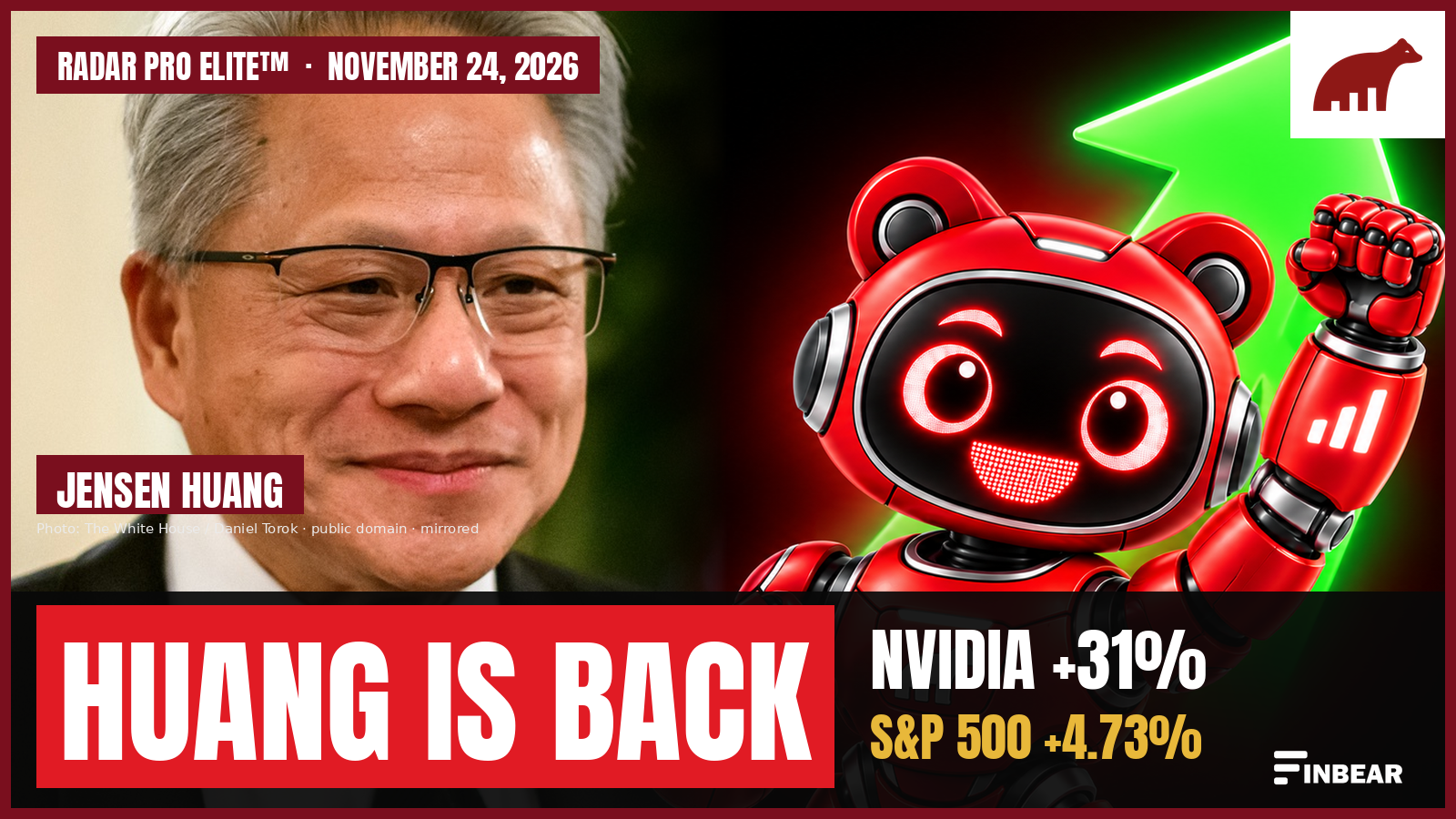
Nvidia announced on Monday that Jensen Huang is back as chief executive, and Wall Street had its best session since April 2025: the S&P 500 rose 4.73%, the Nasdaq 6.51% and Nvidia 31%. The Pretore’s index signatures flip to active long, even though the S&P 500 closed below the level we flagged yesterday as the invalidation point for its active short signature. This morning Tokyo and Seoul are surging, Wall Street futures are catching their breath, HPE is down 9% before the open, and the dollar is holding near the 20-month high it touched on Monday. Tomorrow brings the PCE price index, which tracks changes in the prices households pay and is the Fed’s preferred inflation gauge.
Table of Contents
- 🧭 Before You Open the Terminal
- Key Indicators Dashboard
- 🗿 The Pretore Today
- 🧭 Compass of the Day
- 📐 Yield Curve
- 🏦 Banks: Large vs Regional
- Executive Summary
-
News in Detail
- 1. Best Monday since 2020: S&P 500 +4.73%, Nasdaq +6.51%; Asia rallies this morning as Wall Street catches its breath
- 2. Nvidia reinstates Huang: the stock gains 31%, its best day since 2003, and the board comes under fire over governance
- 3. Williams doesn’t rule out more rate hikes, and the dollar hits a 20-month high ahead of the PCE
- 4. AI companies face their earnings test: HPE −9% despite beating estimates; Dell and HP report tonight
- 5. Oil near three-month lows: rising supply and diplomacy outweigh the Hormuz threat
- 6. Bitcoin slips back below $60,000; Strategy’s market cap is now below the value of its bitcoin holdings
- 📰 In Brief
- Aggregated Sentiment Table
- Fear and Loathing on Wall Street™
- Cross-Cutting Synthesis
- Strategic Alerts
- Disclaimer & Maxim
🧭 Before You Open the Terminal
📈 Comeback Monday
🔥 The S&P 500 closed at 7,237.17 (+4.73%), the Nasdaq Composite at 24,089.56 (+6.51%) and the Dow at 49,595.31 (+3.01%). The semiconductor index jumped 14.03%, and the VIX volatility index dropped to 26.62 (−25.83%). For both the S&P 500 and the Nasdaq, it was the best session since April 2025.
🗿 Huang is back. Nvidia takes off
Nvidia announced that Jensen Huang was returning, effective immediately, and the stock gained 31%, its best day since 2003. This morning it’s down about 3.5% in premarket trading, while in Washington Democrats are drawing up the questions they want to put to Huang.
🏛️ The dollar and the PCE
New York Fed President John Williams says inflation is still too high and doesn’t rule out further hikes. On Monday the dollar touched a 20-month high, and this morning it’s still close to that level. October’s PCE is out tomorrow at 2:30 p.m. CET, with forecasts at 3.8% year over year and 3.2% excluding food and energy.
🖥️ AI earnings
HPE is down 9% before the open despite quarterly results that beat estimates, and Dell is off about 5%. Dell, HP and Workday report tonight after the close.
Verdict
🟡 Medium priority — Fantiborsa’s take: last Tuesday Nvidia’s board was ruling out Huang’s return; on Monday it announced he was back, and the market celebrated like someone finding their keys in the pocket they’ve already checked three times. The Pretore took note and flipped the index signatures. But the S&P 500 is still below the Consensus, the Compass has been showing a bear regime for the past few weeks, and the PCE arrives tomorrow. The turn has begun. The recovery still has to prove itself.
Only have two minutes? Read The Pretore Today and the thesis invalidation ☕
Key Indicators Dashboard
| Indicator | Value | Change | Reading | Signal |
|---|---|---|---|---|
| S&P 500 | 7,237.17 | +4.73% | RSI 41.3; below the SMA50 (7,617.60) and SMA200 (7,350.10); Pretore active long; futures −0.19% this morning | |
| Nasdaq (COMPQ) | 24,089.56 | +6.51% | RSI 41.8; below the SMA50 (26,071.50) and SMA200 (25,162.76); Pretore active long; Nasdaq-100 futures −0.62% this morning | |
| Nasdaq-100 (NDX) | 26,746.10 | +6.86% | RSI 42.0; below the SMA50 (29,176.64) and SMA200 (28,081.65); Pretore active long | |
| Philadelphia Semi (SOX) | 9,588.05 | +14.03% | RSI 43.3; below the SMA50 (11,303.93) and SMA200 (10,928.92); Pretore active long | |
| Dow Jones | 49,595.31 | +3.01% | RSI 39.2; below the SMA50 (51,649.19) and SMA200 (50,773.81); Pretore active long; futures −0.01% this morning | |
| Russell 2000 ETF (IWM) | 265.74 | +3.56% | RSI 41.5; below the SMA50 (277.82) and SMA200 (279.57); Russell futures −0.04% this morning | |
| VIX | 26.62 | −25.83% | Above the SMA50 (18.63) and SMA200 (18.72); RSI 55.9; Pretore active short on its ETF (VIXY); 26.78 (+0.60%) this morning | |
| US 2Y | 4.63% | unchanged | The short end isn’t moving | |
| US 10Y | 4.92% | unchanged | Still below 5% | |
| 2s10s spread | 29 bp | unchanged | Flat curve, shape unchanged | |
| DXY | 104.32 | +0.49% | RSI 72.5; above the SMA50 (102.08) and SMA200 (100.08); Pretore active long on its ETF; session high 104.53, the highest in 20 months | |
| Gold | 3,651.40 | +3.87% | RSI 31.7; below the SMA50 (4,082.40) and SMA200 (4,430.69); Pretore active long; futures 3,619.60 (−0.87%) this morning | |
| Silver | 43.15 | +5.15% | RSI 27.7; below the SMA50 (55.54) and SMA200 (67.14); Pretore active long | |
| WTI | 80.17 | −4.17% | RSI 31.3; below the SMA50 (92.84) and SMA200 (88.28); Pretore active short; 79.46 (−0.88%) this morning | |
| Brent | 89.37 | −3.37% | RSI 33.3; below the SMA50 (102.21) and SMA200 (94.52); Pretore active short; 88.35 (−1.14%) this morning | |
| EUR/USD | 1.0908 | −0.55% | RSI 24.8; below the SMA50 (1.121) and SMA200 (1.149); Pretore active short on its ETF; 1.0914 this morning | |
| BTC | 61,210.98 | +0.08% | RSI 27.0; below the SMA50 (76,158.54) and SMA200 (72,232.08); Pretore active long; 59,872 this morning (−2.4% from the reference price Yahoo Finance uses) | |
| ETH | 1,708.85 | −0.71% | RSI 29.4; below the SMA50 (2,225.69) and SMA200 (2,119.36); Pretore active short | |
| Crypto Fear & Greed | n/a | — | No verified source provides an up-to-date reading |
Closing levels for Monday, November 23, 2026. Prices, the relative strength index (RSI) and moving averages come from StockCharts and Yahoo Finance, with gold and silver taken from the futures series; for the VIX, WTI, Brent and EUR/USD, closes, RSI readings and moving averages are read from the StockCharts chart. Treasury yields are official U.S. Treasury data for November 23, with changes measured against November 20. Bitcoin and ether show Monday’s daily close. Futures and morning quotes come from Yahoo Finance at about 10:07 a.m. CET; the morning readings for WTI, Brent and EUR/USD come from the StockCharts chart at about 9:43 a.m. CET. For those three, RSI and moving averages reflect Tuesday’s chart at that time.
The Pretore Today
U.S. index signatures. The signatures on the S&P 500, the Dow, the Nasdaq Composite, the Nasdaq-100 and semiconductors all flip to active long. Every index, however, is still trading below the Consensus AVWAP: the S&P 500 by 1.39%, the Dow by 1.22%, the Composite by 2.50% and the Nasdaq-100 by 2.53%. Semiconductors sit 2.00% below a Consensus that uses equal weights, because the index's volume data aren't reliable. The VIX signature, read through its reference ETF, VIXY, switches to active short.
Polarity flip: yes, across most of the basket. The indexes, the financial sector (XLF, KBWB, KRE), gold, silver, copper, bitcoin and Solana all move from active short to active long, while VIXY goes the other way, from active long to active short. The dollar, the euro, Treasuries, WTI, Brent and ether keep their previous signatures.
The awkward signatures. First, the S&P 500. Its signature turned active long on a close of 7,237.17, which is 0.85% below the 7,299.08 we flagged yesterday as the level that would invalidate the active short signature. The volume-weighted average price the Pretore calculates from Friday's close now stands at 7,055.57, and on Monday the index finished above it. For the new signature the Pretore hasn't yet set an invalidation level; the first resistance is at 7,322.98, 1.19% higher. Second, gold. It's back in active long with the price 3.43% below the Consensus, inside an underlying trend the Compass reads as bearish.
Macro convergence. The dollar's signature, based on its ETF, stays in active long; the euro's stays in active short. For rates, the Pretore uses an ETF that holds Treasuries maturing in seven to 10 years. Its signature stays in active long, a bullish signal for bond prices, since yields move the opposite way and fall when prices rise. WTI and Brent stay in active short. Half the picture has changed since Friday. The dollar and government bonds remain strong, but gold, silver and copper have all moved from active short to active long.
$SPX operating levels: close 7,237.17 · AVWAP Consensus 7,339.13 (close 1.39% below) · closing invalidation n/a · resistance 7,322.98 (+1.19% from the close). The AVWAP Consensus is the volume-weighted average the Pretore uses as the structural anchor for prices. The invalidation level is the one below which, on a closing basis, an active long signature lapses. It is not a stop-loss order. For today's S&P 500 signature, the Pretore hasn't set one.
The overall read. The Pretore gets the first word, not the last, and on Monday it spoke, flipping the index signatures after a single session. The turn is under way, not confirmed. Prices are below the Consensus on every index, the S&P 500 signature has no level yet at which it would lapse, and the nearest resistance sits just over 1% above the close. The signature agrees with today's thesis; the gap to the Consensus measures how fragile the turn still is.
Snapshot as of November 24, 2026 (reference close November 23).
Compass of the Day
FINBEAR Compass™ · $SPX · Nov 23, 2026
  VERDICT           CONFIRMED          — recent momentum confirms the regime
  OPERATING REGIME  Strong bear
  LINEARITY         Ordinary trends
  COHERENCE         full
  RELIABILITY       MEDIUM
  POSITION          --- far below      — below the underlying trend
  UNDERLYING TREND  Persistent bull    — solid
The Compass still reads a strong-bear operating regime on the S&P 500, and recent momentum confirms it: a single +4.73% session can't overturn the past few weeks. The price remains far below the underlying trend, which is rising, persistent and solid. What the Compass captures, then, is a correction inside a long-term trend that is still positive. The Pretore, which reads the first shift in direction, has already flipped its signatures.
On the Composite, the Nasdaq-100 and semiconductors, recent momentum is challenging the strong-bear regime. These are the indexes where the rebound was biggest.
For the sector ETF (XLF) the regime is sideways and reliability is suspended, meaning the Compass doesn't yet consider the reading stable. The large banks (KBWB) are in a strong-bear regime with medium reliability; the regionals (KRE) are in a strong-bear regime too, with reliability suspended. For all three ETFs, the underlying trend is still rising, so this is a short-term correction inside a long-term trend that remains positive. Gold is in a strong-bear regime inside an underlying trend that is falling as well. Bitcoin is in a strong-bear regime with high reliability. The dollar, read through the UUP ETF, is in a strong-bull regime, though recent momentum is challenging it.
Yield Curve
U.S. Treasury Curve · Nov 23, 2026
  SHAPE       flat
  MOVEMENT    unchanged
  MACRO       normal
For the economy: On Monday, as stocks won back more than half of last week's losses, two- and 10-year yields held at 4.63% and 4.92%, and the other maturities moved only modestly. The bond market didn't share the stock market's excitement. It is waiting for tomorrow's PCE and for the Fed's December 8–9 meeting, with the policy rate currently in a 3.75%–4% range.
For banks: A flat curve does nothing to widen the spread between what banks earn on loans and what they pay on deposits. Rates weren't the reason the sector rose on Monday; it went up with the rest of the market, as the next section shows.
Banks: Large vs Regional
XLF · KBWB · KRE — financial sector
- XLF (sector) — at $55.65 (+1.98%), just below its 50-day average ($55.84) and above its 200-day ($54.02), with RSI at 44.4. The Pretore's signature flips to active long, with invalidation at $54.57 (−1.94%), Friday's close. The first resistance is at $56.61, 1.73% higher, and the price is 1.16% below the Consensus.
- KBWB (large banks) — at $83.86 (+2.63%), below its 50- and 200-day averages ($88.37 and $89.00), with RSI at 38.1. The signature flips to active long, with invalidation at $82.4733 (−1.65%). The first resistance is at $84.19, 0.39% higher, and the price is 1.82% below the Consensus.
- KRE (regionals) — at $69.54 (+1.79%), below its 50- and 200-day averages ($71.24 and $71.18), with RSI at 40.7. The signature flips to active long, with invalidation at $68.2185 (−1.90%). The first resistance is at $70.002, 0.66% higher, and the price is 0.35% below the Consensus.
As we wrote in the November 23 RADAR, the Pretore's signatures on the sector, the large banks and the regionals were all in active short, and the large banks had lost more than the regionals for five sessions running. Monday turned that around. All three signatures flipped to active long, and the large banks bounced harder than the regionals on a day when the stock market got its nerve back. The regionals are still the closest to the Consensus, and the sector as a whole is the only one of the three above its 200-day average.
Executive Summary
🎬 The day in one line
Nvidia announced Jensen Huang’s return and Wall Street had its best session since April 2025; the Pretore’s signatures flip, but prices stay below the Consensus and the PCE arrives tomorrow.
📈 The rebound
- Wall Street. 🔥 S&P 500 +4.73%, Nasdaq +6.51%, Nasdaq-100 +6.86%, semiconductors +14.03%; the VIX lost a quarter of its value.
- Asia and Europe. This morning Tokyo is up 3.91% and Seoul 6.32%. Europe is flat, and Wall Street futures are catching their breath.
🗿 Nvidia
The board ruled out Huang’s return on November 17; now it has reinstated him, effective immediately. The stock gained 31%, adding almost $1 trillion in market value in a single session. Some governance experts quoted by Axios accuse the board of a “lack of backbone,” and Senate Democratic leader Chuck Schumer has issued a warning to Nvidia and to Trump.
🏛️ The Fed and the dollar
Williams doesn’t rule out more rate hikes, and the AI euphoria has revived bets on a Fed that stays aggressive. On Monday the dollar touched a 20-month high. Tomorrow brings October’s PCE and the second estimate of third-quarter GDP.
⏳ The bottom line
As we wrote in the November 23 RADAR, the thesis was: Monday’s rebound is a truce inside a correction that isn’t over. The condition for invalidating that thesis was an S&P 500 close above 7,299.08 by Wednesday. On Monday the index closed at 7,237.17, 0.85% below 7,299.08. Even so, the Pretore’s signature flipped from active short to active long, prompting us to restate the thesis. Today’s FINBEAR reading: the turn is under way, but the price has yet to climb back above the Consensus.
Pretore vs thesis. Signature of the day on $SPX: active long — in line with today’s thesis of a turn that is under way but not yet confirmed. The Composite, Nasdaq-100, Dow and semiconductor signatures, all in active long, agree. The S&P 500’s 1.39% gap to the Consensus measures how fragile the turn still is. Today’s thesis is invalidated if, by Friday, November 27, the S&P 500 closes below 7,055.57.
News in Detail
1. Best Monday since 2020: S&P 500 +4.73%, Nasdaq +6.51%; Asia rallies this morning as Wall Street catches its breath
What happened
✅ On Monday the S&P 500 closed at 7,237.17 (+4.73%), the Nasdaq Composite at 24,089.56 (+6.51%), the Nasdaq-100 at 26,746.10 (+6.86%) and the Dow at 49,595.31 (+3.01%). The semiconductor index rose 14.03%, and the VIX fell to 26.62 (−25.83%) (StockCharts). ✅ For the S&P 500 and the Nasdaq it was the best session since April 2025 (CNN) and the best Monday since 2020 (Yahoo Finance). ✅ The Nasdaq-100 ETF opened with the biggest gain in its history (Yahoo Finance).
✅ According to the Associated Press, Wall Street recovered a little more than half of last week’s losses in a single session, after one of its worst weeks since the 2008 crisis (AP). ✅ S&P 500 companies are nonetheless still worth about $5 trillion less than at their October 6 peak (Fortune). ✅ An analyst interviewed by Yahoo Finance cautions that part of the rally came from mechanical buying (Yahoo Finance).
✅ In Asia this morning the Nikkei is up 3.91% and the Kospi 6.32%, while Hong Kong slips 0.73% (Yahoo Finance). ✅ According to Reuters, Huang’s return has rekindled buying of AI-related stocks across the region (Reuters). ✅ In Europe the STOXX 600 is flat after Monday’s gains (Reuters).
✅ At about 10:07 a.m. CET, S&P 500 futures stand at 7,241 (−0.19%), Nasdaq-100 futures at 26,642 (−0.62%) and Dow futures at 49,673 (−0.01%); the VIX is at 26.78 (+0.60%) (Yahoo Finance).
What sources say
“Jensen’s return doesn’t answer the big questions.” — James St. Aubin, Ocean Park Asset Management (Reuters, via Fortune)
FINBEAR Take: one session doesn’t erase last week
As we wrote in the November 23 RADAR, a chip-led bounce in the futures was typical of a deeply oversold market. On Monday the bounce not only held through the close but grew far stronger than anyone had expected that morning. The Huang news landed with futures already rising and turned a rebound into a historic session.
The number that matters is the proportion. Last week took more than 8% off the S&P 500, and Monday handed back about half of it. Investors bought back the hardest-hit names, chips first, and what they were mostly celebrating was the answer to a governance question, not an earnings one. This morning futures are catching their breath. Monday’s buyers want to see whether the recovery survives tomorrow’s PCE.
Cui prodest? Those who bought chip stocks on Friday, after a 17% weekly loss in their index, and Asian investors watching memory-chip makers climb back this morning. The losers are those who had hedged or sold short on Friday and were forced to close their positions into the rally.
For investors
Instruments involved:
- Stocks: $NVDA, $MU, $AMD, $TSM
- ETFs: $SPY, $QQQ, $SMH, $EWY, $EWJ
- Futures/Commodities: S&P 500 and Nasdaq-100 futures
Opportunities:
A market that has turned, for those who buy in gradually and can stomach wide swings for a while longer
Risks:
A hotter-than-expected PCE, a Fed that confirms it intends to keep raising rates, Dell’s and HP’s results tonight
What to avoid:
Chasing stocks after a 14% jump in semiconductors, before the indexes are back above the Consensus
Bottom line:
One historic session has clawed back half the losses from one of the worst weeks since 2008. The other half still has to be earned.
Impact: (3/5) — Best session since April 2025, index signatures in active long · The other side: those who were hedged or had sold short
2. Nvidia reinstates Huang: the stock gains 31%, its best day since 2003, and the board comes under fire over governance
What happened
✅ On Sunday, November 22, Nvidia’s board reinstated Jensen Huang as chief executive and director, effective immediately, and gave him back the title of president, a role separate from chairing the board. Nvidia announced the move on Monday, November 23 (Nvidia, 8-K; CNN; Yahoo Finance). ✅ The board said Huang is the right person to lead Nvidia (Yahoo Finance). ✅ Board chairman Harvey Jones had said on November 17, while presenting the quarterly results, that the board did not intend to reinstate Huang, as we wrote in the November 18 RADAR (Nvidia, earnings call transcript; YourStory).
✅ The stock rose about 31%, its best one-day percentage gain since 2003, adding almost $1 trillion in market value (AOL; Yahoo Finance). ✅ CoreWeave, an Nvidia customer, rose 22% (Yahoo Finance). ✅ Minutes before the announcement, Polymarket, a prediction market, put the odds of Huang returning by the end of November at around 3% (Yahoo Finance).
✅ Some governance experts quoted by Axios accuse the board of a “lack of backbone” (Axios). ✅ Senate Democratic leader Chuck Schumer issued a warning to Nvidia and to Trump after the reinstatement (Axios), and a Democratic senator previewed questions for Huang (Yahoo Finance). ✅ Musk came to Huang’s defense, saying that friends who are only around when things go well are worth nothing (Yahoo Finance). ✅ Reuters, citing people familiar with the matter, reports that the SEC’s investigation into Nvidia’s accounting is still open (Reuters; Schwab).
✅ This morning, at about 10:07 a.m. CET, the stock is down about 3.5% in premarket trading (Yahoo Finance).
What sources say
“Lack of backbone.” — governance experts quoted by Axios
FINBEAR Take: the board chose market value
As we wrote in the November 23 RADAR, the fight over Nvidia’s leadership was being waged between the White House and the board. In the end the board lost, or chose to stop fighting. On November 17 the board ruled out Huang’s return, on Sunday it decided to bring him back, and on Monday Nvidia announced it. The market’s answer was almost $1 trillion in one session, a precise measure of what Huang’s name is worth to shareholders.
The bill, the critics say, comes due elsewhere: in the board’s credibility. Or maybe not. Those who accuse the board of caving skip a question. Was the mistake bringing Huang back, or removing him 12 days earlier? And was there no political pressure the first time? A board that reverses a bad decision in its shareholders’ interest is doing its job. Democratic senators and the experts quoted by Axios see a capitulation; the market has already picked a side. The SEC investigation into Nvidia’s accounting and the questions from Congress remain open. Monday was about celebrating the man’s return, and from here the stock has to reckon with everything else.
Cui prodest? Nvidia shareholders, and customers like CoreWeave that get their main supplier back with its founder in charge. Those who bet against Huang’s return come out badly, and the board stays under fire from its critics.
For investors
Instruments involved:
- Stocks: $NVDA, $CRWV, $AMD, $AVGO, $TSM
- ETFs: $SMH, $SOXX, $QQQ
Opportunities:
A company that has its leader back, for investors looking at the next few quarters rather than the next session
Risks:
The SEC investigation, congressional hearings, political criticism of the board
What to avoid:
Reading the 31% jump as the end of the SEC investigation and of the questions from Congress
Bottom line:
The market rewarded the man. The questions about the accounting haven’t gone away.
Impact: (3/5) — Nvidia reinstates Huang, best session since 2003 · The other side: those who bet against Huang’s return
3. Williams doesn’t rule out more rate hikes, and the dollar hits a 20-month high ahead of the PCE
What happened
✅ New York Fed President John Williams said inflation is still too high and left the door open to further hikes (Reuters). ✅ He added that the Fed has to act early to bring inflation back toward its target (Yahoo Finance). ✅ The federal funds rate, the Fed’s benchmark, has been in a 3.75%–4% range since the September meeting, and the Fed left it unchanged in October (Federal Reserve). The next meeting is on December 8–9.
✅ The dollar is climbing. According to Reuters, the new wave of AI euphoria is fueling bets on further Fed hikes (Reuters). ✅ On Monday the dollar index touched a 20-month high, two days before Wednesday’s inflation data (BeInCrypto). ✅ It peaked at 104.53 during the session and closed at 104.32 (+0.49%) (StockCharts).
✅ Bill Ackman argues the Fed is about to make another mistake (Fox Business). ✅ S&P Global’s PMI, built on surveys of purchasing managers, shows U.S. business activity growing more slowly again in November (Reuters). Growth is being held back by capacity constraints and high prices, with the latter weighing on orders, but it remains solid (S&P Global).
✅ Tomorrow at 8:30 a.m. New York time, 2:30 p.m. CET, the Commerce Department’s statistical agency releases October’s PCE and the second estimate of third-quarter GDP (Finance Calendar). ✅ According to economists surveyed by Bloomberg, the PCE price index should rise 0.3% for the month, with the annual rate climbing to 3.8% from 3.6%. Excluding food and energy, it should also rise 0.3% for the month, with the annual rate at 3.2%, up from 3.1%. For GDP, TheStreet reports that economists expect annualized growth of 3.5%, up from 3.4% in the first estimate (TheStreet).
What sources say
“Fed’s Williams says inflation still too high, signals more rate hikes possible.” — Reuters (headline)
FINBEAR Take: the dollar is rising with stocks
As we wrote in the November 23 RADAR, on Friday the market had started to believe the Fed would raise rates less than feared, and that belief explained why gold rose and the dollar fell. Monday was different: the dollar climbed alongside stocks. According to Reuters, the AI euphoria brought back bets on more hikes, because an economy running hot gives the Fed fewer reasons to stop.
That’s the weak spot in this turn. Stocks are celebrating Nvidia, two- and 10-year yields aren’t budging, and the dollar is rising. Three markets are reading the same day three different ways, and tomorrow’s PCE will show which reading holds up. A core figure in line with expectations, at 3.2%, would keep bets on a December hike alive. A higher number would reopen the debate about a bigger one. In the minutes of the October meeting, two participants said a move larger than a quarter point could be considered if the inflation data turned out unfavorable (Federal Reserve).
Cui prodest? Holders of dollars and dollar-denominated securities, and those who bet on a Fed that won’t stop. The losers are the currencies of countries that import commodities they pay for in dollars, and those positioned for a less aggressive Fed.
For investors
Instruments involved:
- Stocks: $JPM, $GS
- ETFs: $UUP, $FXE, $TLT, $IEF, $SHY
- Futures/Commodities: Fed funds futures
Opportunities:
A two-year Treasury yield around 4.6%, for those looking for cash that pays
Risks:
A core PCE above 3.2% that puts a bigger December hike back on the table
What to avoid:
Taking a big position in the dollar before tomorrow’s data
Bottom line:
The dollar is rising with stocks. The Fed is doing the pushing, not fear.
Impact: (2/5) — Williams doesn’t rule out further rate hikes, dollar near a 20-month high · The other side: dollar holders
4. AI companies face their earnings test: HPE −9% despite beating estimates; Dell and HP report tonight
What happened
✅ Hewlett Packard Enterprise reported fiscal fourth-quarter results on Monday after the close, with earnings and revenue above estimates (Zacks). ✅ The company had guided to cloud and AI revenue growth of 60% to 72% for the fourth quarter, up from 25% in the third (Zacks). According to the release filed with the SEC, cloud and AI revenue rose 68.6% from a year earlier to $11.3 billion, out of total revenue of $14.5 billion (+50%) (HPE, 8-K). ✅ This morning the stock is down between 9.3% and 10% before the open, depending on the time of the quote (Yahoo Finance).
✅ The midpoint of Zoom’s revenue guidance for the current quarter is slightly below analysts’ expectations (Bloomberg). ✅ Datadog beat estimates but expects its largest AI customer to spend less in the fourth quarter, after that customer spent more in the third quarter than its contract provided for (Investing.com). ✅ Super Micro was up roughly 20% at one point during the session after a Financial Times report that the company is asking for up to 45% more on delivery for AI servers already ordered under signed contracts (TIKR). This morning it’s down 3.47% before the open (Yahoo Finance).
✅ Dell, HP and Workday report today after the close; Analog Devices, Medtronic and Best Buy report before the open (If You Spent; TheStreet). ✅ Dell is down between 4.4% and 5.1% in premarket trading this morning, depending on the time of the quote (Yahoo Finance).
What sources say
“AI’s spending slowdown.” — Axios (headline)
FINBEAR Take: on Monday the market bought the sector; today it judges the companies
On Monday the market bought anything with an AI label, wholesale. HPE’s slide this morning shows the market is drawing distinctions again: a company that beats estimates still loses 9%. When the numbers are good and the stock falls, the market is saying one of two things. Either those numbers were already in the price, or it’s worried about something the numbers don’t show, such as server margins or whether customer spending will hold up.
Datadog and Super Micro show two sides of the same demand for AI. On one side is a big customer that Datadog expects to spend less. On the other is a supplier asking for higher prices on delivery for servers already ordered under contract. Tonight Dell will show which side is winning, and its stock is already down about 5% ahead of the results.
Cui prodest? Buyers who were waiting for a pullback to pick up server makers’ shares, and Zoom’s competitors. The losers are HPE and Dell shareholders, and those who bought the whole sector on Monday without being selective.
For investors
Instruments involved:
- Stocks: $HPE, $DELL, $HPQ, $WDAY, $SMCI, $ZM, $DDOG, $ADI
- ETFs: $IGV, $XLK
Opportunities:
Lower share prices for server makers with growing orders, for investors watching how those orders turn into revenue
Risks:
Margins squeezed by memory costs, big AI customers slowing their spending
What to avoid:
Buying Dell ahead of tonight’s results just because the sector rose on Monday
Bottom line:
The rebound bought the sector. Earnings judge the companies one at a time.
Impact: (2/5) — HPE −9% despite results above estimates, Dell and HP tonight · The other side: Super Micro
5. Oil near three-month lows: rising supply and diplomacy outweigh the Hormuz threat
What happened
✅ On Monday WTI closed at $80.17 (−4.17%) and Brent at $89.37 (−3.37%) (StockCharts). ✅ This morning, at about 9:43 a.m. CET, WTI is at $79.46 (−0.88%) and Brent at $88.35 (−1.14%) (StockCharts).
✅ According to Reuters, oil is hovering near three-month lows because rising supply is offsetting the threat to Hormuz (Reuters). ✅ Prices are staying low despite reports of mines in the strait (Oilprice.com). ✅ According to Bloomberg, the decline is extending on signs of progress in talks between the U.S. and Iran (Bloomberg). ✅ Traders are weighing a glut of supply against the attacks in the Gulf (The Wall Street Journal).
What sources say
“Rising supply offsets Hormuz threat.” — Reuters
FINBEAR Take: the risk premium is deflating
As we wrote in the November 23 RADAR, the attacks in the Gulf were propping up the risk premium on crude. On Monday that premium deflated, as more supply and diplomats who keep talking outweighed the mines and the attacks. The Pretore’s signatures on WTI and Brent stay in active short.
This morning WTI is trading just below the support the Pretore flags at $79.75, and a close below that level would confirm the decline. For inflation it’s good news. Oil at around $80 a barrel takes some pressure off the energy component of PCE inflation over the coming months, though not October’s, which comes out tomorrow.
Cui prodest? Airlines, transportation companies and consumers, along with importing countries. The losers are oil producers and those positioned for a price held up by the risk premium.
For investors
Instruments involved:
- Stocks: $XOM, $CVX, $OXY, $APA, $DAL, $UAL
- ETFs: $XLE, $USO, $BNO
Opportunities:
Lower energy costs for fuel-consuming sectors
Risks:
A fresh flare-up in the Gulf that puts the risk premium back on in a matter of hours
What to avoid:
Buying oil producers just because crude is at a three-month low
Bottom line:
The oil market trusts the diplomats more than the mines.
Impact: (2/5) — Oil near three-month lows, signatures in active short · The other side: airlines and transportation
6. Bitcoin slips back below $60,000; Strategy’s market cap is now below the value of its bitcoin holdings
What happened
✅ On Monday bitcoin closed the day at $61,210.98 (+0.08%) (StockCharts). ✅ This morning, at about 10:07 a.m. CET, it’s at $59,872, down 2.4% from the reference price Yahoo Finance uses (Yahoo Finance). ✅ Ether closed Monday at $1,708.85 (−0.71%) (StockCharts).
✅ The market capitalization of Strategy, Michael Saylor’s company, has fallen below the gross value of the bitcoin it holds (Bloomberg). ✅ According to Grayscale, bitcoin looks oversold, but AI-related short-term risks remain (Stocktwits). ✅ A staff letter from the CFTC, the U.S. derivatives regulator, clarifies that bitcoin, ether and payment stablecoins can count, with prudential haircuts, toward the capital requirements of the platforms and clearinghouses concerned. Liquidity requirements remain separate (CFTC; Reuters).
What sources say
“Strategy is now worth less than its bitcoin.” — Bloomberg
FINBEAR Take: bitcoin skipped the party
As we wrote in the November 23 RADAR, bitcoin was trading like a Nasdaq stock and could fall back with the Nasdaq. It had already done its bouncing over the weekend, gaining 4.1% between Friday’s close and Monday’s close. On Monday itself, though, while the Nasdaq rose 6.51%, bitcoin ended the day almost unchanged, and this morning it’s back below $60,000. The link with stocks holds when investors sell to raise cash. When they start buying again, the money goes to AI stocks first.
The Pretore’s signature flips to active long all the same, with no invalidation level set. The first resistance is at $62,148.54, the level that yesterday would have ended the active short signature, and the price remains 1.75% below the Consensus. Strategy’s market capitalization has dropped below the gross value of the bitcoin it owns, and the value left for common shareholders is also weighed down by debt and preferred stock. For Strategy shareholders, it’s a sign of confidence wearing thin.
Cui prodest? Those who buy bitcoin directly rather than through Strategy, and the platforms that can count bitcoin, ether and stablecoins toward their capital requirements. The losers are Strategy shareholders and those who bought bitcoin expecting it to follow the Nasdaq higher.
For investors
Instruments involved:
- Stocks: $MSTR, $COIN
- ETFs: $IBIT, $FBTC, $ETHA
- Futures/Commodities: CME bitcoin futures
- Other instruments: bitcoin, ether
Opportunities:
A price far below its highs, for those who buy a little at a time and without leverage
Risks:
A fresh drop in tech stocks, pressure on Strategy, a slide back toward last Saturday’s low
What to avoid:
Buying Strategy as a way to get bitcoin at a discount without counting the company’s debt
Bottom line:
Bitcoin fell with the Nasdaq, but on Monday it didn’t follow it back up.
Impact: (1/5) — Bitcoin below $60,000, Strategy’s market cap below the gross value of its bitcoin · The other side: those who buy bitcoin directly
In Brief
- CrowdStrike and Zscaler. ✅ CrowdStrike has signed an agreement to buy Zscaler in an all-stock deal worth $43.9 billion, subject to regulatory approval (TechCrunch; CrowdStrike, SEC filing). ✅ According to Bloomberg, the deal confirms that AI is driving consolidation in cybersecurity (Bloomberg).
- Anthropic. ✅ In Anthropic's first week as a public company, 2x leveraged ETFs and options on its stock are already trading (Yahoo Finance). ✅ The founders' pledge to give away 80% of their stakes, $112 billion at the IPO price, is voluntary and revocable (Fortune). ✅ This morning the stock is down about 3% before the open (Yahoo Finance).
- Alibaba. ✅ The U.S. has blacklisted a company in the Alibaba group, a blow to Alibaba's AI ambitions (Bloomberg). This morning Alibaba's shares are down 2.58% before the open (Yahoo Finance).
- Amazon and Decart. ✅ Amazon has signed a deal to acquire Decart's AI optimization technology and to hire Decart's co-founders along with their team of researchers and engineers, as it gets ready to sell its Trainium chips. According to Bloomberg, as reported by TechCrunch, the deal is worth $7.5 billion (TechCrunch).
Aggregated Sentiment Table
| Cluster | Story | Sentiment | Score |
|---|---|---|---|
| 📈 U.S. Equities | Best session since April 2025, index signatures in active long | Positive / turn under way | +15 |
| 🏢 Corporate & Governance | Nvidia reinstates Huang: +31%, criticism of the board | Positive / with governance caveats | +10 |
| 💰 Central Banks | Williams doesn’t rule out rate hikes, dollar near a 20-month high | Negative / a Fed that won’t stop | -10 |
| 🖥️ AI Earnings | HPE −9% despite results above estimates, Dell down ahead of its results | Negative / the market is selective | -5 |
| 🔋 Energy | Oil near three-month lows | Neutral / falling risk premium | 0 |
| 🪙 Crypto | Bitcoin below $60,000, Strategy’s market cap below the gross value of its bitcoin | Negative / fading confidence | -5 |
| Net Score | +5 |
Fear and Loathing on Wall Street™
Neutral — Index: -7

Registry comparison: the last recorded reading is −44 (Anxiety), from the November 23 RADAR, calculated on the close of Friday, November 20. There has been one trading session on Wall Street since then. The S&P 500 rose 4.73%, the Nasdaq 6.51%, the VIX fell 25.83% to 26.62, and the Pretore’s index signatures moved from active short to active long.
Reading. The market heads into Tuesday with two sets of signals pulling in opposite directions. On one side is a historic session, with Nvidia getting its founder back and the VIX losing a quarter of its value. On the other are a dollar near a 20-month high, a Fed that doesn’t rule out more hikes, HPE punished despite beating estimates, and tomorrow’s PCE. The Pretore has already flipped its signatures. Prices, for now, remain below the Consensus.
Cross-Cutting Synthesis
Today’s six stories describe a market that turned in a single session and now has to prove the move can last. Wall Street had its best session since April 2025, driven by Nvidia, which announced Huang’s return and gained 31%. This morning Asia is rallying while futures catch their breath. Williams doesn’t rule out more rate hikes, and the dollar touched a 20-month high on Monday. HPE loses 9% despite beating estimates, and Dell and HP report tonight. Oil stays near three-month lows, and bitcoin is back below $60,000.
What ties them together is the gap between relief and proof. On Monday the market celebrated the answer to a governance question and bought back everything linked to AI. This morning it’s back to asking harder questions about individual companies’ earnings, starting with HPE and Dell, and about the Fed, with a dollar rising alongside stocks because an economy running hot pushes back the end of rate hikes. The Pretore has already flipped the index signatures, but prices remain below the Consensus, and the Compass has been showing a bear regime for the past few weeks, inside an underlying trend that is rising.
As we wrote in the November 20 RADAR, that day’s thesis would have been invalidated by an S&P 500 close above 7,281.98 by Monday. The deadline passed without that happening. As we wrote in the November 22 RADAR Week Ahead, the week’s plan called for staying defensive while the S&P 500 held below 7,299.08. The index closed below that level on Monday, but the Pretore flipped its signature even though the index had yet to break through. The calendar hasn’t changed: Dell, HP and Workday tonight; the PCE and GDP tomorrow at 2:30 p.m. CET; Wall Street is closed Thursday for Thanksgiving.
Cui prodest? Those who bought on Friday as others panicked, Nvidia shareholders and dollar holders. The losers are those who were hedged or had sold short, HPE and Strategy shareholders, and those who bought on Monday without distinguishing between companies.
📌 Thesis invalidation — This RADAR’s dominant thesis is: Monday’s session flipped the Pretore’s signatures but not yet the regime. The turn is under way, prices remain below the Consensus, and Wednesday’s PCE will show whether the turn holds.
- Holds because:
- the Pretore’s signatures on the S&P 500, the Dow, the Composite, the Nasdaq-100 and semiconductors have all moved to active long;
- prices remain below the Consensus on every index, and the Compass still reads a strong-bear regime on the S&P 500, confirmed by recent momentum;
- the counterweight: the Pretore hasn’t yet set an invalidation level for the S&P 500, and the first resistance, at 7,322.98, is just over 1% above the close.
- Invalidated if: the S&P 500 closes below 7,055.57 (−2.51% from Monday’s close), the volume-weighted average price the Pretore calculates from Friday’s close. This is the RADAR’s own editorial threshold, because the Pretore hasn’t yet set an invalidation level for the new signature.
- By: the close on Friday, November 27, a shortened session.
- In that case: the turn fails and the market falls back into the correction that was still under way last week. To call it a recovery, on the other hand, would take two consecutive closes above the Consensus, at 7,339.13.
Strategic Alerts
active long on the 7,237.17 close; closing invalidation not set by the Pretore; resistance at 7,322.98 (+1.19%); Consensus at 7,339.13 (+1.41%); below the 200-day average (7,350.10).
active long on the 24,089.56 close; closing invalidation not set; resistance at 24,347.04 (+1.07%).
active long on the 26,746.10 close; closing invalidation not set; resistance at 27,097.46 (+1.31%).
active long on the 9,588.05 close; closing invalidation at 8,409.10 (−12.30%).
active long on the 49,595.31 close; closing invalidation at 48,109.70 (−3.00%); resistance at 49,859.67 (+0.53%).
active short on its reference ETF, VIXY (close 22.58); the signature lapses on a VIXY close above 23.365 (+3.48%).
active long on the 55.65 close; closing invalidation at 54.57 (−1.94%); resistance at 56.61 (+1.73%).
active long on the 83.86 close; closing invalidation at 82.4733 (−1.65%); resistance at 84.19 (+0.39%).
active long on the 69.54 close; closing invalidation at 68.2185 (−1.90%); resistance at 70.002 (+0.66%).
active long on the 3,651.40 close; closing invalidation not set; Consensus at 3,781.25 (+3.56%).
active short on the 80.17 close; closing invalidation at 84.125 (+4.93%); support at 79.7525 (−0.52%).
active short on the 89.37 close; closing invalidation at 90.046 (+0.76%); support at 85.78 (−4.02%).
active long on the 61,210.98 close; closing invalidation not set; resistance at 62,148.54 (+1.53%).
active short on the 1,708.85 close; closing invalidation at 1,843.85 (+7.90%); support at 1,518.54 (−11.14%).
at about 10:07 a.m. CET, S&P 500 futures −0.19%, Dow futures −0.01%, Nasdaq-100 futures −0.62%, Russell 2000 futures −0.04% (Yahoo Finance).
today, Analog Devices, Medtronic and Best Buy before the open; Dell, HP and Workday after the close. On Wednesday the 25th at 2:30 p.m. CET, October’s PCE (expected at 3.8% year over year, 3.2% excluding food and energy) and the second estimate of third-quarter GDP (expected at 3.5% according to TheStreet, from 3.4%), along with durable goods orders and jobless claims. On Thursday the 26th Wall Street is closed for Thanksgiving, and on Friday the 27th it closes early; the Fed meets on December 8 and 9.
Disclaimer & Maxim
This RADAR is independent analysis written for a general audience. It is not investment advice and not a recommendation. In the minutes before Nvidia announced Huang’s return, Polymarket put the odds of it happening by the end of November at around 3%, according to Yahoo Finance. If you’re looking for someone who knows in advance what a board of directors will decide, you’ve come to the wrong shop. The decisions are yours, and so are the losses.